
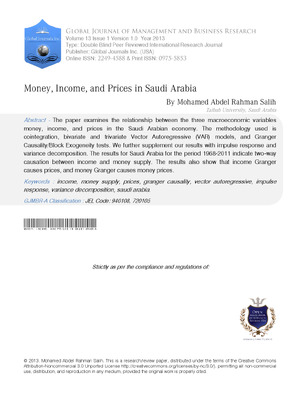
Money, Income, and Prices in Saudi Arabia
Keywords:
granger causality, impulse response, Income, money supply, prices, saudi arabia, variance decomposition, vector autoregressive
Abstract
The paper examines the relationship between the three macroeconomic variables money, income, and prices in the Saudi Arabian economy. The methodology used is cointegration, bivariate and trivariate Vector Autoregressive (VAR) models, and Granger Causality/Block Exogeneity tests. We further supplement our results with impulse response and variance decomposition. The results for Saudi Arabia for the period 1968-2011 indicate two-way causation between income and money supply. The results also show that income Granger causes prices, and money Granger causes money prices.
Downloads
How to Cite
References
A. Ahmed, S. Suliman (1999) The Long-Run Relationship between Money Supply, Real GDP, and Price Level: Evidence from Sudan. 2(2), 68-79.
M. Al-Jarrah (1996) Money, Income, and Prices in Saudi Arabia. 34(1), 41-53.
Hamad Al-Bazai (1999) The Role of Money in Saudi Arabia: A Dynamic Analysis. 13(1), 31-46. https://doi.org/10.4197/eco.13-1.2
Kalbe Abbas (1991) Causality Test between Money and Income: A Case Study of Selected Developing Asian Countries (1960-1988). 30(4), 919-929. https://doi.org/10.30541/v30i4iipp.919-929
Jushan Bai, Pierre Perron (2003) Computation and analysis of multiple structural change models. 18(1), 1-22. https://doi.org/10.1002/jae.659
David Dickey, Wayne Fuller (1981) Likelihood Ratio Statistics for Autoregressive Time Series with a Unit Root. 49(4), 1057. https://doi.org/10.2307/1912517
C. Granger, P. Newbold (1974) Spurious regressions in econometrics. 2(2), 111-120.
C. Granger (1988) Some recent development in a concept of causality. 39(1-2), 199-211. https://doi.org/10.1016/0304-4076(88)90045-0
Robert Engle, C. Granger (1987) Co-Integration and Error Correction: Representation, Estimation, and Testing. 55(2), 251. https://doi.org/10.2307/1913236
Soren Johansen (1991) Estimation and Hypothesis Testing of Cointegration Vectors in Gaussian Vector Autoregressive Models. 59(6), 1551. https://doi.org/10.2307/2938278
K. Joshi, S. Joshi (1985) Money, Income, and Causality: A Case Study for India. 21, 1-2.
A. Khan, A. Siddiqui (1990) Money, Prices and Economic Activity in Pakistan: A Test of Causal Relation. 121-136.
G. Koop, M. Pesaran, S. Plotter (1996) Impulse Response Analysis in Nonlinear Multivariate Model. 74, 119-147.
J. Lee, M. Strazicich (2003) Minimum Lagrange Multiplier Unit Root Test with Two Structural Breaks. 85(4), 1082-1089.
Robin Lumsdaine, David Papell (1997) Multiple Trend Breaks and the Unit-Root Hypothesis. 79(2), 212-218. https://doi.org/10.1162/003465397556791
Pierre Perron (1989) The Great Crash, the Oil Price Shock, and the Unit Root Hypothesis. 57(6), 1361. https://doi.org/10.2307/1913712
P. Perron, J. T, Vogelsang (1992) Nonstationarity and Level Shifts With an Application to Purchasing Power Parity. 10(3), 301-320.
P. Perron (1997) Further evidence on breaking trend functions in macroeconomic variables. 80(2), 355-385.
H. Pesaran, Yongcheol Shin (1998) Generalized impulse response analysis in linear multivariate models. 58(1), 17-29. https://doi.org/10.1016/s0165-1765(97)00214-0
P. Philips (1986) Understanding spurious regressions in econometrics. 33, 311-340.
Peter Phillips, Pierre Perron (1988) Testing for a unit root in time series regression. 75(2), 335-346. https://doi.org/10.1093/biomet/75.2.335
C. Sims (1972) Money, Income and Causality. 62(4), 540-552.
E. Zivot, D. Andrews (1992) Further Evidence on the Great Crash, the Oil-Price Shock, and the Unit-Root Hypothesis. 10(3), 251-270.
Published
2013-11-05
Issue
Section
License
Copyright (c) 2013 Authors and Global Journals Private Limited

This work is licensed under a Creative Commons Attribution 4.0 International License.