
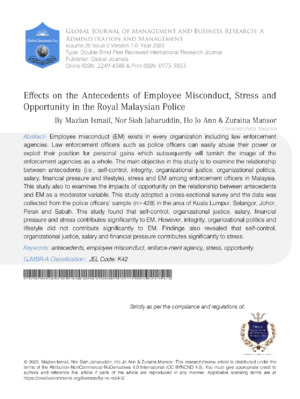
Effects on the Antecedents of Employee Misconduct Stress and Opportunity in the Royal Malaysian Police
Keywords:
antecedents, employee misconduct, enforce-ment agency, stress, opportunity
Abstract
Employee misconduct (EM) exists in every organization including law enforcement agencies. Law enforcement officers such as police officers can easily abuse their power or exploit their position for personal gains which subsequently will tarnish the image of the enforcement agencies as a whole. The main objective in this study is to examine the relationship between antecedents (i.e., self-control, integrity, organizational justice, organizational politics, salary, financial pressure and lifestyle), stress and EM among enforcement officers in Malaysia. This study also to examines the impacts of opportunity on the relationship between antecedents and EM as a moderator variable. This study adopted a cross-sectional survey and the data was collected from the police officers' sample (n=428) in the area of Kuala Lumpur, Selangor, Johor, Perak and Sabah. This study found that self-control, organizational justice, salary, financial pressure and stress contributes significantly to EM. However, integrity, organizational politics and lifestyle did not contribute significantly to EM. Findings also revealed that self-control, organizational justice, salary and financial pressure contributes significantly to stress.
Downloads
How to Cite
References
A. Abbasi, F. Baradari, H. Sheghariji, J. Shahraki (2020) Impact of Organizational Justice on Workplace Deviance with Mediating Effect of Job Satisfaction in SMEs of Malaysia. 12(17), 52-63. https://doi.org/10.7176/ejbm/12-17-06
K. Abbink (2000) Fair salaries and the moral costs of corruption. http://www.nottingham.ac.uk/cedex/documents/papers/2002-05.pdf
F. Adekanmbi, W. Ukpere (2019) The relationship between work stress and workplace deviant behaviours in the Nigerian banking industry. 8, 1190-12.
Michael Adeoti, Faridahwati Shamsudin, Alhamwan Mohammad (2021) Opportunity, job pressure and deviant workplace behaviour: does neutralisation mediate the relationship? A study of faculty members in public universities in Nigeria. 30(2), 170-190. https://doi.org/10.1108/ejmbe-08-2017-0002
M. Adeoti, F. Shamsudin, C. Wan (2017) Effects of occupational stress and workplace spirituality on workplace deviance in academia: A conceptual paper. 1.
R. Agnew (1992) FOUNDATION FOR A GENERAL STRAIN THEORY OF CRIME AND DELINQUENCY*. 30(1), 47-87.
A. Ahmad, Z. Omar, F. Radzali (2017) Mediating role of employee emotional exhaustion in the stress-deviance linkage.
I. Akaah, D. Lund (1994) The influence of personal and organisational values on marketing professionals' ethical behaviour. 13, 417-430.
W. Albrecht, C. Albrecht, C. Albrecht, M. Zimbelman (2018) Fraud examination.
M. Alias (2013) Predictors of Workplace Deviant Behaviour and the Mediating Role of Job Satisfaction among Support Staff in Malaysian Local Authorities [Unpublished doctoral dissertation].
Mazni Alias, Roziah Rasdi (2015) Organizational Predictors of Workplace Deviance among Support Staff. 172, 126-133. https://doi.org/10.1016/j.sbspro.2015.01.345
M. Alias, R. Rasdi, M. Ismail, B. Samah (2013) Predictors of workplace deviant behaviour: HRD agenda for Malaysian support personnel. 37(2), 161-182. https://doi.org/10.1108/03090591311301671
M. Aminuddin (2013) Malaysian industrial relations & employment law (8th. ed.).
Muhammad Asadullah, Ammara Akram, Hameed Imran, Ghulam Arain (2017) When and which employees feel obliged: A personality perspective of how organizational identification develops. 33(2), 125-135. https://doi.org/10.1016/j.rpto.2017.02.002
Hyunin Baek, Michael Losavio, George Higgins (2016) The impact of low self-control on online harassment: Interaction with opportunity. Journal of Digital Forensics. 11(3), 27-42. https://doi.org/10.15394/jdfsl.2016.1417
T. Barker, D. Carter (1994) Police deviance.
Reuben Baron, David Kenny (1986) The moderator-mediator variable distinction in social psychological research: Conceptual, strategic, and statistical considerations. 51(6), 1173-1182. https://doi.org/10.1037/0022-3514.51.6.1173
Mohsin Bashir, Muhammad Abrar, Muhammad Yousaf, Shahnawaz Saqib, Rizwan Shabbir (2019) Organizational Politics And Workplace Deviance In Unionized Settings: Mediating Role Of Job Stress And Moderating Role Of Resilience. Volume 12, 943-959. https://doi.org/10.2147/prbm.s213672
Andrew Baum, Jerome Singer, Carlene Baum (1981) Stress and the Environment. 37(1), 4-35. https://doi.org/10.1111/j.1540-4560.1981.tb01056.x
R. Baumeister, T. Heatherton, D. Tice (1994) Losing control: how and why people fail at self-regulation.
J. Bazzy (2012) Integrity, ego depletion, and the interactive impact on counterproductive behavior. https://trace.tennessee.edu/utk_graddiss/1265
Rebecca Bennett, Sandra Robinson (2000) Development of a measure of workplace deviance. 85(3), 349-360. https://doi.org/10.1037/0021-9010.85.3.349
P. Bentler (1990) Comparative fit indexes in structural models. 107(2), 238-246.
Berita Online (2019) Abdul Hamid terkejut lebih 100 anggota polis dikesan positif dadah. https://www.bharian.com.my/berita/kes/2019/08/598169/abdul-hamid-terkejut-lebih-100-anggota-polis-dikesan-positif-dadah
Berita Online (2021) 234 pegawai, anggota polis terbabit jenayah dadah rasuah dihu- kum. https://www.bharian.com.my/berita/kes/2021/06/826277/234-pegawai-anggota-polis-terbabit-jenayah-dadah-rasuah-dihukum
M. Bhasin (2016) Creative accounting practices: An empirical study of India. European Journal of Accounting. 4, 10-30.
Stephen Bishopp, Nicole Piquero, John Worrall, Alex Piquero (2018) Negative Affective Responses to Stress among Urban Police Officers: A General Strain Theory Approach. 40(6), 635-654. https://doi.org/10.1080/01639625.2018.1436568
S. Bishopp, N. Piquero, A. Piquero, J. Worrall, J. Rosenthal (2020) Police Stress and Race: Using General Strain Theory to Examine Racial Differences in Police Misconduct. 1-28. https://doi.org/10.1177/0011128720937641
Stephen Bishopp, John Worrall, Nicole Piquero (2016) General strain and police misconduct: the role of organizational influence. 39(4), 635-651. https://doi.org/10.1108/pijpsm-10-2015-0122
P. Blau (1964) Exchange and power in social life.
A. Bobbio, A. Karin, T. Alexander (2018) Self-Control and Deviance: A Test of the General Theory of Crime in Argentina. 14(1), 119-142. https://doi.org/10.1080/15564886.2018.1552222
Osei-Assibey Bonsu, Li Dui, Zou Muyun, Evans Asare, Isaac Amankwaa (2018) Corporate Fraud: Causes, Effects, and Deterrence on Financial Institutions in Ghana. 14(28), 315. https://doi.org/10.19044/esj.2018.v14n28p315
R. Butt, X. Wen, R. Hussain, S. Pervaiz (2020) Effect of Job Stress, Benefits and Salary on Employee Job Satisfaction Based on Mediating and Moderating Role of Work Environment and Leadership: Evidence from Telecom Sector. (3). https://ssrn.com/abstract=3648992
B. Byrne (2016) Structural equation modelling with AMOS: Basic concepts, applications, and programming (3rd ed.).
Z. Byrne, R. Cropanzano (2001) The history of organizational justice: The founders speak, in Cropanzano. 2, 3-26.
D. Champion (2001) Police misconduct in America.
Joshua Chanin (2015) Examining the Sustainability of Pattern or Practice Police Misconduct Reform. 18(2), 163-192. https://doi.org/10.1177/1098611114561305
J. Choi, N. Kruis (2020) Gender, self-control and opportunity: Applying the general theory of crime to online harassment. 14(1), 267-282. https://doi.org/10.5281/zenodo.3753014
D. Clercq, R. Pareira (2023) Perceived organizational politics, organizational disidentification and counterproductive work behaviour: moderating role of external crisis threats to work.
W. Cochran (1977) Sampling techniques (3rd ed.).
J. Colquitt, J. Greenberg, C. Zapata-Phelan (2005) Handbook of Organizational Justice. 3-58.
J. Colquitt, B. Scott, J. Rodell, D. Long, C. Zapata, D. Conlon, M. Wesson (2013) Justice at the millennium, a decade later: A meta-analytic test of social exchange and affectbased perspectives.
J. Colquitt, B. Scott, T. Judge, J. Shaw (2006) Justice and personality: Using integrative theories to derive moderators of justice effects. 100(1), 110-127.
J. Cox, D. Zawawi, I. Yasin (2022) The impact of excessive stress on deviant behaviour and the mediation role of emotional intelligence among the Royal Malaysian Police. (3s).
Wayne Crawford, Esther Lamarre, K. Kacmar, Kenneth Harris (2019) Organizational politics and deviance: exploring the role of political skill, Human Performance. 32(2), 92-106. https://doi.org/10.1080/08959285.2019.1597100
Donald Cressey (1950) The Criminal Violation of Financial Trust. 15(6), 738. https://doi.org/10.2307/2086606
D. Cressey (1953) Other people's money; A study of the social psychology of embezzlement.
R. Danish, A. Shahid, N. Aslam, A. Ali (2015) The Impact of Pay Satisfaction and Job Stress on Job Satisfaction in Pakistani Firms of Gujranwala District. American Journal of Economics. 1(3), 207-210.
O. Dar (2011) Trust in Co-workers as a Mediator of Co-workers' Trustworthiness, Social Undermining Behaviour, and Job Performance.
E. Daud, L. Heng, A. Hassan (2019) Faktor-faktor yang mempengaruhi niat untuk melakukan rasuah di kalangan penjawat awam pihak berkuasa tempatan. e-Academia Journal. 8(1), 117-135. http://journale-academiauitmt.uitm.edu.my/v2/index.php/home.html
Steven Dellaportas (2013) Conversations with inmate accountants: Motivation, opportunity and the fraud triangle. 37(1), 29-39. https://doi.org/10.1016/j.accfor.2012.09.003
Christopher Donner, Wesley Jennings (2014) Low Self-Control and Police Deviance: Applying Gottfredson and Hirschi's General Theory to Officer Misconduct. 17(3), 203-225. https://doi.org/10.1177/1098611114535217
C. Donner, L. Fridell, W. Jennings (2016) The relationship between self-control and police misconduct: A Multi-agency study of first-line police supervisors. 66(6), 1-22. https://doi.org/10.1177/0093854815626751
C. Donner, J. Maskaly, W. Jennings, C. Guzman (2021) Using criminological theory to explain police misconduct: A state-of-the-art review. 44(5), 818-837. https://doi.org/10.1108/PIJPSM-08-2020-0142
David Eitle, Stewart D'Alessio, Lisa Stolzenberg (2014) The Effect of Organizational and Environmental Factors on Police Misconduct. 17(2), 103-126. https://doi.org/10.1177/1098611114522042
Enforcement Agency Integrity Commission (EAIC) (2020) Annual Report 2020, gov. https://www.eaic
Enforcement Agency Integrity Commission (EAIC) (2021) Annual Report 2021. 57. https://www.eaic.gov
&. Ernst, Young (2016) 14th Global Fraud Survey: Corporate Misconduct-Individual Consequences. http://www.ey.com/Publication/vwLUAssets/ey-global-fraud-survey-2016/$FILE/ey-global-fraud-surveyfinal.pdf
H. Farhadi, O. Fatimah, R. Nasir, W. Wan Shahrazad (2012) Agreeableness and conscientiousness as antecedents of deviant behavior in workplace.
J. Fechter (2023) What is employee misconduct?. https://hr.university/shrm/employee-engagement/employee-misconduct/
Gerald Ferris, Dwight Frink, David Gilmore, K. Kacmar (1994) Understanding as an Antidote for the Dysfunctional Consequences of Organizational Politics as a Stressor 1. 24(13), 1204-1220. https://doi.org/10.1111/j.1559-1816.1994.tb01551.x
Claes Fornell, David Larcker (1981) Evaluating Structural Equation Models with Unobservable Variables and Measurement Error. 18(1), 39-50. https://doi.org/10.1177/002224378101800104
L. Fridell, J. Maskaly, C. Donner (2020) The relationship between organisational justice and police officer attitudes toward misconduct. 1-19. https://doi.org/10.1080/10439463.2020.1834558
Andrew Goldsmith (2005) Police reform and the problem of trust. 9(4), 443-470. https://doi.org/10.1177/1362480605057727
M. Gottfredson, T. Hirschi (1990) A general theory of crime.
A. Gouldner (1960) The Norm of Reciprocity: A Preliminary Statement. 25, 161-178.
Jerald Greenberg (1990) Organizational Justice: Yesterday, Today, and Tomorrow. 16(2), 399-432. https://doi.org/10.1177/014920639001600208
Jerald Greenberg (1993) Stealing in the Name of Justice: Informational and Interpersonal Moderators of Theft Reactions to Underpayment Inequity. 54(1), 81-103. https://doi.org/10.1006/obhd.1993.1004
S. Haider, Q. Nisar, F. Baig, M. Azeem, W. Hameed (2018) Dark side of leadership: employees' job stress & deviant behaviors in pharmaceutical industry. 7(2), 125-138. http://www.ijpras
J. Hair, W. Black, B. Babin, R. Anderson (2019) Multivariate data analysis (8th ed.
Ebtsam Hashish (2020) Nurses' perception of organizational justice and its relationship to their workplace deviance. 27(1), 273-288. https://doi.org/10.1177/0969733019834978
Suhaily Hasnan, Rashidah Rahman, Sakthi Mahenthiran (2013) Management Motive, Weak Governance, Earnings Management, and Fraudulent Financial Reporting: Malaysian Evidence. 12(1), 1-27. https://doi.org/10.2308/jiar-50353
Matthew Hollow (2014) Money, morals and motives. 21(2), 174-190. https://doi.org/10.1108/jfc-02-2013-0010
Mike Hough, Tiggey May, Gavin Hales, Jyoti Belur (2016) Misconduct by police leaders in England and Wales: an exploratory study. 28(5), 541-552. https://doi.org/10.1080/10439463.2016.1216989
L. Hu, P. Bentler (1999) Cut off criteria for fit indexes in covariance structure analysis: Conventional criteria versus new alternatives. 6(1), 1-55.
Chun-Che Huang, Yu-Min Wang, Tsin-Wei Wu, Pei-An Wang (2013) An empirical analysis of the antecedents and performance consequences of using the moodle platform. 3(2), 217-221. https://doi.org/10.7763/ijiet.2013.v3.267
W. Hunter (2014) The Role of Integrity and Personality in Counterproductive Work Behaviour. [Unpublished doctoral dissertation].
F. Ishaq, Q. Shamsher (2016) Effect of breach of psychological contracts on workplace deviant behaviors with the moderating role of revenge attitude and self-control. 10(1), 69-83.
R. Junusi, R. Agriyanto, Musahadia, S. Wardayati (2023) The Role of Innovative Work Behavior and Proactive Behavior in Mediating Employee Engagement and Performance at Public Universities. 17(3), 345-358. https://doi.org/10.47836/ijeam.17.3.05
S. Kabir (2016) Basic guidelines for research: An introductory approach for all disciplines (1st Ed.).
K. Kacmar, R. Baron (1999) Organizational politics: The state of the field, links to related processes, and an agenda for future research. In G. R. Ferris (Eds.). 1-39.
M. Kashif, M. Gurce, P. Tosun, S. Wijenayake (2020) Supervisor and customer-driven stressors to predict silence and voice motives: Mediating and moderating roles of anger and self-control. 41, 273-286.
S. Khalid (2016) Theory and Practice of Police Corruption in Pakistan: Case Studies of Three Police Departments [Doctoral dissertation. https://research.vu.nl/ws/portalfiles/portal/42167567/complete+dissertation.pdf
M. Khattak, M. Khan, T. Fatima, S. Shah (2018) The underlying mechanism between perceived organizational injustice and deviant workplace behaviors: Moderating role of personality traits. 1-11.
M. Khattak, R. Zolin, N. Muhammad (2020) The combined effect of perceived organizational injustice and perceived politics on deviant behaviors. 1044-4068. https://doi.org/10.1108/ijcma-12-2019-0220
B. Killinger (2010) Doing the Right Thing for the Right Reason.
R. Kline (2016) Principles and practice of structural equation modeling (4th ed.).
P. Kotler, K. Keller (2009) Marketing management. Global Edition.
KPMG (2013) A Survey of fraud, bribery and corruption in Australia and New Zealand 2012. http://www.kpmg.com/au/en/issuesandinsights/articlespublications/fraudsurvey/pages/fraud-bribery-corruption-survey-2012.aspx
A. Lawal, S. Babalola, U. Ordu (2019) Examining age, pay satisfaction and intent to leave in counterproductive work behaviour among university support staff.
S. Lawson, S. Wolfe, J. Rojek, G. Alpert (2021) Occupational stress and attitudes toward misconduct in law enforcement: The moderating role of organizational justice. https://doi.org/10.1080/15614263.202119.46395
K. Lersch (2002) Policing and misconduct.
Harry Levinson (1965) Reciprocation: The Relationship Between Man and Organization. 9(4), 370. https://doi.org/10.2307/2391032
Malaymail (2023) PM Anwar: Government to review public service salary scheme. https://www.malaymail.com/news/malaysia/2023/07/07/pm-anwar-government-to-review-public-service-salary-scheme/78372
Malaysian Anti-Corruption Commission (MACC) (2020) General enquiry: What is the main cause of public service officers accepting a bribe?.
P. Malik, U. Lenka (2019) Overcoming destructive deviance: propositioning an integrated conceptual framework. https://doi.org/10.1108/ijoa-06-2018-1441
C. Martin (1994) Illinois municipal officers' perceptions of police ethics.
Galit Meisler, Amos Drory, Eran Vigoda-Gadot (2019) Perceived organizational politics and counterproductive work behavior: The mediating role of hostility. 49(8), 1505-1517. https://doi.org/10.1108/pr-12-2017-0392
G. Milkovich, J. Newman, B. Gerhart (2011) Compensation management.
A. Mohamed, F. Baig, M. Ahmad, C. Ramalingam (2019) Workplace misconduct and the requirement of due inquiry: with reference to the practice in Malaysia. http://irep.iium.edu.my/77266/1/Workplace%20Misconduct%20and%20the%20Requirement%20of%20Due%20Inquiry.PDF
Byongook Moon, John McCluskey, Cynthia McCluskey, Sangwon Lee (2012) Gender, general theory of crime and computer crime: An empirical test. 57(4), 460-478. https://doi.org/10.1177/0306624x11433784
M. Moorthy, A. Seetharaman, Nahariah Jaffar, Yeap Foong (2015) Employee Perceptions of Workplace Theft Behavior: A Study Among Supermarket Retail Employees in Malaysia. 25(1), 61-85. https://doi.org/10.1080/10508422.2014.917416
Ali Mosadeghrad, Ewan Ferlie, Duska Rosenberg (2011) A study of relationship between job stress, quality of working life and turnover intention among hospital employees. 24(4), 170-181. https://doi.org/10.1258/hsmr.2011.011009
Stephan Motowidlo, John Packard, Michael Manning (1986) Occupational stress: Its causes and consequences for job performance. 71(4), 618-629. https://doi.org/10.1037/0021-9010.71.4.618
Mark Muraven, Roy Baumeister (2000) Self-regulation and depletion of limited resources: Does self-control resemble a muscle?. 126(2), 247-259. https://doi.org/10.1037/0033-2909.126.2.247
K. Narayanan, S. Murphy (2017) Conceptual framework on workplace deviance behavior: A Review. 23, 218-233.
A. Nasurdin, N. Ahmad, A. Razalli (2014) Politics, justice, stress, and deviant behaviour in organizations. 15(2), 235-254.
National Institute for Occupational Safety, Health (NIOSH), U.S. Department of Health, Human Services, Public Health Service, Centers Control, Prevention, National Institute for Occupational Safety, Health (2008) Exposure to stress (Publication No. 2008-136).
A. Nawawi, A. Puteh Salin (2018) Internal control and employees' occupational fraud on expenditure claims. https://doi.org/10.1108/JFC-07-2017-0067
Kristian Nielsen, Jan Bauer, Wilhelm Hofmann (2019) Examining the relationship between trait self-control and stress: Evidence on generalizability and outcome variability. 84, 103901. https://doi.org/10.1016/j.jrp.2019.103901
D. Olsen, H. McCubbin, H. Barnes, A. Larsen, M. Muxen, M. Wilson (1989) Families: What makes them work. Organisational behaviour: global and Southern African perspectives.
Muhamad Omar, Ainie Aluwi, Norashikin Hussein, Idaya Mohd, Syezreen Rusdi (2020) Factors Influencing Job Stress Among Malaysian Traffic Police Officers. 11(3), 155. https://doi.org/10.5430/ijfr.v11n3p155
J. Park (2015) Applying general strain theory to misconduct among South Korean officers. [Doctoral dissertation.
L. Penney, P. Spector (2005) Job stress, incivility, and counterproductive work behavior (CWB): The moderating role of negative affectivity. 26(7), 777-796. https://doi.org/10.1002/job.33
C. Peterson, M. Seligman (2004) Character strengths and virtues: A handbook and classification.
C. Peterson, M. Seligman (2004) VIA Key. http://ipip.ori.org/newVIAKey.htm
N. Piquero, A. Piquero, J. Craig, Clipper. J (2013) Assessing research on workplace violence. 18(3), 383-394. https://doi.org/10.1016/j.avb.2013.03.001
L. Porter (2021) Police misconduct, in Dunham, R.
K. Preacher, A. Hayes (2008) Asymptotic and resampling strategies for assessing and comparing indirect effects in multiple mediator models. 40(3), 879-891.
A. Purcell (2014) Corruption and misconduct: A behavioural reflection from investigative reports into local government. Journal of Business Systems. 9(1), 1-22.
D. Putri, Z. Nihayah (2017) the effect of moral integrity, lifestyle and organizational culture on anticorruption intention. 5(2), 289-300.
F. Radzali (2015) Factors associated with workplace deviant behavior in a public organization in Malaysia and moderating role of religiosity. (Unpublished Master Dissertation).
K. Rae, N. Subramaniam (2008) Quality of internal control procedures: Antecedents and moderating effect on organisational justice and employee fraud. 23(2), 104-124. https://doi.org/10.1108/02686900810839820
S. Rashid, R. Ramli, M. Palil, A. Amir (2021) The influence of power and trust on tax compliance motivation in Malaysia. 15(1), 133-148.
U. Rashid, N. Karim, S. Rashid, A. Usman (2013) Employee's Perception of Organizational Politics and its Relationship with Stress. 5(4), 348-352.
S. Restubog, P. Carcia, L. Wang, D. Cheng (2010) It's all about control: The role of self-control in buffering the effects of negative reciprocity beliefs and trait anger on workplace deviance. 44(5), 655-660. https://doi.org/10.1016/j.jrp.2010.06.007
P. Reynolds, R. Helfers (2019) Organizational injustice and police misconduct: Predicting organizational defiance among police officers. 20(1), 53-70. https://scholasticahq.com/criminology-criminal-justice-law-society/
P. Rogojan (2009) Deviant workplace behavior in organizations: Antecedents, influences, and remedies. https://api.semanticscholar.org/CorpusID:42929582
Royal (RMP) (2023) Statistik Perjawatan/Kekuatan/Kekosongan Mengikut Kontin jen/Formasi Berakhir 30 November 2023.
J. Said, M. Alam, Z. Karim, R. Johari (2018) Integrating religiosity into fraud triangle theory: Findings on Malaysian police officers. Journal of Criminological Research. 4(2), 111-123. https://doi.org/10.1108/jcrpp-09-2017-0027
Jamaliah Said, Md. Alam, Masitah Ramli, Marhamah Rafidi (2017) Integrating ethical values into fraud triangle theory in assessing employee fraud: Evidence from the Malaysian banking industry. 10(2), 170-184. https://doi.org/10.14254/2071-8330.2017/10-2/13
J. Said, N. Omar, M. Rafidi, S. Yusof (2018) Does organizational factor more prevailing than individual factor in mitigating employee fraud? Finding from Royal Custom Officers. https://doi.org/10.1108/jfc-09-2017-0087
B. Samah (2016) Enhancing extension education research using structural equation modeling. Enriching evidence-based extension work practices. https://pnc.upm.edu.my/upload/dokumen/20170731173849Enhancing_Extension_Education_Research_using_Structural_Equation_Modelling_.pdf
M. Sathappan (2017) Deviant workplace behavior among law enforcement officers in the Royal Malaysian Police [Unpublished doctoral dissertation.
M. Sathappan, Z. Omar, A. Ahmad, A. Hamzah, I. Ismail (2016) Exploring Types of Deviant Workplace behavior in a Public Organization in Malaysia. 10(3), 2146-2155. https://doi.org/10.24297/jssr.v10i3.4685
R. Schumacker, R. Lomax (2016) A beginner's guide to structural equation modeling (4th ed.).
U. Sekaran, R. Bougie (2016) Research methods for business: A skill building approach. (7th ed.).
H. Selye (1964) From dream to discovery.
A. Siddiqui, H. Jia, Y. He, Y. Li, S. Zhen, S. Chung, H. Wu, S. He, X. Zhang (2021) Correlation of job stress and self-control through various dimensions in Beijing Hospital staff. 294, 916-923.
H. Silva, R. Ranasinghe (2017) The Impact of Job Stress on Deviant Workplace Behaviour: A Study of Operational Level Employees of Comfort Apparel Solutions Company in Sri Lanka. 7(1). https://doi.org/10.5296/ijhrs.v7i1.10901
K. Sivarajah, S. Achchuthan, R. Umanakenan (2014) Pay satisfaction and Financial Stress: A study of the school Teachers in the Northern Province. 5(7), 16-23. https://core.ac.uk/download/pdf/234635455.pdf
O. Socheat (2015) The relationship between low pay and intention of corruption in the Cambodia public sector. https://doi.org/10.13140/RG.2.2.13417.34409
P. Spector, S. Fox (2002) An emotioncentered model of voluntary work behavior: Some parallels between counterproductive work behavior and organizational citizenship behavior. 12(2), 269-292. https://doi.org/10.1016/s1053-4822(02)00049-9
Paul Spector, Suzy Fox (2005) The stressoremotion model of counterproductive work behavior. 151-174. https://doi.org/10.1037/10893-007
K. Strauss (2017) The 10 most stressful jobs in 2017. https://www.forbes.com/sites/karstenstrauss/2017/01/12/the-10-most-stressfuljobs-in-2017/#3b810fb06020
R. Swanepoel (2012) Self-control and integrity as antecedents of deviant workplace behavior [Master dissertation. https://core.ac.uk/download/pdf/54185042.pdf
June Tangney, Roy Baumeister, Angie Boone (2004) High Self‐Control Predicts Good Adjustment, Less Pathology, Better Grades, and Interpersonal Success. 72(2), 271-324. https://doi.org/10.1111/j.0022-3506.2004.00263.x
M. Teh, E. Ali, K. Low (2023) Organizational factors that contribute to police misconduct among Royal Malaysia Police (RMP) in Kuala Lumpur and Selangor. 1-13.
The Online (2023) Pahang MACC arrests three more cops in OCPD bribery case. https://www.thestar.com.my/news/nation/2023/06/08/pahang-macc-arrests-three-more-cops-in-ocpd-bribery-case
N. Ting (2016) Employees' financial condition towards intention to perform: mediated by financial stress. [Master dissertation.
Fabian Ugwu, Anthony Nwali, Lawrence Ugwu, Chiedozie Okafor, Keyna Ozurumba, Ike Onyishi (2023) Mediating roles of employee cynicism and workplace ostracism on the relationship between perceived organizational politics and counterproductive work behavior. 28(3), 314-332. https://doi.org/10.1108/cdi-07-2022-0208
C. Van Iddekinge, P. Roth, P. Raymark, H. Odle-Dusseau (2012) The criterion-related validity of integrity tests: An updated meta-analysis. 97, 499-530.
C. Van Rijckeghem, B. Weder (2001) Bureaucratic corruption and the rate of temptation: do wages in the civil service affect corruption, and by how much. 65, 307-333.
O. Van Staden (2018) Relationship between personality, integrity and counterproductive work behaviour: A Namibian study. [Master Thesis.
Y. Vardi (2001) The effects of organisational and ethical climates on misconduct at work. 29(4), 325-337.
Eran Vigoda (2002) Stress‐related aftermaths to workplace politics: the relationships among politics, job distress, and aggressive behavior in organizations. 23(5), 571-591. https://doi.org/10.1002/job.160
V. Visvanathan, H. Kunapalan (2020) Individual, organization and opportunity factor in the relation to employee misconduct in workplace: A review. 3(1), 43-49. https://doi.org/10.37231/apj.2020.3.2.178
Yu-Jie Wang, Kui-Yun Chen, Kai Dou, Yao-Zhong Liu (2021) Linking Self-Control to Voluntary Behaviors at Workplace: The Mediating Role of Job Satisfaction. 12, 530297. https://doi.org/10.3389/fpsyg.2021.530297
H. Weiss, R. Cropanzano (1996) Affective Events Theory: A theoretical discussion of the structure, causes and consequences of affective experiences at work. In B. M. Staw & L. L. Cummings (Eds.). 18, 1-74.
J. Wells (2001) Why employees commit fraud. 191(2), 1-6.
Scott Wolfe, Alex Piquero (2011) Organizational Justice and Police Misconduct. 38(4), 332-353. https://doi.org/10.1177/0093854810397739
G. Wu (2018) Exploring the relationship between police stress and police integrity [Doctoral dissertation.
G. Wu, D. Makin (2020) The Differential Role of Stress on Police Officers' Perceptions of Misconduct. 16. https://doi.org/10.1007/s11417-020-09324-1
J. Yates (2007) Housing affordability and financial stress.
H. Yusrianti, I. Ghozali, E. Yuyetta (2020) ASSET MISAPPROPRIATION TENDENCY: RATIONALIZATION, FINANCIAL PRESSURE, AND THE ROLE OF OPPORTUNITY (STUDY IN INDONESIAN GOVERNMENT SECTOR). 8(1), 373-382. https://doi.org/10.18510/hssr.2020.8148
Published
2025-02-25
Issue
Section
License
Copyright (c) 2025 Authors and Global Journals Private Limited

This work is licensed under a Creative Commons Attribution 4.0 International License.