
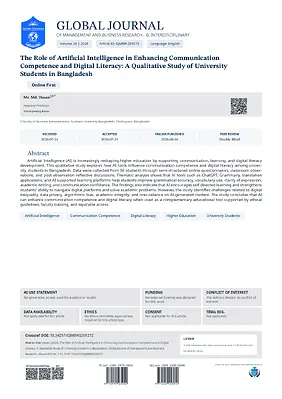
The Role of Artificial Intelligence in Enhancing Communication Competence and Digital Literacy: A Qualitative Study of University Students in Bangladesh
Keywords:
Artificial intelligence, Bangladesh, Communication Competence, digital-literacy, Higher Education, university students
Abstract
Artificial Intelligence (AI) is increasingly reshaping higher education by supporting communication, learning, and digital literacy development. This qualitative study explores how AI tools influence communication competence and digital literacy among university students in Bangladesh. Data were collected from 56 students through semi-structured online questionnaires, classroom observations, and post-observation reflective discussions. Thematic analysis shows that AI tools such as ChatGPT, Grammarly, translation applications, and AI-supported learning platforms help students improve grammatical accuracy, vocabulary use, clarity of expression, academic writing, and communication confidence. The findings also indicate that AI encourages self-directed learning and strengthens students' ability to navigate digital platforms and solve academic problems. However, the study identifies challenges related to digital inequality, data privacy, algorithmic bias, academic integrity, and over-reliance on AI-generated content. The study concludes that AI can enhance communication competence and digital literacy when used as a complementary educational tool supported by ethical guidelines, faculty training, and equitable access.
Downloads
How to Cite
References
Annuš (2023) ChatGPT as a tool for educational content creation and lesson planning. 15(2), 45-60.
Bakhov (2021) Artificial intelligence in emergency education: Ensuring continuity during crises. 26(5), 1-15.
Baranovska (2023) Integration of artificial intelligence tools in higher education institutions. 13(1), 22-35.
Bujold (2023) Artificial intelligence in human resource management: Applications and implications. 22(3), 210-225.
Chiu (2023) Artificial intelligence in education: A systematic review. 4, 100-115.
Chmyr, Bhinder (2023) Legal frameworks for artificial intelligence in education. 8(2), 55-70.
Danylchenko-Cherniak (2023) AI in crisis-driven education systems. 18(1), 33-47.
Davenport, Kalakota (2019) The potential of artificial intelligence in education and communication. 60(3), 1-10.
European Commission (2021) Proposal for a regulation laying down harmonised rules on artificial intelligence (Artificial Intelligence Act). https://ec.europa.eu
Firat (2023) AI-based learning management systems in higher education. 10(1), 88-102.
Fütterer (2023) ChatGPT in education: Opportunities and challenges. 13(4), 412-428.
Gao, Feng (2023) Artificial intelligence and productivity enhancement in education. 71(2), 301-315.
George, Wooden (2023) Artificial intelligence in academic administration and LMS systems. 9, 100-112.
Gligorea (2023) Adaptive learning systems and personalized education. 10(1), 1-14.
González-Calatayud (2021) Emotional recognition in AI-based educational systems. 168, 104-120.
Grassini (2023) The long-term effects of artificial intelligence in education. 8, 112-125.
Kamruzzaman (2023) AI in educational crisis management. 98, 102-110.
Kamalov (2023) Artificial intelligence in higher education: A systematic review. 28, 1-25.
Kohnke (2023) ChatGPT and language learning enhancement. 27(2), 1-15.
Leon (2023) AI-based emotional analytics in education. 85, 101-115.
Lin (2023) Intelligent tutoring systems and adaptive learning. 190, 104-130.
Llovet, González-Rodríguez (2023) AI in virtual classrooms: A new paradigm. 61(5), 900-915.
Memarian, Doleck (2023) ChatGPT in education: A virtual tutor perspective. 28, 1-18.
Memarian, Doleck (2023) Transparency and bias in AI systems. 5, 100-115.
Montenegro-Rueda, Fernández-Cerero, Fernández-Batanero, López-Meneses (2023) ChatGPT in higher education: Opportunities and limitations. 13(3), 245-260.
Nguyen (2023) Privacy challenges in artificial intelligence systems. 38, 1-15.
Nosenko (2019) AI integration in Ukrainian higher education. 38(7), 1-14.
Rahmani (2021) Data-driven decision making in education. 49(5), 789-805.
Ruiz-Rojas (2023) Virtual classrooms and AI technologies. 52(1), 1-20.
Spivakovsky (2023) Institutional policies on AI in higher education. 31(12), 1-18.
Stepanenko, Stupak (2023) ChatGPT in teaching and learning optimization. 14(2), 50-66.
Tan, Cheah (2021) Gamification and AI in education. 117, 106-130.
Veluvali, Surisetti (2022) LMS and student engagement in higher education. 19(3), 200-215.
Yordanova (2020) Gamification in digital learning environments. 25(6), 1-14.
Yu (2024) AI as a complement, not replacement, in education. 2(1), 1-10.
Zhao, Gómez Fariñas (2023) Algorithmic transparency in educational AI systems. 190, 104-145.
Xi (2025) Revisiting communicative competence in the age of AI: Implications for large-scale testing. 1-22.
Asghar, Duah, Iqbal, Järvenoja (2025) Evidence from West Africa on the interplay of affective behavioral cognitive and ethical dimensions of AI literacy in Ghanaian and Nigerian Universities. 28(1), 169.
Zhang (2025) Enhancing oral English learning through AI: a case study on the impact of AI-driven speaking applications among Chinese university students. 16, 1595818.
Published
2026-10-13
Issue
Section
License
Copyright (c) 2026 Authors and Global Journals Private Limited

This work is licensed under a Creative Commons Attribution 4.0 International License.