
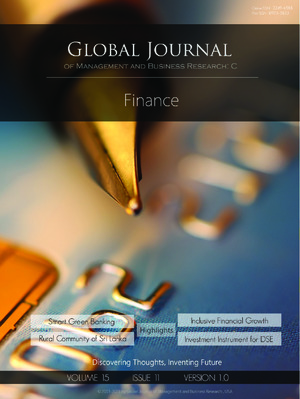
Factors Associated with Peopleas Reliance towards Informal Financing Methods in Rural Community of Sri Lanka
Keywords:
pass-through, politique monétaire, canaux de transmission, taux débiteurs, taux créditeurs
Abstract
This study was focused on investigating factors associated for people's reliance on informal financing methods by Sri Lankans with special reference to rural community in Rathnapura District. To achieve the objectives of the study, data was collected through survey questionnaire from a sample of 250 respondents and data was analysed using Chi -Square test. The results of the research show that there is a significant association between educational level, occupation, income level, financial behavior, personal financial attitudes, financial literacy, trust and reliability on reliance on informal finance. In addition the results showed that people highly depend on informal finance and most preferable financing source is loan from family/friends.
Downloads
How to Cite
References
Adams (1991) Taking a Fresh Look at Informal Finance. 29-42.
Laith Alrubaiee, Nahla Al-Nazer (2010) Investigate the Impact of Relationship Marketing Orientation on Customer Loyalty: The Customer's Perspective. 2(1), 155-174. https://doi.org/10.5539/ijms.v2n1p155
M. Ayyagari, A. Demirgüç-Kunt, Maksimovic (2010) Formal versus Informal Finance: Evidence from China. 23(8).
Abhijit Banerjee, Andrew Newman (1993) Occupational Choice and the Process of Development. 101(2), 274-298. https://doi.org/10.1086/261876
Timothy Besley, Alec Levenson (1996) The Role of Informal Finance in Household Capital Accumulation: Evidence from Taiwan. 106(434), 39. https://doi.org/10.2307/2234930
Diana Beal, Sarath Delpachitra (2003) FINANCIAL LITERACY AMONG AUSTRALIAN UNIVERSITY STUDENTS. 22(1), 65-78. https://doi.org/10.1111/j.1759-3441.2003.tb00337.x
A. Bruni, S. Gherardi, Poggio (2004) Gender and entrepreneurship: An ethnographic approach.
BR Chiswick, Mincer, vol Journal of Political Economy (1972) Time -Series Changes in Personal Income Inequality in the United States from 1939, with Projections to 1985. 80, 34-66.
Hans Degryse, Liping Lu, Steven Ongena (2014) Informal or Formal Financing? Or Both? First Evidence on the Co-Funding of Chinese Firms. https://doi.org/10.2139/ssrn.2289779
B. Francis, I. Hasan, JC Park, Wu (2014) Gender Differences in Financial Reporting Decision Making: Evidence from Accounting Conservatism. 32(2).
D. Godwin, J. Koonce (1992) Cash flow management of low-income newlyweds. 3, 17-42.
M. Hilgert, Hogarth, S. Beverly (2003) Household financial management: The connection between knowledge and behavior. 89, 1-32.
Mohamed Ibrahim, Fatima Alqaydi (2013) Financial Literacy, Personal Financial Attitude, and Forms of Personal Debt among Residents of the UAE. 5(7), 126-134. https://doi.org/10.5539/ijef.v5n7p126
S. Marcolin, A. Abraham (2006) Marcolin, S & Abraham, A 2006, 'Financial Literacy Research: Current Literature and Future Opportunities. http://ro.uow.edu.au/commpapers/223/
Brian Melzer (2011) The Real Costs of Credit Access: Evidence from the Payday Lending Market*. 126(1), 517-555. https://doi.org/10.1093/qje/qjq009
Robert Morgan, Shelby Hunt (1994) The Commitment-Trust Theory of Relationship Marketing. 58(3), 20-38. https://doi.org/10.1177/002224299405800302
J. Riedel, Jin Gao, J. (2007) Overview of Economic Reforms and Outcomes, In "How China Grows: Investment, Finance, and Reform.
M. Rooij, A. Lusardi, R. Alessie (2007) Rooij, MV, Lusardi, A, & Alessie, R 2007, 'Financial literacy and Stock Market Participation, NBER Working Paper 13565. http://www.nber.org/papers/w13565
J. Thomas (2009) Trust in customer relationship: addressing the impediments in research. 346-349.
Wells (2006) Education's effect on income inequality: an economic globalisation perspective. 4(3), 371-391.
Published
2015-12-08
Issue
Section
License
Copyright (c) 2015 Authors and Global Journals Private Limited

This work is licensed under a Creative Commons Attribution 4.0 International License.