
Energy Transition and Sustainable Development in GCC Countries: Strategic Pathways and Policy Implications
Abstract
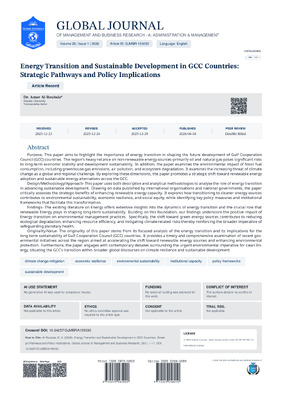
Purpose - This paper aims to highlight the importance of energy transition in shaping the future development of Gulf Cooperation Council (GCC) countries. The region's heavy reliance on non-renewable energy sources-primarily oil and natural gas-poses significant risks to long-term economic stability and development sustainability. In addition, the paper examines the environmental impact of fossil fuel consumption, including greenhouse gas emissions, air pollution, and ecosystem degradation. It examines the increasing threat of climate change as a global and regional challenge. By exploring these dimensions, the paper promotes a strategic shift toward renewable energy adoption and sustainable energy alternatives across the GCC. The paper offers strategic guidance for policymakers in GCC countries to initiate and scale investments in energy transition. It is designed as a decision-support tool that strengthens planning for future energy supply, shields national economies from volatility in global energy prices, and mitigates the risks associated with declining long-term demand for fossil fuels.
Design/methodology/approach - This paper uses both descriptive and analytical methodologies to analyse the role of energy transition in advancing sustainable development. Drawing on data published by international organisations and national governments, the paper critically assesses the strategic benefits of enhancing renewable energy capacity. It explores how transitioning to cleaner energy sources contributes to environmental sustainability, economic resilience, and social equity, while identifying key policy measures and institutional frameworks that facilitate this transformation.
Findings - The existing literature on Energy offers extensive insights into the dynamics of energy transition and the crucial role that renewable Energy plays in shaping long-term sustainability. Building on this foundation, our findings underscore the positive impact of Energy transition on environmental management practices. Specifically, the shift toward green energy sources contribute to reducing ecological degradation, enhancing resource efficiency, and mitigating climate-related risks-thereby reinforcing the broader imperative of safeguarding planetary health. The paper's findings underscore the critical importance of accelerating the energy transition in GCC countries. Continued reliance on fossil fuels risks constraining long-term sustainable growth by limiting future energy availability, particularly from conventional sources.
Originality/value - The originality of this paper stems from its focused analysis of the energy transition and its implications for the long-term sustainability of Gulf Cooperation Council (GCC) countries. It provides a timely and comprehensive examination of recent governmental initiatives across the region aimed at accelerating the shift toward renewable energy sources and enhancing environmental protection. Furthermore, the paper engages with contemporary debates surrounding the urgent environmental imperative for clean Energy, situating the GCC's transition within broader global discourses on climate resilience and sustainable development.
Downloads
How to Cite
References
Amer Al Roubaie (2018) Building capacity for knowledge economies in the Arab world: the role of human capital. 7(4.9), 55-62.
Amer Al Roubaie (2019) Knowledge absorption and economic diversification: the case of Bahrain. 8(IC2).
Amer Al Roubaie, Adel Sarea (2019) Building capacity for green economy: the role of Islamic finance. 12(2).
Amer Al-Roubaie, M. Almubarak (2017) Localisation of knowledge in GCC countries: The case of SMEs. 1(1), 1-15.
Aisheh Al Sarihi (2025) Energy Transition in the Gulf: Best Practices and Limitations. https://carnegieendowment.org
(2024) Sustainable Energy: What It Is & Why It's the Future of Power. https://aqenergy.com
(2025) MEWRE advances 15 key projects under 2025/26 development plan. https://arabtimes.com
(2025) Bahrain renewable energy targets 5% renewable energy by 2025 with solar power. https://pvknowhow.com
(2025) Gulf countries bet big: $100B for renewables to slash emissions by 20%. https://carboncredits.com
(2025) Saudi Arabia Vision 2030's Renewable Energy Project Initiatives. https://www.climatescorecard.org
L. Dai (2025) Investing in the Green Economy 2025.
(2025) Statistical Review of World Energy: 74th Edition.
(2023) Mohammed bin Rashid Inaugurates 5th Phase of the Mohammed bin Rashid Al Maktoum Solar Park. https://www.dewa.gov.ae
(2024) Islamic Finance & Renewable Energy.
(2025) Educate Renewable Energy Toolkit: A Practical Guide for Islamic Financial Institutions.
(2024) GCC Economic Statistics.
(2017) Energy Technology Perspectives 2017.
(2024) Renewables 2024: Analysis and Forecast to 2030.
(2025) Tracking SDG 7: The Energy Progress Report 2025.
(2020) Global Renewables Outlook: Energy Transformation 2050.
(2024) World Energy Transitions Outlook 2024: 1.5°C Pathway.
(2024) GCC Budget Update.
(2026) Gulf drives global sukuk boom as issuance set to hit up to $280 billion in 2026. https://www.khaleejtimes.com
(2024) A System in Peril. 2024-living-planet-report-a-system-in-peril.pdf
Dorothy Neufeld (2025) $2.4 trillion in energy transition spending, by category.
(2021) World Oil Outlook 2045.
(2025) Saudi Vision 2030: Explained, Goals, Key Pillars and Progress to Date. https://peninsula.qa
(2025) Oman selects developers for 500 MW solar-plus storage project. (September). https://www.pvmagazine.com
(2023) PwC boosts global nature and biodiversity capabilities with new Centre for Nature Positive Business. https://www.pwc.com/gx/en/news-room/press-releases/2023/pwcboosts-global-nature-and-biodiversity-capabilities.html
(2025) United Arab Emirates Energy Strategy 2050. https://u.ae/en/about-the-uae/strategies-initiatives-and-awards/federal-governments-strategies-and-plans/uae-energy-strategy-2050
(2026) GCC countries led global Sukuk Issuance in 2026. https://arabtoday.com
(2025) Al Kharsaah: A Pioneering Solar Power Plant in Qatar. https://totalenergies.com
(1987) Our Common Future.
(2025) What is the Energy Transition?.
(2025) Energy Access Has Improved, Yet International Financial Support Still Needed to Boost Progress and Address Disparities.
(2020) The Global Risk Report 2020.
(2020) Fostering Effective Energy Transition: 2020 Edition.
(2021) Fostering Effective Energy Transition: 2021 Edition.
(2025) Fostering Effective Energy Transition: 2025 Insight Report.
Daniel Yergin (2022) Bumps in the energy transition. 59(4), 9-13.
Published
2026-04-10
Issue
Section
License
Copyright (c) 2026 Authors and Global Journals Private Limited

This work is licensed under a Creative Commons Attribution 4.0 International License.