
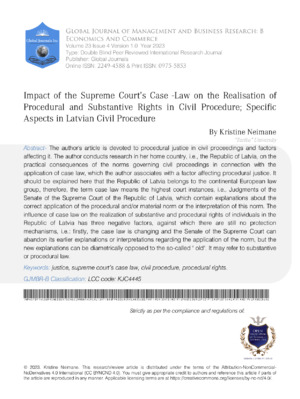
Impact of the Supreme Court's Case-Law on the Realisation of Procedural and Substantive Rights in Civil Procedure; Specific Aspects in Latvian Civil Procedure
Keywords:
justice, supreme court’s case law, civil procedure, procedural rights
Abstract
The author's article is devoted to procedural justice in civil proceedings and factors affecting it. The author conducts research in her home country, i.e., the Republic of Latvia, on the practical consequences of the norms governing civil proceedings in connection with the application of case law, which the author associates with a factor affecting procedural justice. It should be explained here that the Republic of Latvia belongs to the continental European law group, therefore, the term case law means the highest court instances, i.e., Judgments of the Senate of the Supreme Court of the Republic of Latvia, which contain explanations about the correct application of the procedural and/or material norm or the interpretation of this norm. The influence of case law on the realization of substantive and procedural rights of individuals in the Republic of Latvia has three negative factors, against which there are still no protection mechanisms, i.e.: firstly, the case law is changing and the Senate of the Supreme Court can abandon its earlier explanations or interpretations regarding the application of the norm, but the new explanations can be diametrically opposed to the so-called "old". It may refer to substantive or procedural law. Secondly, the lower courts will apply the new case law immediately after the "creation" of this case law, applying to all cases, regardless of the time of their receipt in court; thirdly, it is not predictable in advance when and exactly how the Senate of the Supreme Court will change its explanation regarding the application of a material or procedural norm. So, the impact factors are - volatility, immediate impact, and unpredictability. All the above-mentioned factors mean that a person cannot know whether their case will be decided according to the case law that existed at the time when the person entered or was entered into the legal proceedings, or according to some other case law that could theoretically appear at any future moment and affect the person's chances in the proceedings. In the article, the author analyzes specific examples of the practice of the Senate of the Supreme Court, which show the nature of the problem, as well as compares the results found today in the application of case law, in comparison with the historical development of legal thought about the importance of case law in promoting certainty and justice.
Downloads
How to Cite
References
K. (2012) Civilprocesa likuma komentāri. (Commentary on the Civil Procedure Law) Part II (Chapters 29-60.1). 697-730.
Published
2023-04-21
Issue
Section
License
Copyright (c) 2023 Authors and Global Journals Private Limited

This work is licensed under a Creative Commons Attribution 4.0 International License.