1. Introduction
n recent years, the exponential growth in information and communication technologies and the resulting rapid emergence of electronic commerce have drastically been reshaping the business world. It was pointed out that e-commerce now has reached a phase of change where a revolutionary ideas becomes more evolutionary in nature (Kaynak et al., 2005). Ecommerce has fundamentally changed sales and marketing strategies, the economy and the way business is conducted as well. It has forced companies to find new ways to expand the markets in which they compete, to attract and retain customers by tailoring products and services to their needs, and to restructure their business processes to deliver products and services more efficiently and effectively. E-commerce researchers reported tremendous growth in ecommerce all over the globe, according to International Data Corporation (IDC) (2010), By 2013, worldwide ecommerce transactions will be worth more than $16 trillion (Alam et al,2011).
B2B e-commerce covers a broad range of applications that allows companies to form electronic relationships with their distributors, resellers, suppliers, and other partners. Today, the Internet technology allows B2B e-commerce users to link their companies to the digital markets with other companies easily and inexpensively (Chen, 2010). Today, studying the value and impact of B2B ecommerce is of great interest to both academic researchers and IS practitioners. The current vision for ecommerce is that it is a universal and ubiquitous electronic marketplace relevant to all commercial activities and trading partners. As such, e-commerce has been defined as the process of buying and selling or exchanging products, services, and information through computer networks, such as the Internet (Turban, McLean, and Wetherbe 2002). However, ecommerce is more than simply buying and selling goods electronically (Gregory et al., 2007). McIvor and Humphreys (2004) indicated that effective use of B2B ecommerce has the potential to improve the management of materials for both the buyer and the supplier by reducing inventory, delivery-lot size, purchase orders, and invoices. The Internet technology has enabled companies to create a new market space that facilitates electronic interactions among multiple buyers and sellers. However, e-marketplaces proposed to increase the efficiency and effectiveness of procurement activities by replacing traditional manual processes with automated electronic procedures and by expanding the number of available trading partners (Koch 2003;Chong et al., 2010). Therefore, several empirical studies have examined the role of the Internet in supply chains (e.g., Lancioni, Smith, and Oliva 2000). On the other hand, the perceived contributions of emarketplace to supply chain management are also examined by Eng (2004). It is suggested that buyers may expect two different types of benefits when using emarketplaces: market efficiency and supply chain efficiency (Le, 2002).According to Rao et al. (2006), participants can gain benefits from e-marketplaces through search cost efficiency and market liquidity. However, collaboration enables market participants to build and deepen their business relationships for the purposes of improving individual business processes and overall supply chain performance. E-commerce technically made the supply chain management viable and facilitated SCM use in different industries (Shen et al., 2004). Nevertheless, despite the growth in application of e-marketplaces, there is still a need for closer examination the role of these markets in supply chain management. Therefore, the lack of studies in this area has prompted the authors to look closely at the perceived benefits of B2B e-commerce as major determinant and antecedents of e-marketplace usage and supply chain management. Accordingly, this study essentially aims at investigating the relationship between B2B e-commerce benefits, e-marketplace usage and supply chain management in the context of Jordanian companies. More specifically, study aims to empirically investigate the mediating effect of e-marketplace usage in B2B e-commerce benefits -supply chain management relationship. However, this study certainly strengthens the existing body of knowledge about the perceived contributions of e-marketplace to supply chain management by providing some empirically tested insight in the context of Jordanian companies.
2. II.
3. Literature Review a) E-commerce
Basically, e-commerce is commerce enabled by Internet technologies, including pre-sale and post-sale activities (Whiteley, 2000;Chaffey, 2004). Many businesses around the world have introduced an electronic commerce channel as part of their operations, seeking the many advantages that the online marketplace can provide (Laudon and Traver, 2007). Since the late 1990s, e-commerce's rapid growth is obvious in the developed world. (AlGhamdi et al.,2011).Today, e-commerce has been widely used and many businesses have moved from the offline to the online world in order to serve the global Internet population (Rachjaibun, 2007).Therefore, many large companies continue to set up e-commerce extensively in their enterprise value chains and develop Internetenabled initiatives to manage inventory using electronic links to suppliers, to strengthen online integration with distributors and business partners, to design and customize products and services, and to attempt to serve customers more effectively (Zhu & Kraemer, 2002). Basically, e-commerce defined as an Internet technology that provides the capability to buy and sell online including market creation, ordering, supply chain management, and transfers through opening protocol (Hoffman & Novak, 2000). While Turban et al., (2010) defined e-commerce as the process of buying, selling, or exchanging products, services, or information via computer. Grandon and Pearson (2004) considered three major variables as sources of strategic value of ecommerce: ''operational support" which measures how e-commerce can reduce costs, improve customer services and distribution channels, provide effective support role to operations, support linkages with suppliers, and increase ability to compete. "Managerial productivity" suggests how e-commerce can enhance access to information, provides a means to use generic methods in decision-making, improves communication in the organization, and improves productivity of managers. Finally, "strategic decision aids" defines how e-commerce can support strategic decisions of managers, support cooperative partnerships in the industry, and provide information for strategic decisions (Grandon & Pearson, 2004, p 197). Standing (2001) affirmed that more than ten e-commerce benefits for both buyer and seller. Such as cost savings and speed in selling and purchasing, exposure to new customers (global reach), convenience and transparency to users, better quality of product/service (global reach), reduce need for office space and fewer resources required.
4. b) E-marketplace
Unlike the traditional market in which the meeting place is a physical location, an electronic marketplace refers to a virtual space on an electronic network (Malone, Yates, & Benjamin, 1987). Emarketplaces provide an electronic method to facilitate transactions between buyers and sellers that potentially provide support for all of the steps in the entire order fulfillment process ( Rao et al.,2007). The unique feature of an e-marketplace is that it brings multiple buyers and sellers together (in a ''virtual''sense) in one central market space (Grieger,2003). Basically, the emarketplace provides a mechanism for companies to control, coordinate, and economies on transaction costs, as it improves information flows and helps reduce uncertainty (Eng,2004).However, e-marketplace is an innovative business-tobusiness (B2B) transaction model that covers many functions -including auctions, procurement, catalogue sales, and clearance of excess stock (Fu et al., 2006). Nevertheless, all transactions are done in a specific virtual place called electronic marketplaces. These marketplaces bring together businesses buying and selling goods and services in an online buying community. E-marketplaces proposed to increase the efficiency and effectiveness of procurement activities by replacing traditional manual processes with automated electronic procedures and by expanding the number of available trading partners (Koch 2003;Chong, et al., 2010). Dou & Chou (2002) defined e-marketplace as an online business transaction platform for buyers and sellers. According to Kaplan and Sawhney (2000) emarketplace ''is a meeting-point where suppliers and buyers can interact online''. Turban et al.,(2010) outlined three main functions for e-marketplaces: (1) Matching buyers and sellers, (2) Facilitating the exchange of information, goods, services, and payments associated with market transactions, and (3) Providing an institutional infrastructure, such as legal and regulatory framework, that enables the efficient functioning of the market. An e-marketplace effectively brings players together in a real-time market space to perform basic exchange transactions, such as price and production specifications, and strategic supply chain collaboration, such as forecasting demand and new product development. The primary objectives are to streamline complex business processes and gain efficiencies (Eng 2004). However, Rao et al.(2007) suggest that buyers may expect two different types of benefits when using emarketplaces: "market aggregation" and "inter-firm collaboration". Market aggregation refers to usefulness of e-marketplaces in overcoming market fragmentation, affording buyer with more choices, information about product availability, price transparency, and lower transaction costs. Inter-firm collaboration refers to usefulness of e-marketplaces that enables market participants to build and deepen their business relationships for the purposes of improving individual business processes and overall supply chain performance. Therefore, e-marketplaces have been suggested as one of the most central developments in recent years. Interestingly, based on the results of literature review, Grieger (2003), described seven different e-marketplace categories: (1)Buyer-oriented, seller-oriented or neutral; (2)iVertical or horizontal; (3) Fix or variable pricing mechanism; (4) Manufacturing or operating inputs; spot or system sourcing; (5) Open or closed; (6) Supported transactions phases; (7) Aggregation or matching mechanism. c) Supply chain management (SCM) In today's customer-focused marketplace, supply chain management has become a key to competitive advantage (Grieger,2003). Supply chain management defined as the set of entities, including suppliers, logistics services providers, manufacturers, distributors and resellers, through which materials, products and information flow ( Kopczak ,1997). While, Christopher (1992) defined supply chain management as network of organizations that are involved, through upstream and downstream linkages, in the deferent processes and activities that produce value in the form of products and services in the hands of the ultimate consumer. However, Turban et al., (2010) defined SCM as a complex process that requires the coordination of many activities so that the shipment of goods and services from supplier right through to costumer is done efficiently and effectively. Whereas Chaffey (2009) defined supply chain management as the coordination of all supply activities of an organization from its suppliers and partners to its customers. He also classified supply chain management to upstream supply chain: transactions between an organization and its suppliers and intermediaries, equivalent to buy-side ecommerce, and downstream supply chain: transactions between an organization and its costumers and intermediaries, equivalent to sell-side e-commerce. The lack of a universal definition of supply chain management is in part due to the way the concept of supply chain has been developed. In fact the concept of supply chain has been considered from deferent points of view in deferent bodies of literature (Croom et al..2000). However
,the benefit of supply chain management can be attained through the electronic linkage among various supply chain activities utilizing information technologies and the construction of integrated supply chain information systems (Bowersox & Daugherty, 1995). Christopher (1998) also notes that the goal of supply chain management is to link the marketplace, the distribution network, the manufacturing process, and the procurement activity in such a way that customers are serviced at higher levels and yet at a lower total cost (Eng 2004). Nevertheless, supply chain management was originally developed as a way to reduce costs. It focused on very specific elements in the supply chain and tried to identify opportunities for process efficiency. Today, supply chain management is used to add value in the form of benefits to the ultimate consumer at the end of the supply chain. This required more view of the entire supply chain than had been common in the early days of supply chain management (Schneider, 2006). However, B2B supply chain collaboration involves a group of manufacturers, retailers, and suppliers using the internet to exchange business information and work jointly at forecasting demand for their products, developing production schedules, and controlling inventory flow. The main challenge is to establishing trust among partners to share sensitive business information and upgrading business applications that will advance collaboration. The ultimate goal of supply chain management is to achieve a higher-quality or lower-cost products at the end of the chain (Awad, 2004;Schneider, 2006).Internet capabilities have a profound impact on organization's supply chains. Increasingly, companies are recognizing that the efficient flow of information and material along their supply chain is a source of competitive advantage and differentiation. Electronic supply chain management (E-SCM) is the collaborative use of technology to enhance B2B processes and improve speed, agility, real time control, and costumer satisfaction. It involves the use of information technologies to improve the operations of supply chain activities, as well as the management of supply chains .E-SCM is not about technology change alone; it involves changes in management policies, organizational culture, performance metrics, business processes, and organizational structure across the supply chains (Turban et al, 2010). Organization can gain different benefits from supply chain management such as; higher sales, reduce order-to-delivery time, reduce costs of manufacturing, manage inventory more efficiently, improve demand forecasting, reduce time to introduce new products, improve aftermarket/post-sales operational, share information about costumer demand fluctuations, receive rapid notification of product design changes and adjustments, provide specifications and drawings more efficiently, increase the speed of processing transactions, reduce the cost of handling transactions and reduce errors in entering transaction data (Awad, 2004;Schneider, 2006;Chaffey;2009). d) Relationship among study variables Delfmann et al., (2002) proposed that the logistical implications of e-commerce can be differentiated into two main categories: the rise of emarketplaces; and the elimination of supply chain elements (disintermediation). By analyzing these two categories and their major logistical implications in detail the researchers deduct strategic consequences for logistics service providers. Rudberg et al., (2002) defined three collaborative supply chain planning scenarios. It is shown how collaborative supply chain planning typically could be implemented on an electronic marketplace by the means of a Web-based demonstration. As such, the study indicated how electronic marketplaces can be used to enable supply chain integration. Grieger (2003) exposes the importance of supply chain management within emarketplaces. Also the relevancy of supply chain management for an e-marketplace is analyzed by examining the type of relationship within different emarketplace categories. Larsen, Kotzab and Grieger (2003) discussed the interrelation between Internetdriven e-marketplaces and supply chain management from a procurement portfolio perspective. Study proposed that different types of buyer-supplier relationships require different types of Internet-driven emarketplaces. Eng (2004) posited that e-marketplaces that use Internet protocols as communication standards have gained widespread application in supply chain management . He indicated that full participation in emarketplaces requires companies to integrate their internal and external supply chain activities and share strategic information. The perceived contributions of emarketplace to SCM are examined by Eng,(2004) in three dimensions: unit cost reduction, increased efficiency, and streamlined operations. Shen et al., (2004) revealed that e-commerce and supply chain management are complementary in nature and need to be studied together. Their study confirmed that one of the factors in supply chain structure, supply chain management integration level , was significantly related to e-commerce adoption level. Murtaza, et al., (2004) discussed the opportunities and challenges facing emarketplaces today, and also the concerns facing potential participants in these e-marketplaces who are trying to weigh the risks presented by such participation and the possible benefits that can be reaped by streamlining supply chain processes. (Greyet al.(2005) explored the difficulties faced by e-marketplaces and discuss potential sources of value that will encourage their adoption by preserving and complementing longterm B2B relationships. The study focus on the role of emarketplaces in B2B transactions, where long-term relationships between buyers and sellers are important, as is the case in many supply chains. The main objective of Rao, et al., (2007) study was to investigate how buyers' usage of e-marketplaces was influenced by their perceived risks and expected benefits associated with such markets. Results indicated that buyers' perceived risks and expected benefits had an influence on their usage extent of e-marketplaces. In addition, buyers' e-business readiness moderated the relationship between expected benefits and usage of emarketplaces. By surveying websites, Wang & Archer, (2007) identified five types of horizontal collaboration (buying groups) and four kinds of vertical supply chain collaboration in e-marketplaces. The findings suggest that supply chain collaboration tends to be supported more than buying groups by existing e-marketplaces, and a high percentage of e-marketplaces now offers supply chain coordination and integration. Among online buying groups, the exchange-catalogue model is the most popular, possibly since it puts fewer burdens on members and coordinators. Liu, et al., (2010) study investigates how institutional pressures motivate the firm to adopt Internet-enabled Supply Chain Management systems (eSCM) and how such effects are moderated by organizational culture. The results suggest that the dimensions of institutional pressures (i.e., normative, mimetic, and coercive pressures) have differential effects on eSCM adoption intention. While mimetic pressures are not related to eSCM adoption intention, normative and coercive pressures are positively associated with eSCM adoption intention.
5. III.
6. Conceptual Framework And
Hypotheses Development
7. a) Conceptual framework
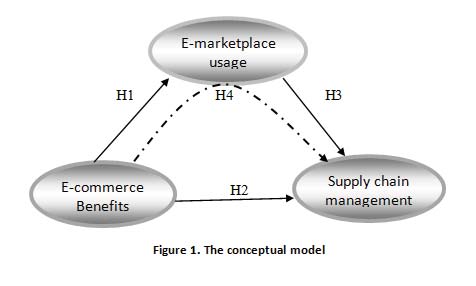
It is now possible to develop an overall model summarizing the hypotheses and reflects a causal ordering derived from the literature reviewed above. The proposed structural model guiding this research is depicted in Figure 1. It builds on core linkages between study variables: B2B e-commerce benefits, emarketplace usage and supply chain management. As can be seen in the figure, the e-marketplace usage as mediator in B2B e-commerce benefits-supply chain management relationship.
The research hypotheses are represented in the Figure 1. An E-commerce benefit is believed to have a positive relationship with e-marketplace usage and supply chain management (H1and H2). It is suggested also that e-marketplace usage have a positive influence on supply chain management (H3). Finally, as for indirect effects, e-marketplace usage are proposed as the key mediators that connect or bridge e-commerce benefits with supply chain management (H4).
8. b) Research hypotheses
The hypothesized relationships of the proposed structural model guiding this research are illustrated in Figure 1. Therefore, to examine these relationships the following hypotheses are formulated: H1: E-commerce benefits have a positive effect on emarketplaces usage. H2: E-commerce benefits have a positive effect on supply chain management. H3: E-marketplaces usage has a positive effect on supply chain management. H4: E-marketplaces usage mediates the effect of ecommerce benefits on supply chain management.
9. IV.
10. Research Methodology
This study is exploratory, quantitative in nature, aiming to develop a better understanding of the relationships among the B2B e-commerce benefits, emarketplaces usage and supply chain management. More specifically, the study intends to empirically investigate the direct and indirect effect of B2B ecommerce benefits on supply chain management through e-marketplaces usage as mediator.
11. a) Selection of sample and respondents demographics
The proposed research model is tested in the context of Jordanian companies in different industries. Accordingly, the study is empirical based on the primary data collected from a sample of companies operating in different industries involved in e-commerce carried out in 2011 in Amman -Jordan (Albayati,2011). To collect information of the study variables from respondents with corresponding positions in the organization (the most knowledgeable informant) to reduce systematic measurement error, information on e-commerce, emarket places and supply chain management can be obtained from executive manager, senior purchasing managers, senior marketing managers, because they should be the most knowledgeable involved about ecommerce activities of their firms. A list of (66) organizations involved in e-commerce in Amman -Jordan was compiled from the Chamber of Commerce and Industry in Amman. Only (47) Organizations across different industries were initially responded In total (130) self administered questionnaires were distributed to the managers in the responded organization. The number of satisfactory completed questionnaires returned was only (82), giving a response rate of 63%. Since the questionnaire was administered in Arabic, the questionnaire was drafted in English and translated into Arabic thereafter. The respondents and the sample firms were described in term of the following: most of respondents were males (74.4 percent), majority (67 percent) of the respondents held the senior purchasing managers. 47 percent of the respondents reported great extent of use e-marketplaces to purchase needed products. Finally (43 percent) of the respondents deal with more than ten e-marketplaces. Based on the completed surveys, statistical analysis was carried out and the results are presented in the next section. variables. Second; a structural equation modeling was conducted using AMOS 7 to test the hypotheses in order to understand the direct and indirect effect of B2B e-commerce benefits on e-marketplace usage and supply chain management.
12. c) Measures and scales
The research instrument was developed using measures from the extant literature. However, these multi items scales have previously demonstrated validity and reliability in other studies. B2B e-commerce benefits was measured using the 8-item scale proposed by Lin et al.,(2007) and adopted by Chen (2010). Emarketplace usage was assessed with 15 items derived from Naidoo (2007), and Rao et al., (2007). In addition, supply chain management was assessed with 21 items developed by Eng (2004) and adopted by Rao et al.,(2007) . for all the scales,. respondents were asked to indicate their agreement or disagreement with several statements using a five-point Likert-type scale ranging from (1) strongly disagree to (5) strongly agree.
13. d) Measures assessment: reliability and validity
Examination of instrumental validity of the scale employed for this study was carried out in two forms, testing content validity and construct validity. As a result of discussions with academic scholars and reviews of existing studies, the scales used in the current study were concluded to have adequate content validity. Following Anderson and Gerbing's (1988), the measures were purified by assessing their reliability, validity, and unidimensionality. Reliability initially was evaluated using Cronbach's alpha. Therefore, the data analysis was conducted in three steps. First, an exploratory factor analysis (EFA) with Varimax rotation was performed to determine the underlying dimensions of the three constructs. However, exploratory factor analysis was employed to assess the scale items individually for each construct (checked for poor factor loadings, and high cross-loadings). Gerbing and Hamilton (1996) suggest that principle components analysis performs as well as other methods in detecting underlying models. Second step involved testing of the measurement model for the constructs using confirmatory factor analysis (CFA) in order to determine if the extracted dimensions in step 1 offered a good fit to the data. Finally, we examine the interrelationships among e-commerce benefits, e-marketplace usage and supply chain management. Composite reliability assesses the internal consistency, which is estimated using Cronbach'salpha. Typically, reliability coefficients of 0.7 are considered adequate (Cronbach 1971;Nunnally, 1978;Hair et al., 1998). As can be seen from Table 1, all the three scales e-commerce benefits, emarketplace usage and supply chain management achieved an alpha above 0.7. : E-commerce benefits 0.972, e-marketplace usage 0.945 and supply chain management 0.983. These results suggest that the theoretical constructs exhibit high Composite reliability.
14. i. Exploratory factor analysis
Construct validity is the extent to which the items on a scale measure the abstract or theoretical construct. The threshold employed for judging the significance of factor loadings was 0.50 (Hair et al., 1992;Kerlinger, 1986). However, unidimensionality of each construct must be checked. Therefore, items in each multi-item scale were factor analyzed separately using principal component factor analysis with Varimax rotation. The criteria for choosing variables are based on Kaiser's (1996) suggestions: an eigenvalue greater than 1 after Varimax rotation, absolute values of factor loadings greater than .50 (Hair, Anderson, Tatham, & Black, 1998). As shown in Table 2, 3, and 4, results indicate that in all case a single factor emerged, i.e. there is one factor derived from each variable: ecommerce benefits (eigenvalue =10.831); emarketplace usage (eigenvalue =5.800 ); and supply chain management (eigenvalue =15.655) and explaining 72.21 , 72.49 and 74.54 percent of the total variance for e-commerce benefits , e-marketplace usage and supply chain management consequently. In addition, all items were loaded on these three factors and all the loadings are well above 0.7. The results imply the statistical significance of the relationships between the items and constructs suggesting homogeneity within each factor and the reliability of individual items. These results suggest that the theoretical constructs exhibit good psychometric properties. ii. Confirmatory factor analysis Construct validity was confirmed using the confirmatory factor analysis. Convergent and discriminant validity of the scales were verified through confirmatory factor analysis to substantiate the assumption that the scaled variables are correlated with the construct to be assessed and not with other constructs (Bagozzi and Yi, 1988;Anderson and Gerbing ,1988). The confirmatory factor analysis (CFA) revealed that all psychometric properties were satisfactory. Table 5 summarizes the measurement model for e-commerce benefits, e-marketplace usage and supply chain management and shows the standardized regression weight for each variable. The standardized regression weights for all variables that are shown in Table 5 are significant at the 0.001 level. The confirmatory factor analysis showed a good fit. The Chisquare x 2 statistic was 406.844 (d f 149, p, 0.000), with the x 2/df ratio having a value of 2.73 that is less than 5.0 (it should be between 0 and 5 with lower values indicating a better fit). The goodness of fit index (GFI) was 0.812 and the comparative fit index (CFI) was 0.921. These indices are close to a value of 1.0 (a value of > 0.90 indicates perfect fit), indicating that the measurement models provide good support for the factor structure determined through the exploratory factor analysis (Anderson and Gerbing, 1988;Hair et al.,2006 ).
15. V. Hypothesis Testing: Structural Model
In order to verify the proposed hypothetical relationships among the three latent variables used for this research, a structural equation model was developed using AMOS7.0 as follows (Figure 2).
As a result of the analysis, the structural model's fitness was found to be adequate according to a relative measure of fitness which takes into consideration both sample size and model's simplicity (Jo¨reskog and So¨rbom, 1993). Although the goodness-of-fit-index GFI (0.812) and normal fit index NFI (0.881), an absolute index of fitness, was somewhat short of acceptable level of > 0.90, the comparative fit index CFI, a relative fitness index, was above acceptable level with 0.921.The chi square x 2/df was 2.73 within acceptable level (< 5) and root mean square error of approximate RMSEA was 0.09, somewhat short of acceptable level of (< 0.08) (Hair et al.,2006). Considering overall values of the indices, it is appropriate to estimate the structural model. The structural equation model incorporating the hypotheses is depicted in Figure 2. In order to examine the hypotheses, the authors utilized the effect decomposition, in which the total effect of an independent variable on a dependent variable was categorized into indirect and direct effects (e.g., Brown, 1997;Tabachnick and Fidell, 1996). A significant indirect effect indicates that a significant amount of the independent variable's total effect on the dependent variable occurs via the mediator. The direct and indirect effects for all the paths hypothesized in the model are depicted in Table 6.
16. E_Commerce Benefits
. The analysis then proceeded to examine the causal relationships between these variables. The results were as expected and provided support for hypotheses 1, 3, and 4. Properties of the causal paths, including standardized path coefficients of the research model was shown in Table 6. Figure 2 illustrates path analysis of the structural model. Standardized path coefficients are provided; numbers on the construct indicate total variance explained (R2). Standardized structural path coefficients and R 2 values are presented in Figure 2. In this model the path from e-commerce benefits to e-marketplaces usage and supply chain management was calculated, and the standardized coefficient that obtained from e-commerce benefits to emarketplaces usage was positive and highly significant (Standardized coefficient = .948; p < .001 ). Thus, there is support for H1. Unfortunately, the standardized coefficient that obtained from e-commerce benefits to supply chain management was positive but not significant (Standardized coefficient = .266; p > .05).
Therefore, there is no support for H2. As predicted by H3, the standardized coefficient that obtained from emarketplaces usage to supply chain management was also positive and highly significant (Standardized coefficient = .709; p < .001).Thus, there is support for H3. However, the indirect effects of e-commerce benefits on supply chain management was positive and highly significant, therefore the effect flow only through e-marketplaces usage (indirect standardized coefficient = .672; p < .001). Therefore H4 supported. The results concerning the testing of hypotheses are summarized in Table 7. As depicted in figure 2 , coefficient of determination (R2 ) values show that, e-commerce benefits account for 90% of variance in e-marketplaces usage; e-commerce benefits and e-marketplaces usage, account for 93%of variance in supply chain management. The results are depicted in Figure 2, which show a structural equation modeling. These results suggest that the model is a reasonable basis upon which to test the research hypotheses.
17. Conclusions And Implications
Based on theoretical considerations, a structural model was proposed to investigate the links among the three constructs: e-commerce benefits, emarketplace usage and supply chain management. More specifically, main thrust of the study was to examine the mediating impact of e-marketplace usage on the relationship between e-commerce benefits and supply chain management within the context of different industries using covariance-based structural equation modeling. Exploratory and confirmatory factor analyses were employed to produce empirically verified and validated underlying dimensions of e-commerce benefits, e-marketplace usage and supply chain management constructs drawing on a sample of organizations held in different industries. E-commerce benefits were significant predictor of e-marketplace usage and supply chain management. The findings of structural equation modeling indicated that while ecommerce benefits had a strong and positive effect on e-marketplaces usage, no significant direct link was found between e-commerce benefits, and supply chain management. Also a strong and positive relationship was noted between e-marketplace usage and supply chain management. The empirical finding of this study i.e. the interrelationship between e-commerce benefits ,e-marketplace usage and supply chain management is consistent with previous study (e.g. Eng,2004;Delfmann et al., 2002;Rudberg et al., 2002;Larsen et al., 2003;Murtaza, et al., 2004;Greyet et al.,2005;Rao, et al., 2007;Liu et al., 2010). This research provides some insights for understanding why most organizations today realize benefits from their B2B e-commerce involvement. This study provides also an empirical evidence for the importance of using an organization e-marketplace to utilize its existing capabilities and processes to obtain business value in the context of B2B e-commerce. E-commerce provides many benefits to both sellers and buyers; e.g. Napier et al. (2001) pointed out that by implementing and using ecommerce sellers can access narrow markets segments that are widely distributed while buyers can benefit by accessing global markets with larger product availability from a variety of sellers at reduced costs. Improvement in product quality and the creation of new methods of selling existing products are also benefits. Also, Rutner et al. (2003) indicate that companies that have successfully implemented logistics information systems are significantly more likely to have also implemented some form of e-commerce than those who have not. Based on our findings we also recommend that manager of organizations should focus on making B2B e-commerce as well as e-marketplace usage an integral part of their business strategy.

| No. Dimension | Items | Coefficient | |
| Number | |||
| 1 | E-commerce benefits | 15 | 0.972 |
| 2 | E-market place usage 8 | 0.945 | |
| 3 | Supply chain | 21 | 0.983 |
| management | |||
| All Dimensions | 44 | 0.989 | |
| Component |
| Extraction |
| Kaiser-Meyer-Olkin -KMO Measure of Sampling Adequacy: .880 | Component |
| Bartlett's Test of Sphericity: Sig: .000 | Extraction |
| q16 Using e-marketplace (EM) gives the organization greater control in carrying out the tasks | .894 |
| q17 Using EM saves the organization's time and effort over other means of performing the same task | .885 |
| q18 Using EM is a more effective way of servicing the organization's needs | .899 |
| q19 Overall, the organization finds the EM very useful | .897 |
| q20 Our organization uses EM for announcing purchasing requirements | .866 |
| q21 Our organization uses EM for placing orders on supplier's website | .896 |
| q22 Our organization uses EM for tracking payment information | .680 |
| q23 Our organization uses EM for sharing design information with our suppliers | .767 |
| Component |
| Extraction |
| Estimate | S.E. C.R. | P |
| e16 | e17 | e18 | e19 | e20 | e21 | e22 | e23 | |||||
| .85 | .86 | .87 | .88 | .72 | .78 | .33 | .64 | |||||
| q16 | q17 | q18 | q19 | q20 | q21 | q22 | q23 | |||||
| .92 | .93 | .93 | .94 .85 | .88 | .58 | .80 | ||||||
| .90 | d1 | |||||||||||
| E_Marketplace | .73 | |||||||||||
| Usage | q24 | .85 | e24 | |||||||||
| e1 e2 e4 e5 e6 e7 e8 e9 e10 e11 e12 e13 e15 e14 e3 | q15 q14 q13 q12 q11 q10 q9 q8 q7 q6 q5 q4 q3 q2 q1 | 74 .86 .78 .88 .72 .85 .84 .92 .87 .93 .83 .91 .78 .88 .65 .81 .67 .66 .49 .70 .84 .88 .88 | .82 .81 .70 .84 .91 .94 .94 | .95 | .27 | q42 q41 q25 q26 q27 q28 q29 q30 q31 q32 q33 q34 .84 q35 .92 q36 q37 .90 q38 .92 q39 .75 .90 .91 .92 .93 Supply Chain Management .85 .93 .71 .89 .92 .93 .93 .95 .88 .94 .88 .91 .90 .89 q40 d2 | .81 .84 .86 .80 .85 .86 .87 .89 .78 .88 .82 .71 .85 .80 .84 .56 .82 .78 | e42 e41 e25 e26 e27 e28 e29 e30 e31 e32 e33 e34 e35 e36 e37 e38 e39 e40 | ||||
| q43 | .79 | e43 | ||||||||||
| q44 | e44 | |||||||||||
| Direct Effect | Indirect Effect | Total Effect | ||||||||||
| From | E- | E- | E- | E- | E- | E- | ||||||
| To | commerce | marketplace | commerce | marketplace | commerce | marketplace | ||||||
| benefits | usage | benefits | usage | benefits | usage | |||||||
| E- | ||||||||||||
| marketplace | . .948 | .000 | .000 | .000 | .948 | .000 | ||||||
| usage | ||||||||||||
| supply chain management | .266 | .709 | .672 | .000 | .938 | .709 | ||||||
| Hypothesis | causal path | Coefficients Standardized | Test result | ||
| H1 | E_ Commerce Benefits | E _ Marketplace Usage | .948*** | supported | |
| H2 | E -Commerce Benefits | Supply Chain Management | .266 | Not | |
| supported | |||||
| H3 | E-Marketplace Usage: | Supply Chain Management | .709*** | supported | |
| H4 | Indirect effect E -Commerce Benefits | Supply | .672 *** | supported | |
| Chain Management through E-Marketplace usage as | |||||
| mediator | |||||
| Note: * ** indicates p<0.001 | |||||
| VI. | |||||