1. INTRODUCTION
oday we are living in a knowledge world where intellectual capital plays a very important role. Educational Institutions being the home of intellectual capital can play a vital role in knowledge sharing and disseminating. Equally important is the role of Information and Communication technology in enhancing Knowledge sharing. We have moved from scarcity of information to its abundance due to information and communication technology, internet, television etc. Thus, KM has to play a vital role in transformation of economies into knowledge economies.
Knowledge Management (KM) is the process of transforming data into information and intellectual assets and thus enhancing its value. It also helps in connecting people with the knowledge that they need to initiate action (Kidwell et al, 2001). Infact, KM is making the right knowledge available to the right person/ processor (computer), at the right time in the right presentation for the right cost. (Holsapple, 1999). Its well said by Drucker in 1999 that "We have entered the knowledge society in which the basic economic resource?is knowledge?and where the knowledge worker will play a central role".
Like water, this rising tide of data can be viewed as an abundant, vital and necessary resource. With enough preparation, we should be able to tap into that reservoir --and ride the wave --by utilizing new ways to channel raw data into meaningful information. That information, in turn, can then become the knowledge that leads to wisdom (Les Alberthal,1995). Data is processed to provide information, which answers to "who", "what", "where", and "when" questions. Information embodies the understanding of a relationship of some sort, possibly cause and effect. In an organizational context, data represents facts or values of results, and relations between data and other relations have the capacity to represent information. Patterns of relations of data and information and other patterns have the capacity to represent knowledge. Knowledge is a gradual transition from data to information.
2. II.
3. LITERATURE REVIEW
4. Review of literature has been classified into two categories: Knowledge Management Knowledge Management and Education a) Knowledge Management
The idea is that information, knowledge, and wisdom are more than simply collections. Rather, the whole represents more than the sum of its parts and has a synergy of its own. Knowledge is broadly defined as information combines with experience, context, interpretation and reflection, is a high value form of information that is ready to business process, decisions and actions. Knowledge refers to the sum of what is known: A familiarity, awareness or understanding gained through experience that, in a business context, guides operations and administrative processes (Coukos and Eleni, 2003). Knowledge represents a pattern that connects and generally provides a high level of predictability (Bateson 1988). People attain knowledge while performing specific tasks, taking decisions in crucial situations, and solving the problems. The new knowledge resides in their minds, but that has not been documented in a structured manner leading to its loss most of the time.
A common way to discuss knowledge is by dividing it into two dimensions, explicit knowledge and tacit knowledge.
Explicit knowledge can be expressed in words and numbers and is shared in the form of data, manuals, copyright and patents (Nonaka 1991; Smith 2001). Furthermore, explicit knowledge is carefully codified, stored in a hierarchy of databases and is accessed with high quality and fast information systems. The advantage of this type of knowledge is that it is easily accessible for other people, and can therefore be reused to solve similar problems (Smith 2001). Explicit Knowledge is documented information that can facilitate action. It is easily codified, communicable and transferable. It can be expressed in formal, shared language (Kidwell et al. 2000). Examples include formulas, equations, rules, and best practices.
Tacit knowledge is know-how and learning embedded within the minds of the people in an organization. It involves perceptions, insights, experiences, and craftsmanship. Humans are not always able to express all tacit knowledge and as opposed to explicit knowledge it becomes difficult to share it. Therefore, tacit knowledge is often seen as the iceberg below the surface of the water, i.e. unseen and embedded in our social identity and practice (Spender 1996). Tacit knowledge is deeply rooted in actions and experiences as well as in the ideals, values or emotions that an individual embraces (Nonaka and Nishigushi 2001). Therefore it is hard to formalize it and, difficult to communicate or share it with others. Due to this difficulty in formalizing tacit knowledge, it is often transmitted through face-to-face contact. Furthermore, tacit knowledge is technical or cognitive and is made up of mental models, values, intuitions, insights and assumptions.
Technical tacit knowledge is demonstrated when people master a specific knowledge like the one gradually developed by master craftsmen (Smith 2001). Tacit knowledge is personal, context-specific, difficult to formalize, difficult to communicate and more difficult to transfer.
Knowledge Management is generally about the gathering, storing, disseminating and application of knowledge via the know-how and creation of work by the individuals in an organization (Miller, 1999). Bernbom (2001) explains that KM involves the "discovery and capture of knowledge, the filtering and arrangement of this knowledge, and the value derived from sharing and using this knowledge throughout the organization". It is this "organized complexity" of collaborative work to share and use information across all aspects of an institution which marks the effective use of knowledge.Most business actions require the guidance of both explicit and tacit knowledge (Kidwell et al. 2000). These master craftsmen have years of experience and therefore also a wealth of expertise. Nevertheless, they often have difficulty in articulating the technical and scientific principles behind what they know.
5. b) Knowledge Management and Education
Libraries, as well as colleges and universities, are facing major transformational change as digital technology fundamentally alters how services are provided, research is conducted, and learning is enabled. Technology is breaching the traditional disciplinary boundaries through which the institutions are organized and through which information is categorized and accessed (Hawkin, 2000). Knowledge Management is generally about the gathering, storing, disseminating and application of knowledge via the know-how and creation of work by the individuals in an organization (Miller 1999). Knowledge Management principles recognize that it is important for organizations to "know what they know." All institutions inherently store, access, and deliver knowledge in some manner. According to Thorn (2001), the problem is that it is such a "wide open area of study that it is difficult to understand the implications of Knowledge Management for an educational setting".
Realizing the importance of knowledge management, the Indian Government has established National Knowledge Commission (NKC) which was established on 13th June 2005. According to "National Knowledge Commission (NKC) of India: An Overview", the NKC is in particular concerned with the following aspects of Indian education.
Higher education: Funding, regulatory frameworks, curricula, private sector participation, academic standards and research are all issues that require urgent attention and sincere resolution with a long term view in mind. Although there has been a great deal of recognition in business world that information and knowledge management can be vital tools in organizations, now the educational administrators and teachers have begun to look at how they might use knowledge management to assist in creating effective learning environment. Higher education institutions have "significant opportunities to apply knowledge management practices to support every part of their mission," explains (Kidwell et al. 2000).
According to Petrides and Nodine (2003) educational institutions however seem to be working in a more complex way, as these organizations are adaptive and are social systems where people co-operate with technologies to evolve processes to achieve common goals. Just as ecosystems rejuvenate themselves through cycles and seasons, educational organizations grow and revitalize themselves through the knowledge they create, their processes facilitate passing that knowledge on to others and the exchanges and relationships that they foster among people. Knowledge Management therefore, very aptly brings together three core organizational resources -people, processes and technologies -to enable the educational institutions use and share information most optimally and effectively (Figure 2). Fig. 1 : Key Realms of Knowledge Management KM in education can therefore be thought of as a framework or an approach that enables people within the institution to develop a set of practices to collect information and share what they know leading to actions that improve services and outcomes (Petrides and Nodine 2003). Now days educational institutions are facing intense competition because of emerging local and global educational institutions. The Porter's 5 Forces tool is a simple but powerful tool for understanding where power lies in a business situation. This is useful, because it helps you understand both the strength of your current competitive position, and the strength of a position you're considering moving into.
The competitive analysis of education sector based on Michael Porter 5 force model has been performed. There are many external forces like new entrants, bargaining power of customers, threat of substitute courses etc. which are bothering well established educational institutions. The analysis is shown in figure 2 Porter five forces analysis assumes that there are five important forces that determine competitive power in business situation which are discussed in the context of higher education: New Market Entrants : Due to the globalisation the scope of higher educational institutions to have students across the borders is increasing. Infact the universities are opening their campuses in other countries. Already established institutions are now facing competition.
Buyer Power : With the emergence of technical era, the new skills demand from the industry specially information and technology (IT) and others are changing rapidly in comparison to the earlier days. Now students also want to take the courses which can place them above par and fetch them good jobs. Students are also concerned about course and fee structure because of the available choices. IHTE cannot go ahead with their regular courses, they have to upgrade their curriculum, new courses and flexibility according to the demand to the industry and learners.
Product and Technology Development : Before taking admission the learners are concerned about technology used by the IHTE and courses offered. Institutions should consistently upgrade their systems to remain competitive by having classroom response systems, podcasting, lecture webcasting and like. Supplier Power: The reputation of the institution, infrastructure and quality of the faculties play an important role for the establishment of the institution.
Competitive Rivalry : There are number of institutions which offer equally good courses and provide facilities. Then an institution has little power in the situation, because students can go elsewhere. . There is a difference in ranking in two universities with identical numbers of faculty, degree programs, expenditures, and enrollment as those surveys conducted by U.S. News and World Report. Milam (2001) The results of ANOVA highlight that there is a significant difference in senior management and Junior management in case of: i) Intranet, ii) Document Management, iii) Blogs, iv) Decision support System and Group ware technologies. Thus the present hypothesis cannot be accepted that there is no significant difference amongst the Senior academia, viz. the thought leaders of KM and Junior academia consisting of Assistant Professors and Lecturers, regarding Knowledge Management strategies.
6. b) Knowledge Management and Research
Davenport and Prusak (1998) have said, 'Knowledge derives from minds at work'. When employees use knowledge management system, best practices are stored throughout the organization, and each employee accessing the system has similar power to the best employee (Markus, 2002). As stated by Syed Z. Shariq (1997), knowledge increasingly becomes the key strategic resource of the future our need to develop comprehensive understanding of knowledge processes for the creation, transfer and deployment of this unique asset are becoming critical. In the face of a globally seeking fundamental insights to help them nurture, harvest and manage the immense potential of their knowledge assets for capability to excel at the leading edge of innovation. Schools (K-12), universities, and training organizations (traditional suppliers of knowledge); and businesses and knowledge based organizations in public sector (growing users of knowledge) are in need of an integrative discipline for studying, researching and learning about the knowledge assets -human intellectual capital and technology.
Just as businesses can improve efficiency and effectiveness of their organizations through sound knowledge management, similarly educational institutions can realize the potential of knowledge creation and the power of knowledge-sharing in order to enhance the learning of pupils, students and staff (Sallis and Jones). The need for universities to make better use of their information assets was stressed in, for example, the National Committee of Inquiry into Higher Education (1977), which called for the development of communications and information strategies in every December expanding and highly competitive knowledge-based economy the traditional organizations are urgently university in UK by the turn of the millennium (McManus and Loughridge(1999). Knowledge Management is generally about the gathering, storing, disseminating and application of knowledge via the know-how and creation of work by the individuals in an organization (Miller 1999). Orsenigo (2000) observed the fact that, while Western European countries do not lag behind the US in basic research or in applied R and D, they are comparatively slow to transform research into innovation and ultimately into market success. He identifies the organization of the innovation process as a particular European weakness.
Knowledge management system can create a common gateway to the data, information and knowledge that the people throughout the higher educational institutions need to effectively share information and work together on projects. When employees use Knowledge Management System, best practices are stored throughout the organization, and each employee accessing the system has power similar to the best employee (Markus, 2002).
In academia, most of the tacit knowledge associated with an area of study lies with the faculty who study it. The tacit knowledge of a literature may be what characterizes much of the informal, side-conversations at academic conferences, in discussions between graduate students and their mentors, etc. However, this information has always been informal, word-of-mouth, and not the province of the library or any other organisational unit. However, in commenting on knowledge management in the university context, Cronin and Davenport (2000) suggest that this informal knowledge can be captured by creating a space, and reconstituting the academic village, so that both explicit and tacit information can be combined and shared by faculty.
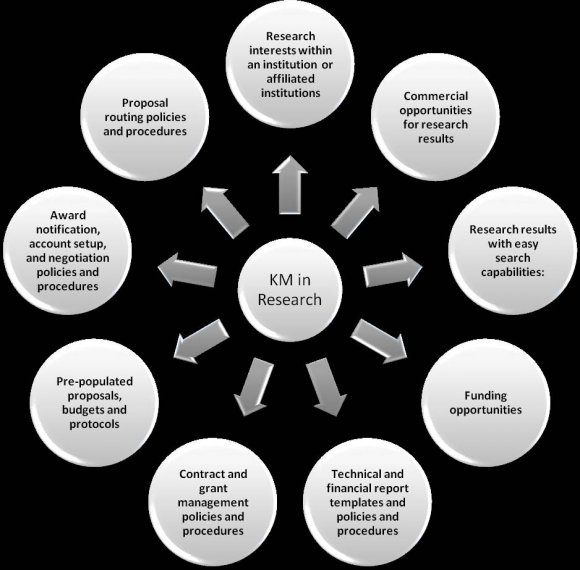
The challenge is to design a customized, yet flexible infrastructure that supports both individual and collective learning so the organisation, whether a corporation of a university, can adapt to discontinuous change in its operating environment. (Cronin and Davenport, 2000) The academic community has been collecting tacit information for years. This tacit information is what one person argued is so valuable to be lost. However, for the most part, these have been "tools" or "aids" that are created by the individual, and this information is not systematized, and certainly not available to a broader community.Knowledge management can play a vital role to acquire, store and disseminate knowledge for the research process in higher technical institutions if implemented. It can be helpful to the novice if the following features are incorporated in knowledge management system:
1. Research interests within an institution or affiliated institutions : Every institution has particular areas in industry links and collaboration are crucial for the efficiency of that process. The list of subjects in which the IHTE is willing to sponsor projects along with their interest areas should be made available in this section.
7. Research results (where possible) with easy search capabilities :
The list of all the projects undertaken by the research institution is listed in this section.
The novice who wants to start a new research can have an impression of work being done. Thesis, articles and case studies can be obtained from previous research work. Industry can see the kind of research being conducted by the institution and can sponsor it also.
8. Funding opportunities :
The list of all government, non government agencies which are willing to fund the research with their terms and conditions should be provided in this section.
5. Technical and financial report templates and policies and procedures : To save the time and maintain the uniformity technical report templates are provided by the institution which will guide the researcher to prepare his/her report.
6. Contract and grant management policies and procedures : How the contract can be placed and what procedures are to be followed is described.
9. Pre-populated proposals, budgets and protocols :
Newcomers can have assistance from this section to draft proposal.
8. Award notification, account setup, and negotiation policies and procedures : The list of all the accounts and awards and their details are notified. 9. Proposal routing policies and procedures : All the administrative policies related to the proposal routing are encapsulated here which can save precious time of an apprentice.
Research scholars can get a direction/guidance from this section while kicking off new research. All the information regarding initiation of research in the particular institution is compiled. December which it as niche in research. Research interests of a particular institution can be listed in this section.
10. Commercial opportunities for research results :
Universities play a key role in several aspects in the process of industrial innovation, and university-
11. Perceived Benefits of KM for Research in Institutions of Higher Education
To find out if the academia confirm the perceived benefits extracted from the literature, proposed by the think tanks of Knowledge management, a survey was conducted. The perceived benefits considered are: i.
Latest research can give good inputs to improve the curriculum development process
ii.
Quality research at the institution level will cultivate future scientists iii.
Increased competitiveness and responsiveness for research grants, contracts, and commercial opportunities. iv.
Reduced turnaround time for research. v.
Minimized devotion of research resources to administrative tasks. vi.
Facilitation of interdisciplinary research. vii.
Leveraging of previous research and proposal efforts. viii.
Improved internal and external services and effectiveness. ix.
Reduced administrative costs.
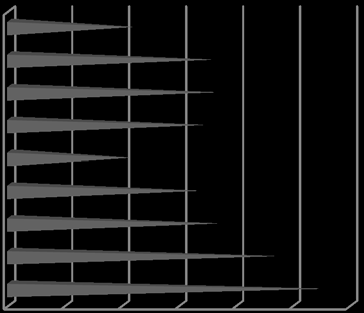
12. Fig. 4 : Perceived Benefits of Research
There was an overwhelming support from the academia for the knowledge management. The mean score of the following benefits have been the highest i.
Latest research can give good inputs to improve the curriculum development process ii.
Quality research at the institution level will cultivate future scientists
13. c) Knowledge Management and Curriculum Development
There is a need for the educational institutions to offer stakeholder, i.e., learners to offer effective learning environment, state-of-art research, dynamic and industry oriented curriculum, which can place them above par. Although there has been a great deal of recognition in the corporate world that information and knowledge management can be vital tools in organizations, now the education administrators and effective learning environment. Higher education institutions have "significant opportunities to apply knowledge management practices to support every part of their mission," explains (Kidwell et al., 2001).
According to Petrides and Nodine (2003) educational institutions however, seem to be working in a more complex way, as these organizations are adaptive and are actually social systems where people co-operate with technologies to evolve processes to achieve common goals. One of the main aims of any IHTE is to impart knowledge to the students in the most efficient way, meet the needs of the students more effectively and improve the outcomes of the students. All of this can be accomplished by developing an ingenious curriculum. Curriculum development is the process whereby values are interpreted and arranged into (Gupta and Earnest, 2008). Curriculum can also be defined as an educational path, when discussing the technical education system (Balu, 1982). provided for the reference in the knowledge management system in the institutions of higher technical education. Reference of contents : All the instructions and help required by the educator to find the references is provided.
Teaching Method : Improve consistency and competitiveness through reduced costs, were seen as being associated with efficiency.
Likert scale. The mean values for the usages were calculated on the following from highest to lowest scale that is from 5 = Very High and 4 = High to 2 = Low and 1 = Very Low.
Perceived Benefits :
? Good curriculum will enhance the research.
? An industry oriented and latest curriculum will produce competent professionals
? PhD. Supervision ? Do's and Don't A survey was conducted to find out according to academia which could be the perceived benefits if Knowledge Management System (KMS) is implemented in the view of curriculum. The academia was asked to rank the following perceived benefits using a 5-point ? Improved responsiveness by monitoring and incorporating lessons learned from the experiences of colleagues, student evaluations, and corporate or other constituent input.
? Interdisciplinary curriculum design and development facilitated by navigating across departmental boundaries. As explained in Fig. 5 top priority has been given by academia to an Industry oriented and latest curriculum will produce competent professionals. This is followed by Good curriculum will enhance the research.
Enhanced faculty development efforts, especially for new faculty was ranked at no. three. Lower ranks have been accorded to Interdisciplinary curriculum design and development facilitated by navigating across departmental boundaries and Improved administrative services related to teaching and learning with technology.
Knowledge is generated within the organization or outside which can be useful. The organization should make an effort to acquire that knowledge. In universities or higher educational institutions, it can be accomplished by dedicating resources to detect and obtain external knowledge. Such teams can focus on research institutions which are the power house of new knowledge. Faculties should be encouraged to participate in project teams with external experts. They can engross their knowledge and can gain from their experience.
The Academia perceives that Research will enhance Curriculum development process. This has the highest rating. This was followed by ability of research in cultivating future scientists. Another perceived benefit rated higher was 'reduced turnaround time for research' and 'facilitation of interdisciplinary research'.
'Reduced administrative costs' and 'minimized devotion of research resources to administrative tasks'.
V.
14. KM BASED FRAMEWORK FOR RESEARCH AND CURRICULUM DEVELOPMENT
On the basis of inputs from academia the following framework has been designed for enhancing research and Curriculum in IHTE.



| ? To identify the perceived benefits of KM for | |||
| Curriculum development. | |||
| ? To identify the perceived benefits of KM for | |||
| Research. | |||
| ? To propose a framework for KM Portal for research | |||
| and Curriculum Development | |||
| III. | RESEARCH DESIGN AND | ||
| METHODOLOGY | |||
| a) Research Design | |||
| The study uses a descriptive design. | |||
| b) Sample | |||
| The universe of the study is the IHTE in India. | |||
| The study has taken top institutions covered by AC | |||
| Nielson, India Today (2009) based on their rankings. | |||
| The questionnaire were sent to 100 institutions / | |||
| Universities but 40 were returned and out of these forty | |||
| questionnaires from | twenty eight Institutions/ | ||
| c) Research Tool | |||
| Data has been collected through a survey | |||
| based on questionnaire based on Likert scale and | |||
| supported by personal interviews. The questionnaire has | |||
| been designed according to the following research | |||
| objectives and it contains these sections: | |||
| i. | KM Technologies and IHTE | ||
| ii. | Benefits of KM based portal for Research | ||
| iii. | KM Portal for Curriculum Development | ||
| iv. | Factors of KM based portal for research and | ||
| Curriculum development. | |||
| The questionnaire has been tested for Reliability | |||
| and Validity. | |||
| S. No. Factor |
| learning experiences (Wiles and Bondi, 2006). Richards | |
| (2001) describes curriculum development as "the range | |
| of planning and implementation processes involved in | |
| teachers have begun to look at how they might use | developing or renewing a curriculum". Curriculum is a |
| knowledge management to assist in creating an | total plan for learning. All plans consist of a vision that |
| interprets societal needs and a structure that translates | |
| those values into learning experiences for learner |