1.
The Nexus of Perceived Organizational Support, Job Satisfaction, Job Motivation on Turnover Intentions of Pharmaceutical Sales Executives using Structural Equation Modeling
Abstract-In developing countries, there is arguably little or no research study done to evaluate the outcome of path analysis of Job satisfaction (JS), Job motivation (JM), Perceived organizational support (POS), and Turnover Intentions (TIs) on sales professionals in the pharmaceutical marketing industry, using structural equation modeling techniques (SEM). The objective of the study was to evaluate the direct and indirect effects of the relationship between Job satisfaction (JS), Job motivation (JM), Perceived organization support (POS), and Turnover intentions (TI). TI was operationalized as an Intentionto-leave firm for another in the same Industry (TWI) and Intention-to-leave industry entirely (TWO). A cross-sectional study with self-administered questionnaires to pharmaceutical sales executives using random sampling. 406 out of 500 questionnaires were received (81.2%). Results revealed positive relationship existed between JM and JS (p<0.01, ?=0.394), POS and JS (p<0.01, ?=0.422), TWI and TWO (p=0.046, ?=0.124). JS and TWO (p=0.015, ?=-0.178), POS and TWI (p=0.023, ?=-0.235) produced negative relationships. TWI fully mediated the relationship between JS and TWO (? =0.002, p=0.05).TWI was a partial mediator between POS and TWO (?=0.029, p=0.003). Employees in multinational firms showed a negative relationship between JS and TWI (?=-0.224, p=0.016), compared to Indigenous firms (?=-0.093, p=0.227). Indigenous firms showed significant relationship between POS and TWI (?=-0.235, p=0.023) compared to multinational firms (?=-0.082, p=0.495). Total years of industry experience (TYE) revealed negative relationships with JS (?=-0.084, SE=0.041, p=0.043), and POS (?=-0.114, SE=0.035, p=0.002). Lower TYE predicted higher JS. The study suggests employee-centered policies to support JS, JM, and minimize TI.
Keywords: job satisfaction, job motivation, perceived organization support, turnover intentions, structural equation modeling, pharmaceutical marketing, human resource management.
2. Introduction
any studies have been done on employeremployee relationships in organizations, bordering on Job satisfaction (JS), Job motivation (JM), perceived organization support (POS), and turnover intentions (TIs). It is common knowledge to human resource managers that the employee is a focal resource of an organization as it seeks to achieve its corporate objectives. [1][2][3] Several human resource management (HRM) studies have examined the hypothesized causal and correlational relationships between Job satisfaction (JS), Job motivation (JM), perceived organizational support (POS), turnover intention (TI), and Job performance (JP) within the domains of organizational support theory. [4][5] POS was derived from the concept of organizational support theory (OST) propounded by Eisenberger et al., (2001) on the basis that there exists an exchange of good faith between the employee and organization/employer when there is an exchange of value as perceived by the employee. [6,7] POS is associated with enhanced employee retention/stay, improved satisfaction, and commitment. [6,8] (Some attributes of POS include; remuneration rates based on industry standards, training & development opportunities, marketing support, job security as perceived by the employee, incentives and reward for performance, and career growth opportunities. However, the employee's perception of these attributes influences their estimation of support from management. [9,10] However, research studies have identified POS as a precursor for employee motivation and JS. [11] Several studies have shown no relationship between POS and JM. [10,12] However, some studies have suggested that a strong relationship exists between JS and POS [6][7][13][14] Job satisfaction (JS) is a positive state of mind of an employee towards/with their jobs. JS tends to improve employee retention and supports positive behavioral tendencies in the workplace. The higher an employee's level of satisfaction implies better motivation and job performance. [15][16][17] JM as a concept, has been extensively explored in several research studies and is an essential element that drives an employee to pursue organizational goals in the workplace. [18,19] JM is also an ongoing concern in organizations and is known to be a precursor/driver of overall employee performance. [20,21] An attractive incentive structure is also known to drive motivation in employees. [22] JM conceptually refers to the drive either internally or externally that enables an employee to perform his given tasks maximally. JM is an important stimulant for satisfactory Job performance (JP). [23] TI refers to the chances, probability, or possibility of an employee leaving the organization. [24] Although many reasons may be responsible for this intention, it is linked to the overall welfare structure provided for the employee, which may or may not delay actualization. [24,25]. Predisposing factors for TI include; negative work stress, low JS, low JM, uninspiring remuneration/salary, the influence of demographic factors, delayed prospects for promotion or career progression. [24] In present work environments, firms are in constant flux as far as motivating and retaining employees are concerned in the pharmaceutical marketing industry. This is essential for maintaining consistency, keeping productive employees, and competitiveness in the given industry. Studies have shown that decreased work output and productivity are linked to a lack of motivation among employees. [6][7]26] To the best of our knowledge, no study has examined the overall relationship between JM, JS, POS, and TI within the pharmaceutical sales and marketing industry in a developing country like Nigeria, using structural equation modeling techniques. The focus of this study was to evaluate industry attractiveness to employees involved in drug marketing and distribution in Nigeria.
3. II.
4. Methods a) Study setting
The research study was conducted in Nigeria. Nigeria is a developing country with a growing population of over 200 million residents with a landmass of 923,768 km2 and is arguably the most populous African Country. [27]
5. b) Study design
A cross-sectional, quantitative research study that used literature-guided questionnaires administered to field medical and sales professionals across the six geopolitical zones in Nigeria.
6. c) Eligibility Criteria
A cohort of pharmaceutical sales and medical representatives operating in Nigeria were sampled for the study. They must work for either multinational or indigenous pharmaceutical companies. Also excluded were Independent sales representatives and freelancers. This criterion is based on the assumption that employees from both multinational and indigenously owned pharmaceutical companies have an organized sales and human resource structure or departments.
7. d) Sample population and Sample size determination
The population consists of all pharmaceutical sales representatives in Nigeria. The sample size calculation was determined using the Raosoft sample size calculator. Also, sample size determination for the study applied a 5% margin of error and 95% confidence level. [28]The sample size obtained was 377 from a sample population of more than 20,000 sales and marketing professionals across the six geopolitical zones in Nigeria. The targeted sample population of 20,000 was used in this study because the estimated sample size does not change significantly for a population greater than 20,000. This computational approach was used because of the absence of a central database of pharmaceutical sales and marketing professionals in Nigeria. [
8. 29]Sampling technique & Data Collection
The random sampling method was adopted for the administration of the questionnaires in the study.
9. e) Design of Questionnaire
A structured questionnaire was developed based on an extensive search of relevant studies and from experts in pharmaceutical marketing. The questionnaire was composed of two sections; Section A consists of individual and occupation-based demographic variables. Section B consists of discrete choice questions.
Path Analysis of study variables using AMOS SPSS
10. Measures of Study Variables
11. b) Job satisfaction (JS)
This was measured using both a single-item on a dichotomous scale to determine overall satisfaction; 'Are you satisfied with your present job?' similar to studies by Scarpello &Campbell (1983), and Mann et al., (2020). [6,31] c) Turnover Intention (TI) TI was measured using a dichotomous scale (yes or no) to two questions; 1) Intention to leave organization to another organization in same Industry (TW1), and 2) Intention to leave the pharmaceutical industry for another Industry entirely (TWO) if the opportunity arises respectively. [24,25]
12. d) Perceived Organizational Support (POS)
POS was computed from responses to five (5) questions graded on a 3-point Likert scale. It was from a survey tool that was adapted from Eisenberger et al., (1986) [8] with the internal consistency of 0.829 (Cronbach alpha coefficient) for 5 items constituting POS (availability of work tools, career prospects, reward system, incentive structure, and marketing support)
13. e) Control Variables
In this study, demographic variables such as; marital status, qualifications, gender, years of experience, and age of respondents were used as control variables. This was done to avoid confounding effects of these variables on the outcomes of the path model. [6] f) Occupational Demographic Variables
In the study, the type of firm and total years of experience in the pharmaceutical industry were respectively used as independent variables to test their impact on POS, JM, JS, TWO, and TWI.
14. g) Data Analysis
Data were analyzed using IBM Statistical Package for Social Sciences version 25 and Analysis of Moments Software (Amos-23). Descriptive statistics such as mean, standard deviation were used to describe demographic data. Inferential statistical measures were performed using SPSS AMOS-23.
15. h) Test for Mediation (Indirect effects)
Mediation tests of each path of the path model were computed using the bootstrapping method with 5000 samples with replacement with bias-corrected confidence Intervals of 95% in SPSS Amos. Statistically significant mediation effect was confirmed by the absence of absolute zero between lower confidence interval (LCI) and the Upper confidence Interval (UCI) values.
16. Global Journal of Management and Business Research
17. i) Study Hypothesis
The hypotheses of the study as stated in the null were as follows:
1. There is no direct effect between the independent and dependent variables in the path model-H1 2. There is no mediation effect of JS &TWI, in the interrelationship between POS, TWI, TWO, JM, and JS in the path model (mediation effects)-H2 3. There is no difference in paths between employees in indigenously owned pharmaceutical firms and multinational firms (Multi-group path analysis)-H3 4. There is no effect of total years of experience (TYE) in Industry on the relationship between POS, JS, JM, and TI.-H4
IV.
18. Results and Discussion
19. a) Demographic Characteristics of Respondents
A total of 406 valid responses were collected out of 500 questionnaires distributed, representing an 81.2% return rate; this was above the calculated sample size of 377. Hence the dataset was adequate for further analysis. The majority of respondents were males (n=293, 72.2%) compared to females (n=113, 27.8%). A significant proportion of respondents were from indigenously owned pharmaceutical companies (n=249, 61.3%) and the remaining from Multinational pharmaceutical companies (n=157, 38.7%). A minority of respondents (n=16, 3.9%) and (n=2, 5%) were aged between 20 to 25 years, and greater than 50 years respectively. The bulk of respondents (n=355, 87.5%) were within the age bracket of 26 to 40 years and a cumulative 8.1% (n=33) were aged between 41 to 50 years. In terms of years of experience in the present place of employment, 68 (16.7%) respondents representing had less than 1-year work experience. 316 (77.8%) had a cumulative experience of between 1 to 10 years. 20 (4.9 %) had between 11 to 20 years' experience and the least represented (n=5, 1.2%) had less than 20 years of work experience. Also, Total Industry experience had a mean value of 2.53 (SD=0.86) years of experience compared to a mean of 2.19 (SD=0.82) for years spent in their present companies. The salary grade per year of respondents was $1,000 (n=120, 29.6%), $3,000 (n=230, 56.7%), $5,000 (n=40, 9.9%), $6000 (n=9, 2.2%), and greater than $7,000 (n=7, 1.7%) respectively.
20. b) Model fit characteristics of Path Model
To achieve an optimum fit to test for the hypothesis of the mediation model, several adjustments to fit parameters were performed in other to achieve a proper model for the study. Final model produced the following values; chi-square X2=0.516 (cut-off=>0.05), GFI=0.999 (cut-off=?0.95), AGFI=0.990 (cut-off=?0.95), CMIN/DF=0.421 (cut-off=<5); TLI=1.035 (cut-off=?0.95), NF1=0.998 (cutoff=?0.95), RMR=0.006 (cutoff=<0.08), RMSEA=0.001 (cutoff=< 0.08, and CFI=0.999 (cutoff= ?0.90). The final measurement model suggests that Turnover Intentions expressed as TWI & TWO, POS, JM, JS are suitable constructs for further analysis.
21. c) Path Analysis of Final Measurement Model
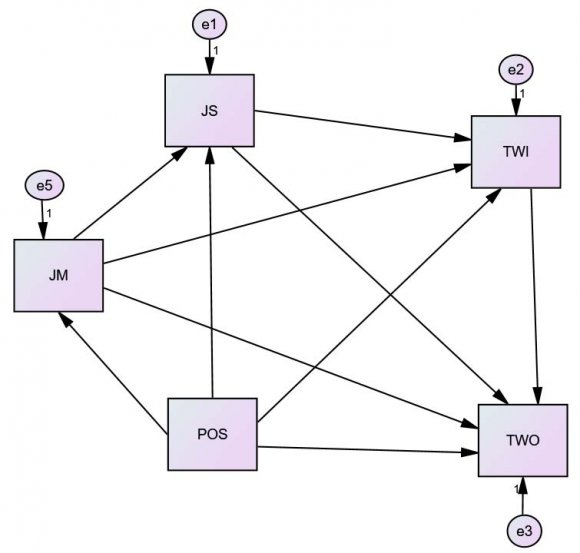
The model revealed five (5) 1 showed that Path A expressed as JS mediating the relationship between IV (JM) and DV (TWI). Path B showed that JS is a mediating variable between the predictive relationship between POS and TWI. Path C showed that TWI served as a mediator between JS and TWO. Path D showed that the relationship between the independent variable POS and the dependent variable TWO. Finally, Path E showed the hypothetical relationship between POS and TWO under the mediating influence of TWI 2, showed that a significant positive relationship existed between JM and JS (p<0.01, ?=0.394), POS and JS (p<0.01, ?=0.422), TWI and TWO (p=0.046, ?=0.124). JS and TWO (p=0.015, ?=-0.178), POS, and TWI (p=0.023, ?=-0.235) respectively produced significantly negative relationships. Also, nonsignificant negative relationships existed between JS and TWI (p<0.227) as well as a non-significant positive relationship between JM and TWO (p=0.724), JM and TWI (p=0.782). The positive relationships between JM and JS showed that as the employees' motivation increases, their level of satisfaction with their jobs also increases. In the same vein, increased POS leads to higher satisfaction with Job. This finding is supported by research studies done by Maan et al., (2020) and Alcover et al., (2018) in which significant relationships were obtained. This study showed that the more the turnover intentions of an employee to exit the present company to another company in the same industry (TWI), the higher the intention to exit the pharmaceutical industry entirely (TWO). These results are in harmony with the findings of other studies. [24,32] The negative, inverse relationship between JS &TWO, and, POS & TWI in the study imply that lower satisfaction levels increase the intention to leave the industry entirely. This showed that the level of industry attractiveness for field staff improves as steps to improve JS are implemented. This consequentially leads to higher employees' retention and improved competitiveness. [33,34] This inference holds or is valid when the welfare of staff is optimal as revealed by a positive relationship between POS and TWI. Therefore, the alternate hypothesis that direct effects exist between study variables is supported by the study results. Hence we fail to accept the null hypothesis (H1)
22. critical paths shown in Table 1
23. e) Indirect effects (Mediation) among Study Variables
Table 3 showed that significant indirect (mediation) effects only existed in two scenarios; firstly, TWI fully mediated the relationship between JS and TWO (regression coefficient=0.002, p=0.05). Secondly, TWI expressed partial mediation between POS and TWO (regression coefficient=0.029, p=0.003). Other relationships between IV, MV, and DV did not have any statistically significant indirect effects. The study hypothesis was tested on the mediation effects of JS and TWI in the path model. The full mediation observed in the analysis showed that although employees' level of motivation does not influence their likelihood to exit the pharmaceutical industry, the presence of TWI increases the likelihood and intention of the employee to leave the industry. This invariably means that lowered TWI, imply lowered TWO (p<0.05; ?=0.124). Furthermore, partial mediation effect occurred due to the mediation effect of TWI on the significant relationship between POS and TWO. In other words, the effect of decreased POS on the increased tendency for the employee to exit is further exacerbated when there is an existing intention to leave the company for another company in the pharmaceutical industry. [1,24]The study outcomes in testing the null hypothesis (H2) showed that the null hypothesis was accepted for Paths A, B, and C whereas failed to accept the null hypothesis for Paths D and E where full and partial mediation occurred respectively. 4 shows comparative path analysis between Indigenous and multinational firms concerning the relationship between study variables using statistical tools. [35] The results showed that employees in multinational firms have a negative predictive relationship between JS and TWI (?=-0.224, p=0.016) compared to those from Indigenous firms (?=-0.093, p=0.227). The Z-score difference obtained was 1.089 below the mean. Also, employees in Indigenous firms showed a significant negative relationship between POS and TWI (?=-235, p=0.023) compared to those from multinational firms (?=-0.082, p=0.495) with a Z-score difference of 0.967 below the mean. This finding suggests that field staffs in indigenous companies tend to show lower levels of POS. And consequently, higher levels of TWI compared to those from multinational companies. This finding suggests the need for indigenous companies to incorporate some relevant human resource policies of multinational companies. In the same vein, employees in multinational firms showed a higher tendency (?=-0.224, p=0.016) to change jobs within the same pharmaceutical industry when they experience low levels of satisfaction with their jobs compared to employees from indigenous firms. (?=-0.093, p=0.227) Hence, it presupposed that the intraindustry turnover intention depicted as TWI may be linked to feelings of slow career progression, concerns about job security amongst others. This finding is supported by other studies. [32]The null hypothesis (H3) was thereby rejected based on the presence of statistically significant differences between Indigenous and multinational firms in the multi-group path analysis. 5 showed the predictive relationship between Total years of experience in Industry (TYE) with JM, JS, POS, TWI, and TWO. Significant relationships only existed between TYE and JS (?=-0.084, SE=0.041, p=0.043), and TYE and POS (?=-0.114, SE=0.035, p=0.002). These results highlight the possibility that the lower the total years of experience in the industry, the higher their level of Job satisfaction. This inference suggests that staffs with longer lengths of stay tend to show higher levels of dissatisfaction with their jobs. This may be as results of poor career progression, work fatigue, lower than anticipated remuneration. [36][37][38]Hence, the study suggests that job role improvements and management responsibilities would improve JS in this category of employees. This finding is in line with a study by Maan et al., (2020) [6]that identified that POS needs differ among employees. [39] The null hypothesis (H4) was also rejected due to the presence of statistical differences in the path analysis. The model presented in this study has simplified the relationship between POS, JS, JM, and TI (operationalized as TWI and TWO) and also depicted several interacting scenarios in the pharmaceutical marketing industry. The key objective of the study was to simplify by evaluating the complex relationships between POS, JS, JM, and TI (expressed by two constructs; TWI and TWO) to highlight the impact on the HRM of field force employees in the pharmaceutical sales and marketing industry in Nigeria. The study outcomes improved our understanding of the factors influencing intra-and inter-industry attractiveness to pharmaceutical marketing employees. Based on the results of this study, there are, however, implications for HRM in the pharmaceutical marketing industry.Firstly, there is the need for operational managers to ensure that the work environment and tooling are optimal for the field staff. Therefore, it reduced the tendency for increased work dissatisfaction and turnover intentions. Secondly, indigenously owned firms need to adapt and incorporate advanced human resource policies from multinational firms. The theme of this research work is to add to the existing literature on the impact of demographics, JM, and JS on pharmaceutical sales staff in the pharmaceutical distribution space in Nigeria. Moreso, this study provides a template with which strategic and policy managers can formulate policies that will create more enabling work \environments for the industry.
24. The causal relationship between Total years of experience in
The study addressed the issue of comparative analysis of relationships between JS, JM, POS, TWO, and TWI in the light of privately owned indigenous firms versus multinational firms; the results revealed that employees in indigenous firms tend to consider organizational support (POS) as very critical to informing their decision or willingness to leave one firm to another within the pharmaceutical industry. This assertion is, however, not the case with employees in multinational firms. This significant difference in perception may be assumedly associated with a better working environment and developed human resource management systems. [34,[40][41][42] This calls for increased incorporation of HR principles available in multinational companies.
V.
25. Conclusion
This study adds to the existing literature on HRM in the pharmaceutical marketing industry as it throws more light on the complex interrelationships between POS, JS, JM, and TI as they affect the field sales and marketing workforce. This study is relevant based on high employee turnover rates prevalent in the pharmaceutical industry. Outcomes of this study will shape how management in companies formulates their personnel policies to support employee retention and job satisfaction. Therefore, industry attractiveness to employees can be enhanced by improving or employing measures to enhance employee motivation or a sense of belonging. This study is relevant to an international audience as it highlights the use of structural equation modeling techniques to improve understanding of the factors influencing Intra and inter-industry turnover decisions within the context of the pharmaceutical marketing industry in a developing country.
26. Limitations of the study
There were several limitations to the study. Firstly, the study addressed the human resource needs of pharmaceutical field staff; hence there is a need to assess the study variables to other stakeholders in the sector. Secondly, the study design used was crosssectional, hence it is suggested that a longitudinal approach is applied to evaluate the study constructs and variables. Thirdly, apart from the type of firm and total experience in the industry, demographic variables such as age, gender, work experience in the present company, and salary cadre were not included in the analysis due to the possibility of confounding effects on the study outcomes.
| Path Relationships |
| Dependent Variable | Relations | Independent Variable | Estimate | Standard error | Critical Ratio p-value | Inference | |
| JS | <--- | JM | 0.394 | 0.056 | 7.051 | 0.001 | significant |
| JS | <--- | POS | 0.422 | 0.081 | 5.194 | 0.001 | significant |
| TWI | <--- | JS | -0.093 | 0.077 | -1.208 | 0.227 | not significant |
| Path Relationships | Direct Effect | Indirect Effect | Confidence Interval p-value | Conclusion | |||||
| IV | MV | DV | estimate | p-value | estimate | LCI | UCI | (<0.05) (no, partial, full) | |
| JM | JS | TWI | 0.02 | 0.782 | 0.037 | -0.102 | 0.019 | 0.199 | no mediation |
| POS | JS | TWI | 0.235 | 0.023 | 0.039 | -0.021 | 0.104 | 0.170 | no mediation |
| JS | TWI | TWO | -0.178 | 0.015 | 0.012 | -0.05 | 0.004 | 0.151 | no mediation |
| JM | TWI | TWO | 0.025 | 0.724 | 0.002 | -0.143 | -0.014 | 0.015 | full mediation |
| POS | TWI | TWO | 0.099 | 0.002 | 0.029 | 0.035 | 0.206 | 0.003 | partial mediation |
| Notes: p-value < 0.01; p-value < 0.05, LCI=lower confidence interval, UCL=upper confidence interval | |||||||||
| Path Analysis | Indigenous | multinational | ||||||
| Dependent Variable | Relations | Independent Variable | Estimate | p-value | Estimate | p-value | Z-score | Inference |
| JS | <--- | JM | 0.394 | 0.001 | 0.445 | 0.001 | 0.541 | parity |
| JS | <--- | POS | 0.422 | 0.001 | 0.273 | 0.007 | 1.148 | parity |
| TWI | <--- | JS | -0.093 | 0.227 | -0.224 | 0.016 | -1.089 | multinational |
| TWI | <--- | JM | 0.020 | 0.782 | 0.069 | 0.481 | 0.394 | parity |
| TWI | <--- | POS | -0.235 | 0.023 | -0.082 | 0.495 | -0.967 | Indigenous |
| TWO | <--- | JM | 0.025 | 0.724 | -0.171 | 0.057 | -1.71* | parity |
| TWO | <--- | JS | -0.178 | 0.015 | -0.183 | 0.040 | -0.045 | parity |
| TWO | <--- | TWI | 0.124 | 0.046 | 0.155 | 0.044 | 0.304 | parity |
| Notes: p-value < 0.01; p-value < 0.05, parity=when there is no statistical difference in effects between groups | ||||||||
| Table | ||||||||
| f) Implications of study outcomes on human resource |
| management (HRM) in the pharmaceutical |
| marketing Industry |