1. High-Rise: European Lessons from Management and Maintenance
Paul Van Soomeren
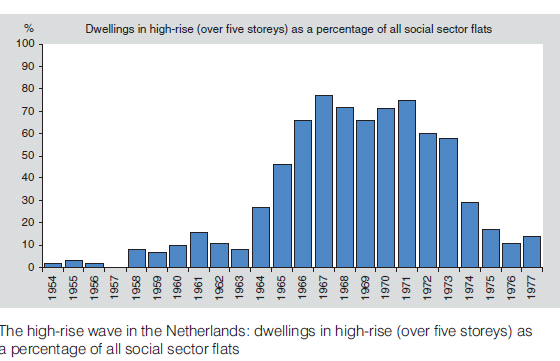
I.The (first) High-Rise Wave igh-rise buildings are extremely popular in Asia nowadays and high-rise seems to regain a new momentum in Europe and the Netherlands. The failed high-rise wave of the 60s/70s of the last century, with the Amsterdam Bijlmermeer as an all-time low, caused an aftershock that lasted for many years. More than two-thirds of the Bijlmer, a high-rise district with 17,000 homes and over 40,000 inhabitants, was demolished (Wassenberg, 2013, Bijlmermonitor, Klundert, 2014, Kleuver & Soomeren, 2009). This "cleanup operation" cost approximately 1.5 billion euro. The dream of individualistic urban developers turned into a nightmare and caused considerable trauma to high-rise buildings in The Netherlaands. (Dekker, 2017). "The Bijlmer is a symbol of a high-rise district where almost everything that could go wrong went wrong from the moment of completion: the accumulation of problem groups, social insecurity, drug nuisance, and limited (financial) support for retail and other facilities. High-rise buildings are etched in Dutch memory as misery." (Gadet, 2018) The Bijlmer was part of the short but powerful high-rise wave in the Netherlands and Europe, as shown in Figure 1:
Source: Turkington et al. 2004 This high-rise wave emerged across Europe in the mid-1960s, but quickly disappeared: "Between 1960 and the mid-1970s high-rise buildings were constructed in all western countries. High-rise estates dominated the building in this era, and these years proved to be the time of peak housing production in the Netherlands and many other European countries. Housing production had to be optimized by reducing the variation in dwelling types, repetition of construction patterns and using new construction techniques. High-rise fulfilled these requirements. (?). In countries like France, Sweden, Germany, Britain and the Netherlands the majority of the high-rise was built as public housing." (Wassenberg, 2006/192) In the literature ( Year 2021 ( )
2. G
Aurhor: e-mail: [email protected] ? Freeing the countryside from urban sprawl as it occurred in the US;
? To meet the demand for better and more spacious housing; ? The competition between municipalities/public housing providers to provide modern housing; ? Government policy that supported radical solutions to solve the housing shortage. The high-rise wave turned out to be a brief belch in the Netherlands -and other European countries as well. But not long after that in Asia, the high-rise wave turned into a tsunami. Perhaps that, and some of the same motives as back in the 60s, caused high-rise buildings to gain back popularity in The Netherlands in recent years. Not without risk, as history shows. Highrise buildings were not a success in Europe, and certainly not in the Netherlands. Maybe we can learn something from the Dutch and European past?
II.3. High-Rise Buildings and Density
Once again, in 2020, the acute housing shortage is an essential motive for building high. It sounds plausible: "we have to accommodate many people in the coming years, and if we build high, we can accommodate more people". Yet this reasoning is far too simple. It is too readily assumed that building high means that many more houses/people fit on a square kilometre: building high = high density. This may be true for Asia, where the 50 or more storey high-rise buildings are close together. And sometimes that is the case with high-rise buildings close to centre/station locations. Yet high-rise buildings and high density in the Netherlands appear to be a rare combination. With all its high-rise buildings, the Bijlmermeer was the district with the lowest housing density in Amsterdam. Alice Coleman (1985) states in her book 'Utopia on Trial' that the assumption "high-rise automatically means high density" is a persistent myth. The high-rise flats are often surrounded by lots of greenery and open space, following the credo "light, air and space". Coleman also points out that high-rise buildings require all kinds of facilities that are often not necessary in low-rise buildings: stairwells, halls, lifts, fire lifts and compartments, galleries, technical/service rooms, shafts, etc.
Partly for this reason, high-rise buildings nearly always cost more than low-rise. In the Netherlands, architect Sjoerd Soeters argues against high-rise buildings and particularly against the new Amsterdam high-rise sold as "Vancouver on the Amsterdam Waterfront". Soeters said about this area: "In the case of a project such as this area, the contradiction of starting points is even more poignant: the plan must mainly consist of high towers, which are also slim because that is beautiful. That is the most expensive building form that can be devised: structural, ratio facade surface/floor area, ratio net/gross, extra costs of fire services, extra costs for installations, extra costs for maintenance installations." (Stadszaken, 2019) And:
"High-rise buildings are like an avocado. As the building gets higher, the wick gets more prominent, and the floor area's efficiency decreases. That even drops from seventy to eighty per cent to fifty per cent. Moreover, our swampy soil is not suitable for high-rise buildings. In Amsterdam, for example, we have to drive piles as deep as 25 and 50 meters deep for high-rise buildings, and then the whole lot is still 'wiggling' on stiletto heels." (De Architect, 2018).
4. III.
CIAM: Light, air and Space in a Functional City
The often low building density in the Netherlands is partly due to the ideas of CIAM (Congrès Internationauxd' Architecture Moderne). CIAM is a group of architects and planners who, from the 1920s to the late 1950s, made their mark on the architectural debate with concepts such as the functional city, segregation of functions (living, working, traffic, recreation) and light, air and space. All this in response to the miserable living conditions and slums of the 19th century (Woud, 2010). Or as Le Corbusier put it in his Athens Charter (1933):
The quote is a plea for high building in very low (!) density. High-rise buildings in a sea of public greenery. The well-known architect and MIT professor John Habraken finds that there is often too much public space with poor visibility/control. Maintenance and social safety are often appalling (Habraken, 2000). "We have drifted away from territorial patterns so that we tend to maximize public space, ignore territorial boundaries. We have forgotten how to treat territorial edges, and we do not like gates. The territory is established by giving control to inhabitants. " (Habraken, 2003) Others support Habraken in his harsh judgment: Jacobs, 1961; Newman, 1972and 1980, Kube, 1982, Soomeren, 1989;Soomeren et al., 2014. The CIAM ideas may have been an excellent response to the 19th-century slum woes. Still, the emphasis on low densities in combination with high buildings in particular often turns out badly nowadays, because that (public) space requires a lot of cost-CIAM 29 (recommendation): "High buildings, set far apart from one another, must free the ground for broad verdant areas. Indeed, they will have to be situated at sufficiently great distances from one another, or else their height, far from being an improvement of the existing malaise, will actually worsen it; that is the grave error perpetrated in the cities of the two Americas. (?) a city (?) population density must be great enough to justify the installation of the communal facilities that will form the extensions of the dwelling.
Once this density has been determined, a presumable population figure will be adopted, permitting the calculation of the area to be reserved for the city."(Modernist Architecture, 2010) increasing maintenance, is challenging to control and oversee, resulting in poor social safety. High-rise in itself does not always have to be or become problematic (Aquilué and Stummvoll, 2015, Soomeren et al. 2014 and2016), but those who want to build high do start with a 5-0 disadvantage: 1. High-rise buildings are expensive, 2. Less suitable for families with children, 3. Certainly in the increasingly extreme Dutch climate, 'windier' and therefore less pleasant, 4. It has more semi-public space which often leads to (inter-ethnic) conflicts and hassle (Crul et al. 2020), 5. And a poorly monotonous design -for example, a dead plinth full of storage areas -often results in crime and fear of crime (Soomeren, 2013), especially if the spaces between the buildings are large, green and unclear (Korthals Altes, 1987). It is certainly not just a question of how high a building is, many more variables are important, but planners and architects rarely have a good sense of what these are. If you want to build high, you often have to sit on the expensive management blisters.
Nowadays-similar to the Asian high-rise-we built differently: no more gallery flats but a large parking garage with a high-rise building on top of that. The individual apartments are directly accessible from the garage with lift and staircase that connect to 2 or 4 flats per floor.
There is often still a fence around a complex of high-rise towers with a security guard, barrier, and automated number plate recognition (ANPR). Contacts in the building between neighbours are often limited (at most per floor or sometimes in the elevator). Moreover, such a building/complex is not part of the city; it is not part of the urban fabric. In principle, this type of building forms a "gated community". Incidentally, this is a form of housing that enjoys increasing popularity worldwide (Glaze et al. 2006). For that "Desire for security and fear of crime" is often an important argument.
Interestingly enough, criminals also like to settle in such communities. You see the enemy approaching from afar, and you are-if you want-completely anonymous. You can arrive and leave unseen by car. That social isolation is not a soft concept shows Eric Klinenberg (2002) in his book Heat wave. People living anonymously with little contact with family and neighbours, experience -sometimes deadly -problems in an extreme crisis (heat wave, pandemic). Nobody sees, knows or helps them.
5. IV.
6. Learning
Have planners, architects, public housing providers, and investors learned anything from the past management experiences -particularly in Europe -of the first wave of high-rise buildings?
Learning through structural evaluation proves difficult in the world of urban planning, architecture and design since the problems pop up later in the management and maintenance phase. Or as one Dutch planner pointed out: "we never learn our lesson, we should, but we just don't take the time to reflect". And even if some planner or architect does learn from the design errors, it often remains implicitly in the head of that one planner or designer. There is no structural retrospective evaluation-learning from management& maintenance-that shows us the lessons we need to know for the future. (Soomeren et al., 2014/65) Only the beautiful sunny image with that one smiling young family with cheerful children in summer clothes lasts upon completion in the architecture magazines.
"After nearly a hundred years of renewa linar chitecture an durban building it may beacause for wonder that the unacceptable inner-city forms which were then rejected (PvS: by the CIAM adepts) have become an inspiration forurb an planners in their search for new diversity and shapes in the compact city. It illustrates the temporary blindness that invariably accompanies revolutionary ideas. While innovation sometimes leads to improvement it is nearly always also coupled with rejection of what was essentially valuable and needed to becherished. " (Zimmerman, 2007) With the "search for new diversity and shapes in the compact city", Zimmerman refers to American critics such as Jane Jacobs (1961), Lewis Mumford (1961) and Christoffer Alexander (1977). Or in Europe Jan Gehl (2010) and recently in the Netherlands Foor Milikowski (2018). Academics and practitioners who stood up against megalomaniacal and monotonous urban renewal. Critics that consider issues such as diversity, view of the street, mixing of functions and the human scale more important than buildings and their form. Perhaps panners and authorities in Asia still find that human scale and diversity is not that important (Yuen & Yeh, 2011) and undoubtedly we in the Netherlands -in all haste to build a lot and high -forget the past lessons. Still, perhaps we should try to reflect more seriously on lessons learned in the past and learn from management and maintenance.