1. Introduction
t is obvious that over the last few decades, ICT has seen a significant growth. Simultaneously the modes of business the modes of business operations have become overly complex with higher functional integration. Thereby, management decision making has become more complex and more data oriented. In this context, efficient information systems that inter-relate all business functions such as finance, logistics, and production are obligatory and further, accurate and timely information is considered a key for winning the competitive advantage. The purpose of this research is, either through the review of literature on the topic, or via the case study, examine how an organization is a mixture of both ERP and non-ERP application benefit for performance in a positive curve in a business model. One of the most important characteristics of ERP systems is that they are built on a single comprehensive database to share information across the enterprise. ERP system integration, on the internal side, can be assumed to be complete and comprehensive. Further, if the ERP systems covers all your information management needs, and there are no external systems or applications in place or planned, integration should not be a concern. An ERP system is an integrated software system package composed by a set of standard functional modules such as Financial, Sales and Marketing, Purchasing, Production, Inventory, Human Resources etc... Developed by the vendor, that can be adapted to the specific customer needs. (Elragal and Haddara, 2012).
The integrated process framework provided by ERP enables standardization, visibility, traceability and controllability over the business. A successfully integrated ERP system can improve operational efficiency by supporting a firm's business processes as well as create competitive advantage by enabling pioneering practices. (Albadri and Abdallah, 2009)).The Global ERP market grows 7 % annually through 2009 and to become from $8.8B in 2004 to over $12B in 2009. Even though the demand for ERP applications rising, failure rate of ERP applications is remaining high and according to survey conducted by Robbins-Gioia LLC, a leading provider of management consulting services found that 51 % of companies across a wide range of industries stated that their ERP implementations were unsuccessful. Sri Lanka has experienced ERP systems for nearly two decades, and it is observed that several Sri Lankan organizations are still struggling to achieve the anticipated benefit of their ERP implementations.
The emergence of the enterprise resource planning (ERP) software radically transformed the computing platform of most organizations (Haddara and Hetlevik, 2016). One of the ERP systems characteristics is the ability to automate and integrate organizations' business processes (Ha and Ahn, 2014). However, even though ERP systems were introduced as integrated suites, they have not achieved many of their anticipated benefits while they still co-exist with autonomous and heterogeneous applications (Peng and Gala, 2014). This fact indicates the importance and the need for applications integration and justifies the recently large number of publications examining integration technologies. (Claybaugh et al, 2017) Despite the advantages, ERP implementations have a nasty reputation for going over time, over budget, and underperforming. There are several examples and many reasons why. Let's look at a few of the reasons ERP software implementations go over time, over budget, and under perform. One issue with implementing an ERP system is, knowing what should be integrated, and what should not. It is difficult to know where integrating systems in an organization can gain a competitive advantage and where it will hinder the organization's workflow. This becomes even more complicated in a large organization where different business divisions view each other as competition, or good old-fashioned office politics gets in the way. The challenge this adds with ERP implementations is that decision makers often do not know fully what the ERP system is capable of when they are planning the system, and these decisions and goals need to be decided on in the beginning.
The biggest problem by far though with ERP implementations comes from not having well-defined measurable goals and objectives at the outset of the project as well as a process in place for adding to or changing these goals. Many projects, not just an ERP implementation, have failed because of this. One of the most often misunderstood issues with most ERP systems is that they typically require extensive customization. Often what a company is buying is not a packaged solution, but a framework with which to build a solution. When decision makers do not ask the right questions and do not appreciate these two factors, projects are delayed and experience cost overruns.
Another issue that is often a problem is that an ERP system that is not flexible may force an adopter to change their business processes to fit the ERP system model. This requires a re-engineering of steps needed to complete business tasks and a retraining of employees and business partners; and sometimes even customers. As we all know people inherently do not like change, and this will create resistance and delays for any organization (at least in the short term). Despite these challenges, ERP is a resource that is here to stay and can significantly improve an organization's workflows, business, and decision making. Doing it right though is worth the extra effort.
Although integration success in ERP implementations is questionable, ERP system functionality and integration greatly improved over the last decade by incorporating specific industry solution. In addition, integration capabilities with third party non-ERP systems increase system functionality, flexibility and integration, supporting streamlined business processes. This research reports on a case study aiming at describing and evaluating the integrated operational and financial system implemented at a group company utilizing an ERP application and non-ERP systems. Serendib Group is presently implementing, Oracle E-Business Suite ERP application, for few of its subsidiary companies, and plan to extend the ERP system to other subsidiaries also. Though the organization has implemented a sophisticated ERP application, they had to implement some non-ERP application also to fully automate their entire operation and needed to integrate both the ERP and non-ERP application to get a maximum benefit of the automation. At the present implementation they face lot of challenges in integrating the ERP system with existing and newly developed non-ERP system. Hence, this understanding would make them more committed and would make them to provide more support in the future ERP implementation.
2. II. Methodology a) Conceptual Framework
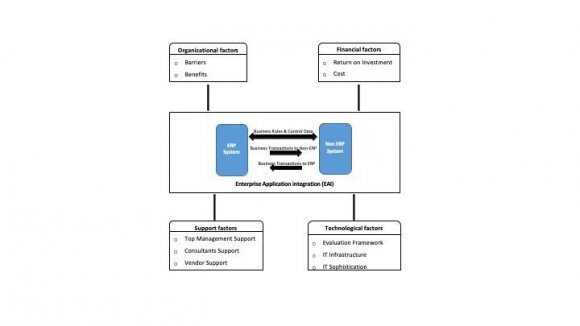
Researcher has developed the following conceptual model based on the literature review and discussions with experts (Figure 1). The case study technique was selected as the methodology for the research. Case study is now accepted as a preferred research strategy within the IS research community (Haddara and Moen, 2017). A series of well-known research investigations have used the case study method to develop and support a range of IS hypotheses and Yin has provided the guidelines to follow for case study researchers (Seethamraju, 2015). Case study-based researchers are aligned more towards practically, which may suggest more relevance for practitioners. The natural setting gives case researcher the opportunity to conduct situational and indepth studies of complex phenomena that is not always possible due to the restrictions on studies conducted using laboratory conditions.
3. c) Questionnaire
Questionnaire has been designed in English, and the questions are driven from the observation and literature review of the researcher and the discussions had with consultants and research supervisor. The structure of the questionnaire has divided into three parts, and the parts are as follows. Part A: Need for both ERP system and Non-ERP system; This part is constructed to identify the objectives of the companies to implement an EPR system, and to identify the needs to implement a non-ERP system as well to the same organization. This part will find out the major benefits and drawbacks of the ERP system from their own business point of view and will ensure that there is a real business need for another non-ERP application. Part B: Challenges faced during the integration of ERP system and Non-ERP system. This part is constructed to identify the various challenges faced during the integration of the ERP system and the non-ERP system and how did they manage to overcome from those challenges. Part C: Benefits of the integration, this part is constructed to identify the ultimate tangible, intangible and monetary benefits achieved by the implementation and integration of both ERP system and non-ERP system. The work of this research was intended to answer questions that initially arose. These issues defined how the problem was approached and led the search for answers to the achievement of the objectives. The following are the questions that guided this research.
4. III.
erp System and Non-erp System Integration: Challenges & Benefits Why there is a need for both ERP system & non-ERP system? 1. What were your main reasons to go for an ERP system? 2. What are the benefits you were expecting from the ERP system? 3. Did you achieve those benefits? (if No, go to question 04) 4. Why do you think, that you could not achieve those benefits from the ERP application? 5. Did you consider customizing ERP application to suite your requirement? 6. Did you consider re-engineering your business process to suite world best practices of ERP? 7. So, did you require a customized application to full fill those gaps? 8. Did the customized/tailor make application full fill the expected benefit? / did it fill the gap? 9. Did it require to integrate the tailor-made application with ERP application? Why? What are the challenges when integrating? 10. Since the both applications are from two different vendors and uses two different technology, did you
5. Global Journal of Management and Business Research
Volume XX Issue X Version I Year 2020 ( )
Aexperience any difficulties in integrating both application? 11. Did both vendors supported well for the integration? 12. Did you ever require your senior management involvement to solve any issues? 13. Was the data transfer between both system smooth or have you faced any issues? 14. What would you say the key challenge for the integration of ERP system and non-ERP system? 15. How did you overcome from that challenge? 16. What are the benefits of the integration of ERP system and non-ERP system? 17. What were benefits you were expecting from the integration of the both application? 18. Did you achieve those benefits? 19. Do you see any tangible benefits from this integration? Any cost cutting or profitability increase? 20. Do you able to get a management information report easily now? 21. Does your management happy about the implementation of the both system and its integration?
6. a) Business Rules and Control Data
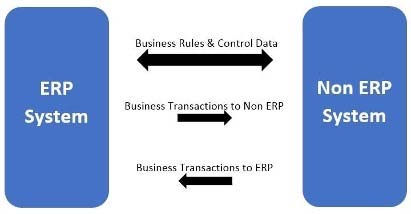
Business rules and control data, which defines or constrains some aspect of business and always resolves to either true or false. Business rules are intended to assert business structure/logic or to control or influence the behavior of the business model of any given business function. This rule is defined to control the information flow and management of the information inside the ERP system, and non-ERP system. Hence, this rule needs to be shared between the both applications to have seamless integration between the both applications.
7. b) Sampling
The sample selected should represent the population in unbiased manner. By studying the sample, the researcher should be able to draw the confusions that would be generalized to the interested population. However, presently only two companies have implemented the ERP and non-ERP system within the group. Serendib Group is a diversified group of company in Sri Lanka, manages one of the nation's most successful diversified blue-chip portfolios spanning into the following different industries. Therefore, the researcher will conduct interviews from both the companies key resource persons. The key objective of the research is to make the Serendib Group management to understand the importance of the ERP system and Non-ERP system integration and strategic benefits what they would gain from the integration. Hence, the sample should represent the senior management interest also. Therefore, the sample for the research has been categorized and identified as follows. These are the people at the management level, who actively involves in process designing, resource allocation and decision making. This people will use the systems for reporting and management decision making purposes.
8. c) Data collection
The researcher is part of the group ERP implementation team. Even before the idea of the research come to his mind, he was observing the total lifecycle of the implementation of ERP system, non-ERP system and the integration of the both systems. Therefore, starts the research with the observation, and then through the literature review he could find out the relevance of the same concept in other companies. In order to carry out the survey, an open-ended questionnaire has been constructed. Researcher made special emphasis on designing the questionnaire as this is the most critical stage in the research process and the more specific data collected would help the researcher to come to a better conclusion. Good questionnaire design should focus upon three areas; the wording of the questions, the principle of the measurements, the general appearance of the questionnaire (Juell-Skielse and Enquist, H. 2012).
9. IV.
10. Results
In order gain competitive advantage by synergizing all the subsidiary companies, the group management has decided to move into a new model of operating with the concept of share services for the entire group. The group believes that this model of operating would enable the central point of control of all the subsidiary company and eliminate duplication of work and would bring optimum benefits by synergizing the resources within all the subsidiary company. Therefore, the better solution is a hybrid solution of ERP and a tailor-made system. ERP may cover the back-office operation, and the tailor-made system bridge the gap of ERP and business requirement. This solution would reduce the total cost of a fully integrated application. This ERP system enhance the process and optimize the process to reduce the cost, by eliminating manual and non-value adding activities which incur additional overhead cost and time to the company. This helps to discontinue the legacy and isolated system and to come up with an integrated solution to manage all the companies in one platform and one window. Management need enough, accurate, and timely information in order to compete and survive in the
11. Global Journal of Management and Business Research
Volume XX Issue X Version I Year 2020 ( ) market. Further, ERP provides better communication between not only between different functional units, but also between different legal entities. This helps the management to have a better consolidated picture of their entire function in a comparative manner. Which help them to take much better decisions.
Though the ERP system has all these benefits, some companies find difficulty to adopt ERP system alone to cater their entire requirement. Though the ERP system incorporate the world best practices in it, the uniqueness of certain business operations cannot be mapped with ERP system. Therefore, the ERP application may not fit to the exact and hundred present business requirements. When it comes to Sri Lankan context, to adopt a fully-fledged ERP application is very expensive and sometimes it may suite exactly the local requirement owing to its global nature. Therefore, it requires some customization and personalization to match with the exact requirement, however that also can be done up to a certain level. Owing to these reasons there are always a gap between ERP and business requirement.
Further, since we cannot upgrade, we are stuck with one version of the application. ERP is the world best applications, where they incorporate new enhancement and improvement to the application time to time in order to cater the dynamic world, which cannot be ad in to the customized application. Therefore, customizing up to a certain extend is fine, without changing the core of the ERP, however, customizing highly to exactly fit to the requirement is not advisable. Having said that, it is not advisable reengineer a business process to suite the ERP application also. Though the ERP application has all the world best practices, the way our business operates may have some unique nature to compete the market. If we change that process, then we may lose the competition.
Further, even the reengineering is costly. Mainly the cost of reengineering by changing the process model, introducing new functions and eliminating certain functions. Then, training the staff is also another additional cost. Nowadays, finding the labors to the shop floor work is very difficult, and their turn over also high. If we introduce a sophisticated process environment, then we must have a training team only to train the shop floor workers. Sometimes, we may have to layout people after reengineering, which is a very difficult task in Sri Lanka.
12. b) Challenges Faced During the Integration (Company 1)
ERP vendors always knows that they may need to integrate with other applications, therefore, they have incorporated this as part of their ERP application. ERP applications have some feature call interface tables, which provides any other application to use these tables to integrate the data transfer. These tables provide all the necessary validations, integrity checking, etc. However, the custom application vendors use outdated technologies provide cost effective solutions and they have limited human resources who knows those technology very well. This is one of the main problems when it comes to custom application.
When pulling out the data from custom made system, it does not provide all the required data by the ERP system as they make the system to exactly fit the requirement. Therefore, they need additional software components to feed the missing parameter to the custom application. Further, the data in the custom application is inconsistence and it is not in a standard presentable manner as they do not use better software development models and standards. ERP system has high information security and standardized data models; however, the custom application does not follow those standards. Therefore, ERP system cannot pull the data as it is from the custom applications.
"In ERP, high security and standardized data models are used. But in legacy system does not have those, or they do not follow those standards, therefore ERP cannot take data as it is from the legacy system. So it required to modifying legacy system to match with ERP data set standards, and it is a cost". (Source: Mr. X, Head of Business Applications & Consulting, Company 1). Sometimes, ERP consultants also not competent enough to understand the requirement and scenarios. Owing to these issues integration between ERP and non-ERP system become very challenging. Therefore, these type of project needs very keen attention of the senior management or the project steering committee of the company. When we face any issues which cannot be sorted out within our level, then immediately seek for the steering committee or senior management support. Without their involvement the project would be a failure.
As consultants, before we initiate any major project, we look at the level of commitment of the senior management towards the project. If we found that they are not very keen and sincere to the project, sometimes we may not commence the project. In summary, key challenge of the integration is not using the standard software development models and not having competent resource personal. To successfully address this, the key things are the management support and the testing of the integration with all possible scenarios.
13. c) Benefits of the Integration (Company 1)
ERP itself has a lot of benefits to the company, and a customized application also has numerous benefits to the company. ERP helps to streamline the processes and bring the processes into the right track, while custom application fills the gap of ERP and business process. By integrating both the application that would bring the benefit of the best of the breed
14. Global Journal of Management and Business Research
Volume XX Issue X Version I Year 2020 ( ) A application.Both the application together, will help the company to get the operational and financial information day by day and timely manner. Any management information could be obtained without any time delay, it is just one button click away. Communication between different functional divisions is easy and quick as the information passed through the applications can be accessible by any department any time. Accurate and consistent information, and the security and control of information is very high.
"The management can really achieve their benefits, as we have brought up the both systems together, it becomes the best of the breed application for them. Therefore, they will achieve. However, if it is only ERP or only legacy system, they may not achieve the full expected benefit". (Source: Mr. X, Head of Business Applications & Consulting, Company 1). Owing to the above benefits, any company can achieve their objectives of implementing a comprehensive application system to support their entire business function. Further, there could so many intangible benefits, such as less time for preparing monthly and quarterly accounts, elimination of duplicated and manual data entry work, and timely and accurate reporting makes the customers happy with the company so help to retain them, and employee's workload is reduced therefore relaxed and cool work environment without manual paper work.
Moreover, management always require management information reports with all the operational and financial analysis. Since the integrated application capture all the data into the share database, it is just a matter of pulling out the data into the required form. Which would have consumed number of days to prepare earlier, could be reduced to minutes.
" Though the ERP is not fitting to the exact requirement, it also not possible to customize the ERP as it is huge cost and even the consultants does not advice to customize the ERP application. Sometimes, customizing may make their life more complex and difficult, there they have dropped the idea of customizing the ERP. Since they could not customize the ERP, they must reengineer certain business process, and reengineering is very beneficial for SL to eliminate the loopholes of the present business setup.
"Yes, with the ERP the process or this kind of a major system implementation re-engineering is a must, without reengineering certain practices we will not achieve the maximum benefit of those project, and by reengineering the process only we can eliminate the loop wholes which we have had". (Source: Mr. Z, Director, Company 2)
However, SL could only reengineer their process up to a certain extent. They could not reengineer the process to exactly match with the ERP as it very expensive and not practical for their business model.
"We cannot re engineer entirely to match with the ERP practices. That is very expensive, and it is not a workable solution". (Source: Mr. Z, Director, Company 2)
The ERP system has very advanced business process model, which requires SL to upgrade the workshop infrastructure and requires additional training to work shop staff. These are extra burden for SL, therefore they do not want to reengineer the process to match with the ERP practices.
"Our workshop people are just technicians they are not capable to hand computer systems, sometime one or two may capable, and the turnover also high. So that is very difficult". (Source: Mr. Z, Director, Company 2)
Owing to the above reasons, they compelled go for another system to capture the nonfinancial and operational data where ERP is focusing on financial data and cannot match with operational requirement entirely. Without the operational system, the information what they get from only the ERP is not enough for the management decision making, and end of the day ERP is not beneficial from the management perspective. This custom application/operational system gave flexibility which ERP could not give to SL. ERP could be customizable up to a certain extend but the other system is made exactly to their requirement.
Moreover, both this system required integrate to achieve fullest benefit. Some of the information in the front end should be reported with financial information,
15. Global Journal of Management and Business Research
Volume XX Issue X Version I Year 2020 ( ) then only the information is very meaningful to the management. Just only the operational system may beneficial to the operational staff and just only the ERP may beneficial to the finance department staff or shareholders, but for the management to run the business very effectively, they need the financial and non-financial data consolidated reports, which provides them the right detail for decision making. "We have just evaluated the requirement and output and accepted the solution. At the time of integration only we got to know, that there are so many things to consider. But that knowledge was not shared". (Source: Mr. Y, Chief Financial Officer, Company 2) Most of the companies including SL do not have technical expertise within the company. They see the system with the business and requirement point of view, they do not know the underlying technology and other stuff. There was no mediator between both vendors and both applications. Therefore, they have faced a lot of challenges and issues while integrating both the applications. SL would be more benefited, if both the vendors communicate very openly and frankly about their requirement and needs for the integration, etc. From SL point of view, is very less complicated the integration is, if the vendors put forward all what they require at the beginning of the implementation. Sometimes the consultants also exactly do not know, what they require. This is owing to their less expertise. This caused lot of issues as the both systems needed so may changes even at the live run.
Further, they faced some other issues like data transferred from one system to another was not smooth that could be because of data entry mistakes because the users are new to the system. Depending on the challenge and issue, they have required the senior management/director board involvement to sort out those. Sometimes, there were some additional development required to capture certain information which would be out of the scope and needed more funding, sometimes, need some changes in the process and it requires certain management decisions, therefore, these types of issues have got escalated to the board and sorted out.
"If there is a person who can understand both the language, which is the ideal solution for these kinds of implementation. That person will understand the business process and he can talk in IT technical term as well. I think that is the solution". (Source: Mr. Z, Chief Financial Officer, Company 2) f) Benefits of the Integration (Company 2)
Their major motive to go for these systems is to get the management information report with financial and non-financial data. Since they are in very competitive and challenging business, they need accurate information in timely manner. Secondly, they have a lot of loopholes in their operations due to information unavailability. They cannot monitor everything as and when it happens. It is all what they do is postmortem analysis. Therefore, by the time they found some mistakes, it has been already done and may not be corrected. Therefore they want control on every operation upfront.
"Do not just invest on ERP. You need to have customize solution to capture some data which does not captured by ERP. Then only you will have a 100% benefit from those applications. Further, you need to have one team to do the entire project a to z, and that must comprise with financial and non-financial team". (Source: Mr. X, Chief Financial Officer, Company 1) There was no mediator between both vendors and both applications
The operational system was very straight forward and simple. However, the ERP system required some extra parameters to get captured from the operational system. Less communication between both vendors about their requirement and needs for the integration Compatibility issue between the both systems.
16. Integration Company2
Common Benefits
The management information report with financial and non-financial data
The mix of the both systems helps to streamline the process to match with world best standards like budgeting and controlling and bridge the gap of the ERP and captures all necessary information required for management reporting. Management and control on each operation upfront.
17. Conclusions
The intention of this study is to identify the need for the ERP system and non-ERP for an organization to fulfill the complete requirement, challenges of the implementation and integration of both application system and the final benefit from the integrated application. The researcher had three objectives to fulfil from the study.
First objective is to ascertain the importance of integrating non-ERP system to the ERP system. It is obvious that the ERP system has the world best practices incorporated to its functions and modules which benefitted to any company to streamline and match the business process to world standards and to have best control over the business information. It also provides best financial and management reporting function in various angles for the management to analyze their operational and financial activities very closely.
However, owing to the following reasons, all the companies may not be able to adopt the entire suite of the ERP functions. The list as certain unique nature of the business operation cannot be matched by the ERP. Furthermore, certain modules of the ERP are very advanced when compared to the operations of the firms in Sri Lanka. Also re-engineering of the operation to match the ERP's best practices is expensive and it may not be right solution. Finally customizing ERP system to match with the business process is never advised and the customization also very expensive.
Therefore, there is a gap between the ERP and the business requirement. To bridge the gap, the organizations need non-ERP applications. This non-ERP application required to bridge the gap of the ERP by capture all required data for the business management reporting purposes. Developing this custom application or non-ERP application is not enough, but this must get integrated with the ERP system to get best out of the both systems. Through the integration, the data is being shared from on system to another, then there will be on database with all the necessary data for the management to analyze. In conclusion, the best of the breed application solution can be achieved by these type companies by using a hybrid solution of ERP and non-ERP application and integrating those application.
Second objective is to determine the challenges & issues faced during the integration. From the above analysis researcher found out so many issues and challenges during the integration of both ERP and non-ERP application and found out the reasons and solutions also. The challenges of the integration of the both ERP and non-ERP system is listed below. Its custom application is developed for the exact requirement of the business need and does not intend to capture additional details required for an ERP. Also, ERP system follows best standards of application development models, however the custom applications does not. But also, ERP system is having lot of control sequence and measures on its data, but the custom application does not. Sometimes, ERP consultant or software application engineers do not the exact requirement for their system, and what type of data is needed for the integration.
Third objective is to make certain the benefits to the company in integration ERP systems are known for its world best practices and functions which allows the organizations to streamline their business processes and link all the functional departments in a single and common database. In the meantime, ERP does not full fill the entire requirement of an organization and non-ERP applications plays a major role in bridging these gaps.
After the integration of the both applications, these applications functions as the best of the breed application and bring the maximum benefit to the organization. The key benefits of the ERP system and non-ERP system integration is listed below. Benefits of the best of the breed application can be achieved by the organization. Also cost-effective solution to automate the entire business process. Management information reports can be driven with financial and nonfinancial data for decision making easily. Furthermore, less harm/modification to the existing business process or model. Any reports can be generated easily and comparatively in very much less time as the entire data are available in the shared database. From the analysis of the case study, the researcher has developed the model/framework for the adoption of ERP system and non-ERP system and its integration. The developed model is been given in Figure 02. The research has focused on few organization's case studies where they implement a specific ERP application. Subsequently, the research can be generalized through a quantitative research with the mix of all other world known ERP system. The companies selected for the case study is business to consumer companies. Research can be extended to other type of companies as well to find whether out the same condition is applicable.
| Logistics Company | Advertising and Media Company | ||
| Company1 | Common Requirements | To have a structured solution | To have proper structured solution |
| To get report of operational and financial information linked together. | To provide very efficient and accurate management reporting with financial and non-financial data linked together. | ||
| Unique | To eliminate lot of loopholes of present | To maintain the client accounts and monitor costing | |
| Requirements | operation | and profitability | |
| Group decision to go with ERP. | |||
| They could not reengineer the process | They cannot adopt the ERP process to their business | ||
| Company2 | Common Requirements | to exactly match with the ERP as it is very expensive and not practical for | model as the organization's operational model is very simple and less complicated when compared with the |
| their business model. | international standards of the ERP. | ||
| Unique Requirements | Some functions and the models in the ERP are not exactly that they require | The critical information what we need is coming from the operation and it does not get captured with the existing modules of the ERP | |
| They could not effort to buy a new module of the ERP | |||
| as the cost of the module is not bearable by the | |||
| company | |||
| Integration Company1 | Common Challenges | Consultants also exactly do not know, what they require | Consultants' incapability |
| Unique | |||
| Challenges |