1. Introduction
or establishment of new roads and highways, buildings, industries, markets, crop land of Bangladesh (Extends from 20°34? North Latitude to 26°38? North Latitude and from 88°01? East Longitude to 92°41? East Longitude) has declined by 68,760 ha year -1 (0.73%) since 1976 (Hasan et al. 2013). These will cause serious shortage of cultivable land for crop production and a severe food shortage to feed the increased population in the near future.
So, to feed the increased population production potentiality of different crops must be increased through the development of new varieties, improved cropping pattern, intercropping practices, etc. Increasing the cropping intensity through the development of improved cropping system by the selection of suitable crop varieties would be one of the methods. Farmers usually prefer the patterns which involve fewer risks and offer the best economic returns for investment. Most of the cropping patterns in Bangladesh are based on rice or have rice in common with other crops (Alam et al. 2011). Most observable cropping patterns are Aus rice/Jute-Fallow-Rabi crops, Aus rice/Jute-Aman rice-Fallow, Aus rice/Jute-Aman rice-Rabi crops, Fallow-Aman rice-Fallow, Mixed Rice-Rabi crops, Rice (B. Aman)-Fallow-Rice (Boro), Fallow-Rice (Boro)-Rice (T. Aman), Mixed Aus rice and other Kharif (wet season) crops (Jhum cultivation) are generally practice in Bangladesh. From the above cropping pattern, it is identified that the aristocratic crop mustard as conjunction crop between T. Aman and Boro is very negligible. Bangladesh Rice Research Institute (BRRI; www.brri.gov.bd) has developed several improved Aman and Boro rice varieties along with their optimum sowing and harvesting time for farm-level cultivation. A large number of local rice varieties are available in the markets which are also practicing by the farmers.
Farming System Research and Development Programme (FSRDP, 1987) found that the farmers' were continuously changing cropping pattern keeping Aman rice in constant. For this reason, farmers' were changing the Aman rice varieties which face relatively less natural hazard and uncertainty. On the other hand, assuming that the area of improved mustard varieties is gradually increasing and local varieties area is decreasing year after year might be due to the development of wide
The earlier study was conducted by Akter et al. (2010) and Miah and Alam (2008) respectively on the adoption status of BARIBARI-Bangladesh Agricultural Research Institute, (www.bari.gov.bd) released mustard varieties and relative profitability and farmer's attitude toward BARI's mustard cultivation in some areas of Bangladesh and they found the positive attitude and profitability from the respondent farmers' through the farming of mustard preceding Boro rice farming.
Mustard which is a leading oilseed crop, contributing to more than 60% of the total oilseed production in Bangladesh providing calories and aiding in digestion of several fat-soluble vitamins, for example, Vitamin A (National Research Council, 1989). For maintaining good health, at least, 15% of the total calories must come from visible and invisible oils or fats. Some oilseeds are also a source of good quality protein, vitamins, and fuel.
Many areas of the country new numbers of cropping pattern are being practiced by the farmers' because the rate of expansion depends on yield and profit potentiality of the cropping systems. Khan et al. (2017) revealed that the highest gross return and gross margins were respectively $ 4248.7 and $ 2010.7 ha -1 which were 80% and 207% higher due to the inclusion of mustard between two rice crops. Similarly, Paul et al. (2016) opined that based on benefit-cost ratio (BCR) most profitable cropping patterns was Mustard-Jute-T. Aman rice. Further, relevant information on the adoption rate of local and high yielding Aman and Boro rice, mustard varieties, their sowing and harvesting situation, constraint in mustard production of the study areas is very scanty and sporadic. Therefore, it was needed to identify the farming system of the study areas from which farmers' will be benefited by gathering information on high yielding and local varieties for adopting at farm level that will influence the social impacts. Therefore, the present study was conducted to fulfill the following objectives; i. To observe the shifting rate of socioeconomic impressions of farmers' influencing by mustard inclusion preceding Boro rice farming ii. To identify the farm-level adoption of Aman and Boro rice, mustard varieties along with their planting and harvesting time iii. To categorize the possible limitations for the adoption of mustard crop preceding Boro rice farming iv. To find the present dominant rice-based cropping pattern(s) in the study areas and economic profitability.
2. II.
3. Materials and Methods
It is an empirical study based on collected primary data from the selected district farmers' who cultivated the T. Aman (wet season rice) and Boro rice (dry season rice) dominantly. Previously, secondary data of selected districts were collected from printed report of DAE and other Non-Government Organization (NGO).
4. a) Selection of Study Area and Study Period
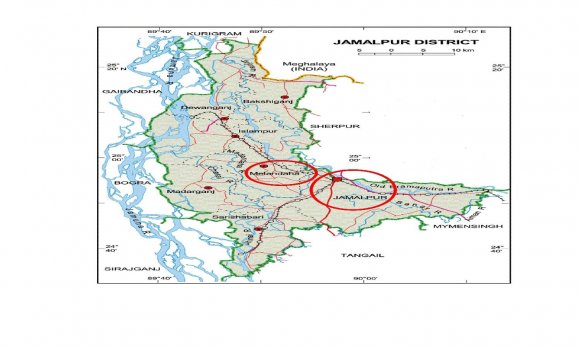
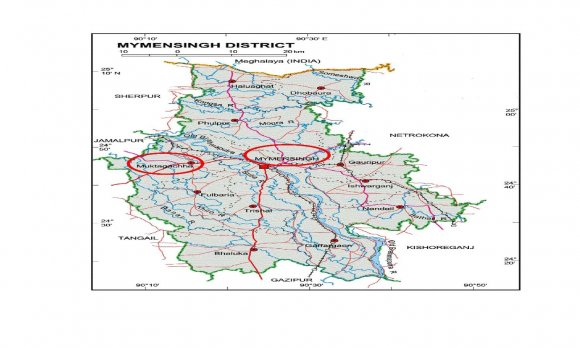
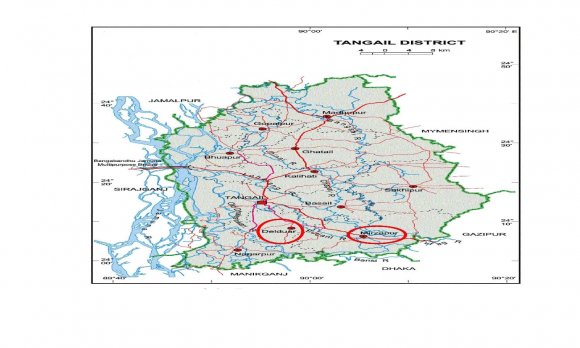
Based on easy access for the researcher (communication facilities) and less prone to natural calamities Mymensingh Sadar and Muktagachha from Mymensingh district, Jamalpur Sadar and Melandaha from Jamalpur district, Mirzapur and Delduar Upazila from Tangail district selected for this study. Geographically Mymensingh district lies between 24 0 15 ? and 25 0 15 ? North and 90 0 49 ? East longitudes, Jamalpur district lies between 24 0 34 ? and 25 0 26 ? North latitudes and between 40 °89 ? and 12 °90 ? East longitudes and Tangail district lies between 24 °01 ? and 24 °47 ? north latitudes and between 89 °44 ? and 90 °18 ' east longitudes. The study was based on the farm level as well as the market level and conducted during the period from June 2014 to October 2014.
5. b) Sample Size and Sampling Technique
A purposive sampling technique was adopted in this study to select the respondent farmers' of Fallow /Mustard-Boro rice-T. Aman rice cropping pattern to know the existing crop varieties practiced under this pattern, their planting and harvesting time at farmers' level, dominant cropping system and as well as economic profitability. In the first stage of sampling, three mustard growing districts between T. Aman and Boro rice, namely Mymensingh, Jamalpur and Tangail selected based on high, medium, and low-intensity area. In the second stage, two Upazilas carefully chose from each district. In the third stage, a total of 90 farmers, taking 15 farmers from each Upazila were chose by random sampling technique.
6. c) Preparation of Interview Schedule
A preliminary interview schedule planned to collect data from the respondents. The introductory interview schedule contained the socioeconomic profile of the respondents, the existing crop varieties and their sowing and harvesting time, dominant cropping pattern, cost and return of Mustard inclusion in the preceding period of Boro rice farming.
7. d) Methods of Data Collection
The researcher himself collected field-level data by face to face interview using a preliminary interview schedule. The unit of data collection was multiple plots of each selected farmers, where detailed information regarding Mustard/Fallow-Boro rice-T. Aman rice cropping pattern was taken, and these data analyzed on a hectare basis. Data about existing cultivated variety, cost of input, market price, yield, etc considered.
8. e) Analytical Techniques
The collected data were scrutinized, edited, summarized, tabulated, and analyzed to fulfill the objectives of the study. Profitability studies of Fallow/Mustard-Boro rice-T. Aman rice cropping patterns were estimated using the cost of cultivation (based on farmers' information), gross return (based on local market price), and profit analysis.
Gross return (GR) was calculated multiplying the total output of an enterprise by the average market price during the harvesting period. The following equation was used to estimate Gross return.
9. ?????? ? ???????? ?? ??=1
Where, GR i = Gross return from the ith product ($ ha -1 ), Q i = Quantity of the ith product (kg), P i = Average price of the ith product ($), i=1, 2, 3 Gross margin is an estimate of the difference between total return and variable costs. i.e, GM= TR-VC Where, GM= Gross margin TR= Total return VC= Variable cost III.
10. Result and Discussion
11. a) Socioeconomic Profile of sampled farmers'
Age is the important factors that were about individuals in qualities make up, his need, and way of thinks and behaves that are all closely related to the whole life (Smith and Zope, 1970). In the study areas, the highest percentage of farmers' (43.3%) was in the age group of 41-50 years in Mymensingh region. The lowest percent of the farmers' (10%) were under the age group of up to 30 and 31-40 years in Mymensingh region. On an average of the three locations, the highest respondent farmers' (31.1%) were under the middle age group of 41-50 years (Table 1). If these young aged respondents would be trained, motivated, and guided, they would be able to struggle against poverty by engaging themselves in employed occupation.
Year 2019 ( ) BEducation is a vital factor that makes the farmers' to access the relevant technical expertise and scientific information. The study revealed that the highest percentage of illiterate farmers found in Mymensingh region (30%) followed by Jamalpur region (13%). Mean of all locations indicated that 18 percent of respondents had at the secondary, 23 percent at SSC, 4 and 8 percent had at HSC, and graduate and above level education (Table 1). Ray (1998) defined the main occupation as the work for a man who has engaged him throughout the year. The survey results reflected that on an average of three locations, 69 percent of farmers solely engaged in Agriculture (Table 1). But small/medium farmers' with their small land cannot survive on agriculture alone. For this reason, they have to go for subsidiary/off-farm activities for supplementing the family income. For this reason, some of the respondents were found to depend on business. On an average of three surveyed areas, the farm family size practicing Mustard/Fallow-Boro rice-T. Aman rice cropping pattern was 5.44 members (Table 1) while it was 5.89 in Tangail region, 5.40 in Mymensingh region, and the lowest 5.05 in Jamalpur region.
12. b) Aman varieties cultivated by the sampled farmers of the surveyed areas
To choice, a crop or variety, different factors like prevailing farm condition, varietal adaptability, resistance to pests and diseases and marketability and profitability should be taken into consideration. From the survey program, it reflected that the high yielding T. Aman rice variety BRRI dhan49 was cultivated in the 47 percent of respondent in Mymensingh region followed by Madhobi and Hari dhan (e.g.; dhan is Bengali word and Rice is English word) was cultivated by 33.3 and 30 percent of respondents respectively. Similarly, in Mymensingh region, the variety BRRI dhan49 occupied the highest 28.1% land (DAE, 2014). In Jamalpur region, the local variety Hari dhan (e.g.; dhan is Bengali word and Rice is English word) was cultured by 47 percent respondent farmers followed by HYVHYV-High Yielding Variety BRRI dhan49 was practiced in 43 percent respondent whereas in Tangail region, 90 percent respondent farmers adopted BRRI dhan49. Thus BRRI dhan49 was found as the most prominent Aman rice variety. Within the sampled farmers from 3 to 13 percent respondent cultivated BRRI dhan30, Gutishurna, Kalijira, Binadhan-7, Kartikzone, Lalchamara, etc. (Table 2).
13. c) Sowing and harvesting time of cultivated Aman rice varieties by the respondent farmers' of Mustard-Boro rice-T. Aman rice or Fallow-Boro rice-T. Aman rice cropping pattern in surveyed areas
The sowing and harvesting time of any crop depends on rainfall, irrigation facilities, soil condition, and other climatic factors. Sowing time is an important factor for getting better yield, to fit the new crop in a cropping pattern to increase the cropping intensity. The survey results revealed that in Mymensingh region 100 percent respondent farmers' sowed the high yielding and long duration local Aman rice varieties (e.g., BRRI dhan49, Hari Dhan, Madhobi, Gutishurna, and Kalijira) before BRRI recommended time and harvest the local varieties in recommended time and High yielding varieties in before recommended time. In Jamalpur region, 57 percent of respondents reaped the local Aman rice variety ''Hari Dhan'' (e.g., Dhan is Bengali word and Rice is English word) after the recommended time. In Mymensingh and Jamalpur regions, 100 percent of respondents sowed the variety Pajam (e.g, name of rice variety) and BRRI dhan49 before the recommended time and also harvested them earlier than the recommended time. While in Tangail region 62.9 percent of respondent sowed the seeds of BRRI dhan49 before the recommended time and 37 of percent respondent in the recommended time. But the 100 percent of respondents harvested this variety before the recommended time. It might be due to nonphotosensitivity character. On the other hand, BR10, BR11, and BRRI dhan30 are less-photosensitive varieties, and in the surveyed areas, 100 percent of respondent sowed and harvested these crops in recommended time (Table 3).
14. d) Mustard and non-mustard growing farmers in the surveyed areas
The survey revealed that in Tangail region, 18 respondents (60%) engaged themselves in mustard production in between T. Aman and Boro rice, and it was followed in Mymensingh region. Data showed that in Jamalpur region, there were the lowest six respondents (20%) engaged themselves in mustard production among the surveyed farmers (Figure 2).
15. e) Problems of mustard production between T. Aman and Boro rice
The survey result revealed that on an average of three locations, 43.0 percent of respondent opined that poor yield, low price of seeds are the problem for mustard cultivation. On an average of 28% respondent opined that transplantation of Boro becomes late due to mustard cultivation. In Mymensingh and Jamalpur regions, 11% and 13% respondents opposed the mustard cultivation for lack of short duration improved variety. In Jamalpur and Tangail regions, 8% and 17% respondent farmers opined that the lands are not suitable for mustard cultivation (Table 4). variety Hira was cultivated by the respondent farmers' after harvest of mustard or T. Aman rice. Among the above mentioned Boro varieties in Tangail region, 100 percent of respondents cultured the BRRI dhan29 followed by Mymensingh region. On average, 64% of respondents refined BRRI dhan28 in Mymensingh and Jamalpur regions. Considering the Over locations, 1-2 percent of respondents adopted different hybrid varieties during Boro season (Table 5). On an average of Mymensingh and Jamalpur region, 77% of respondents cultivated the variety BRRI dhan28 at the recommended time. But 94% of respondents harvested them after the recommended time. Similarly, the highest 82% (mean of three locations) of respondents cultivated the variety BRRI dhan29 at the recommended time. But 70% of respondent harvested in the recommended time. Also, the 20% and 28% of respondents harvested the BRRI dhan29 at before the recommended and after the recommended time respectively (Table 6).
16. g) Dominant rice-mustard based cropping patterns followed in the study areas
The survey result revealed that there were twenty-six, rice-mustard based cropping patterns in the where the survey was conducted. Alone in Mymensingh district, the dominant cropping pattern was Fallow-BRRI dhan28-BRRI Dhan49 (30%) followed by Fallow-BRRI dhan29-Madhobi (27%). Cropping patterns Fallow-BRRI dhan28-Hari Dhan and Fallow-BRRI dhan29-Hari Dhan moderately adopted by the respondent farmers in the Mymensingh region. As like as Mymensingh region Fallow-BRRI dhan28-BRRI Dhan49 cropping pattern was dominantly adopted by the farmers of Jamalpur region followed by Fallow-BRRI dhan29-Hari Dhan cropping pattern. In Tangail region BARI Sarisha-14-BRRI dhan29-BRRI dhan49 cropping pattern dominantly adopted by the respondent farmers. On an average of three locations, the dominant cropping pattern found Fallow-BRRI dhan28-BRRI Dhan49 followed by BARI Sarisha-14-BRRI dhan29-BRRI dhan49. In Mymensingh and Jamalpur regions Fallow-BRRI dhan29-Hari Dhan was a promising cropping pattern (Table 7). Note. Total number of respondents is higher than n=30 as because in some cases the same farmers cultivated more varieties.
- -- -- -- -- -- Recommended 1 (100) 1 (100) -- -- -- -- After recommended -- -- -- -- -- -- BRRI dhan34Before recommended Mymensingh (N = 6) Jamalpur (N = 0) Tangail (N = 0) 6 ( 100) Note: Total number of respondents is higher than n=30 as because in some cases the same farmers cultivated more varieties.
6 (100) -- -- -- -- Recommended -- -- -- -- -- -- After recommended -- -- -- -- -- -- BR10 Before recommended Mymensingh (N = 0) Jamalpur (N = 1) Tangail (N = 0) -- -- -- -- -- -- Recommended -- -- 1 (100) 1 (100) -- -- After recommended -- -- -- -- -- -- BR11 Before recommended Mymensingh (N = 0) Jamalpur (N = 0) Tangail (N = 4) -- -- -- -- -- -- Recommended -- -- -- -- 4 (100) 4 (100) After recommended -- -- -- -- -- -- Binadhan-7 Before recommended Mymensingh (N = 0) Jamalpur (N = 0) Tangail (N = 1) -- -- -- -- -- -- Recommended -- -- -- -- 1 (100) 1(100) After recommended -- -- -- -- -- -- Lal chamara Before recommended Mymensingh (N = 0) Jamalpur (N = 0) Tangail (N = 2) -- -- -- -- 2 (100) -- Recommended -- -- -- -- -- 2 (100) After recommended -- -- -- -- -- -- Kartikzone Before recommended Mymensingh (N = 0) Jamalpur (N = 0) Tangail (N = 2) -- -- -- -- 2 (100) -- Recommended -- -- -- -- -- 2((N = 0) Tangail (N = 0) - - - - - - Recommended 1 (100) 1 (100) - - - - After recommended - - - - - - BRRI dhan29Before recommended Mymensingh (N = 27) Jamalpur (N = 14) Tangail (N = 36) -7 (25.9) -2 (14. For determining of the relative profitability of different produces and cropping pattern, all cost items for each of the individual crops considered. Costs are the expenses involved in organizing and carrying the production process up to getting yield or output. For calculating the cost of cultivation of T. Aman, mustard, Boro rice crops under Fallow/Mustard-Boro rice-T. Aman rice cropping pattern, all variable costs like human labor, land preparation, seed, chemical fertilizer, insecticide, irrigation calculated per hectare basis. Under this calculation, fixed cost and family labor cost were not included. Labor wages considered on a local value basis. Gross return ($ 4 ha-1) was calculated based on the local market price of the economic yield and byproduct of those crops. The cost variation in T. Aman rice cultivation among the surveyed areas was mainly influenced by the variation of available labour number and their wages. The highest cost of cultivation for T. Aman rice was found $ 591.96, One dollar = Tk. 84.63 (Bangladeshi currency) as per on day value ha-1 in Tangail region followed by Jamalpur region $ 570.88 ha-1 due to the highest number of labor and wages. The lowest cost of cultivation was found in Mymensingh region $ 545.75 ha-1 due to lowest of labor. The highest gross margin in T. Aman rice was found $ 651.30 ha -1 from BRRI dhan49 in Jamalpur region followed by $ 577.6 ha-1 in Tangail region. The local variety Hari dhan contributed the gross margin $ 511.87 ha-1 in Jamalpur region. The local Lal Chamara and Kartikzone funded the lowest gross margin in Tangail region (Table 8). For mustard cultivation, the highest cost of cultivation was found in Mymensingh and Jamalpur regions $ 332.15 ha-1 and $ 377.10 ha-1 respectively while in Tangail region was found the lowest $ 317.97 ha-1. The highest gross margin $ 294.72 ha-1 was obtained by cultivating BARI Sarisha-15 in Mymensingh region followed by BARI Sarisha-14 in Mymensingh and Tangail regions. The local variety Tori-7 produced the lowest gross margin of $ 77.60 ha-1 (Table 9). In the case of Boro rice, the highest cost of cultivation $ 833.51 ha-1 was found in Tangail region followed by Mymensingh region $ 801.02 ha-1. Cost of cultivation for Boro rice was varied among the studied areas due to variation of irrigation cost. The lowest cost was found in Jamalpur region at $ 777.24 ha-1. Considering all locations, in case of Boro, BRRI dhan29 incurred the highest gross margin followed by BRRI dhan28 (Table 10).
(N = 0) Jamalpur (N = 3) Tangail (N = 0) - - - - - - Recommended - - 3 (100) - - - After recommended - - - 3(17. i) Gross return analysis of the dominant cropping pattern
The gross return of farmers' under Fallow/Mustard-Boro rice-T. Aman rice was mainly influenced in the conjunctions of mustard between T. Aman and Boro rice. The highest profitability was found $ 1218.10 ha -1 from BARI Sarisha-14-BRRI dhan29-BRRI dhan49 cropping pattern in Tangail region followed by Mymensingh region $ 1114.53 ha-1. BARI Sarisha-14-BRRI dhan29-Hari Dhan cropping pattern also earned $ 1068.01 ha-1 profit in Jamalpur region (Table 11).
IV.
18. Conclusion
The survey study revealed that over locations the dominant cropping pattern was found Fallow-BRRI dhan28 (Boro rice)-BRRI dhan49 (T. Aman rice) followed by BARI Sarisha-14-BRRI dhan29 (Boro rice)-BRRI dhan49 (T. Aman rice). Hence, there is enough scope of cultivation high yielding mustard crop in the Fallow-BRRI dhan28 (Boro rice)-BRRI dhan49 (T. Aman rice) cropping pattern by applying agronomic management practices by which 24.4% respondent of the survey areas may fetch a higher income of the farm families in the study area.
| Year 2019 |
| ) |
| ( B |
| Profile | Mymensingh (n = 30) | Jamalpur (n = 30) | Tangail (n = 30) | All areas (n = 90) | |||||
| Age group (years) | Number of farmers | Percentage | Number of farmers | Percentage | Number of farmers | Percentage | Number of farmers | Percentage | |
| Up to 30 | 3 | 10.0 | 4 | 13.3 | 6 | 20.0 | 13 | 14.4 | |
| 31-40 | 3 | 10.0 | 4 | 13.3 | 4 | 13.3 | 11 | 12.2 | |
| 41-50 | 13 | 43.3 | 8 | 27.0 | 7 | 23.3 | 28 | 31.1 | |
| 51-60 | 4 | 13.3 | 7 | 23.3 | 9 | 30.0 | 20 | 22.2 | |
| 61-above | 7 | 23.3 | 7 | 23.3 | 4 | 13.3 | 18 | 20.0 | |
| Total | 30 | 100 | 30 | 100 | 30 | 100 | 90 | 100 | |
| Educational level | |||||||||
| Illiterate | 9 | 30.0 | 4 | 13.0 | 2 | 7.0 | 15 | 17.0 | |
| Primary | 11 | 36.6 | 4 | 13.0 | 12 | 40.0 | 27 | 30.0 | |
| Secondary | 3 | 10.0 | 9 | 30.0 | 4 | 13.0 | 16 | 18.0 | |
| SSC | 5 | 16.6 | 5 | 17.0 | 11 | 37.0 | 21 | 23.0 | |
| HSC | 0 | 0.0 | 3 | 10.0 | 1 | 3.0 | 4 | 4.0 | |
| Graduate and above | 2 | 6.66 | 5 | 17.0 | 0 | 0.0 | 7 | 8.0 | |
| Total | 30 | 100 | 30 | 100 | 30 | 100 | 90 | 100 | |
| Occupational status | |||||||||
| Agriculture | 21 | 70.0 | 26 | 87.0 | 15 | 50.0 | 62 | 69.0 | |
| Agriculture + Business | 9 | 30.0 | 4 | 13.0 | 14 | 47.0 | 27 | 30.0 | |
| Agriculture+ | - | - | - | - | 1 | 3.0 | 1 | 1.1 | |
| Van/Auto puller | |||||||||
| Total | 30 | 100 | 30 | 100 | 30 | 100 | 90 | 100 | |
| Family size | |||||||||
| Total | 5.40 | 100 | 5.05 | 100 | 5.89 | 100 | 5.44 | 100 | |
| Male | 2.90 | 54.0 | 2.65 | 52.5 | 2.86 | 48.5 | 2.80 | 51.5 | |
| Female | 2.50 | 46.0 | 2.40 | 47.5 | 3.03 | 51.4 | 2.64 | 48.5 | |
| Source: Field survey, 2014 | |||||||||
| Mymensingh (n = 30) | Jamalpur (n = 30) | Tangail (n = 30) | All areas (n = 90) | |||||
| Varieties | Number of farmers Percentage | Number of | Percentage | Number of farmers Percentage | Number of | percentage | ||
| farmers | farmers | |||||||
| Hari dhan | 9 | 30.0 | 14 | 47.0 | - | - | 23 | 25.5 |
| Madhobi | 10 | 33.3 | - | - | - | - | 10 | 11.1 |
| BRRI dhan49 | 14 | 47.0 | 13 | 43.0 | 27 | 90 | 54 | 60.0 |
| Pajam | 4 | 13.0 | 4 | 13.0 | - | - | 8 | 9.0 |
| BRRI dhan30 | 1 | 3.0 | - | - | - | - | 1 | 1.1 |
| BRRI dhan34 | 6 | 20.0 | - | - | - | - | 6 | 7.0 |
| Gutishurna | 4 | 13.0 | - | - | - | - | 4 | 4.4 |
| Kalijira | 1 | 3.0 | 1 | 3.0 | - | - | 2 | 2.2 |
| BR10 | - | - | 1 | 3.0 | - | - | 1 | 1.1 |
| Binadhan-7 | - | - | - | - | 1 | 3.0 | 1 | 1.1 |
| Kartikzone | - | - | - | - | 2 | 7.0 | 2 | 2.2 |
| Lal chamra | - | - | - | - | 2 | 7.0 | 2 | 2.2 |
| BR11 | - | - | - | - | 4 | 13.0 | 4 | 4.4 |
| Varieties | Seeding/harvesting time categories | Mymensingh (N = 9) Seeding Harvesting time time | Jamalpur (N = 14) Seeding Harvesting time time | Tangail (N = 0) Seeding Harvestin time g time | |||
| Before recommended | 9 (100) | - | 5 (35.7) | 1(7.14) | - | - | |
| Hari dhan | Recommended | - | 9 (100) | 9 (64.2) | 5 (35. | ||
| Varieties | Seeding/harvesting time categories | Mymensingh (N = 1) Seeding Harvestin time g time | Jamalpur (N = 0) Seeding Harvesting time time | Tangail (N = 0) Seeding Harvesting time time |
| BRRI dhan30 Before recommended | - | |||
| Sl. No. | Problems and constraints | Mymensingh (N = 19) Number of farmers | Jamalpur (N = 24) Number of farmers | Tangail (N = 12) Number of farmers | Average | |||||
| 1. | Lack | of | short | 2 | 10.5 | 3 | 13.0 | -- | -- | 8.0% |
| duration improved | ||||||||||
| variety | ||||||||||
| 2. | Transplantation of | 4 | 21.0 | 7 | 29.0 | 4 | 33.0 | 28.0% | ||
| Boro become late | ||||||||||
| 3. | Low | soil | 1 | 5.3 | 2 | 8.00 | 2 | 17.0 | 10.1% | |
| moisture/land is not | ||||||||||
| proper | ||||||||||
| 4. | Excessive | soil | 2 | 10.5 | 2 | 8.00 | 2 | 17.0 | 12.0% | |
| Mymensingh (n = 30) | Jamalpur (n = 30) | Tangail (n = 30) | All areas (n = 90) | |||||
| Varieties | Number of farmers | Percentage | Number of farmers | Percentage | Number of farmers | Percentage | Number of farmers | Percentage |
| BRRI dhan28 | 21 | 70.0 | 17 | 57.0 | - | - | 38 | 42.0 |
| BRRI dhan29 | 27 | 90.0 | 14 | 47.0 | 36 | 120 | 77 | 86.0 |
| Pajam | 1 | 3.3 | - | - | - | - | 1 | 1.1 |
| Hira | - | - | 2 | 7.0 | - | - | 2 | 2.2 |
| Varieties | Seeding/harvesting time categories | Mymensingh (N = 21) Sowing Harvesting time time | Jamalpur (N = 17) Sowing Harvesting time time | Tangail (N = 0) Sowing Harvesting time time | |||
| BRRI dhan28 | Before recommended -Recommended 15 (71.4) After recommended 6 (28.5) | --21 (100%) | -14 (82.3) 3 (18) | -2 (11.7) 15 (88.2) | --- | --- | |
| Before recommended | Mymensingh (N = 1) | Jamalpur | |||||
| Pajam | |||||||
| Mymensingh (n = 30) | Jamalpur (n = 30) | Tangail (n = 30) | All the areas (n = 90) | |||||||
| Sl. No. | Cropping pattern | Number of farmers | Percentage | Number of farmers | Percentage | Number of farmers | Percentage | Number of farmers | Percentage | |
| (N) | (N) | (N) | (N) | |||||||
| 01. | Fallow-BRRI dhan28-Hari dhan | 4 | 13 | 1.0 | 3.0 | -- | -- | 5 | 6.0 | |
| 02. | Fallow -BRRI dhan29-Hari dhan | 4 | 13 | 9.0 | 30.0 | -- | -- | 13 | 14.4 | |
| Year 2019 | 03. 04. 05. | Fallow -Paijam -Hari dhan BARI Sarisha-14-BRRI dhan29-Hari dhan dhan28-Hari dhan BARI Sarisha-14-BRRI | 01 ---- | 3.3 ---- | --02 02 | --7.0 7.0 | ---- | ------ | 01 02 02 | 1.1 2.2 2.2 |
| 06. | Tori-7-BRRI dhan28-Madhobi | 02 | 7 | -- | -- | -- | -- | 02 | 2.2 | |
| 07. | Fallow-BRRI dhan29-Madhobi | 08 | 27 | -- | -- | -- | -- | 08 | 9.0 | |
| 08. | Tori-7-BRRI dhan29-BRRI dhan49 | -- | -- | -- | -- | 03 | 10 | 03 | 3.3 | |
| 10. | BARI Sarisha-14-BRRI dhan29-BRRI | 05 | 17 | -- | -- | 14 | 47 | 19 | 21.0 | |
| dhan49 | ||||||||||
| 11. | Fallow-BRRI dhan28-BRRI dhan49 | 09 | 30.0 | 13 | 43.3 | -- | -- | 22 | 24.4 | |
| 12. | Fallow-BRRI dhan29-BRRI dhan49 | -- | -- | -- | -- | 10 | 33 | 10 | 11.0 | |
| ) | 13. | BARI Sarisha-14-BRRI dhan28-Pajam | 02 | 7.0 | 01 | 3.3 | -- | -- | 03 | 3.3 |
| ( B | 14. | Fallow -BRRI dhan29-Pajam | 02 | 7.0 | 03 | 10.0 | -- | -- | 05 | 5.5 |
| 15. | BARI Sarisha 15-BRRI dhan29-BRRI | 02 | 7.0 | -- | -- | -- | -- | 02 | 2.2 | |
| dhan34 | ||||||||||
| 16. | Fallow -BRRI dhan28-BRRI dhan34 | 02 | 7.0 | -- | -- | -- | -- | 02 | 2.2 | |
| 17. | Fallow -BRRI dhan29-BRRI dhan34 | 02 | 7.0 | -- | -- | -- | -- | 2.0 | 2.2 | |
| 18. | Fallow-BRRI dhan29-Gutishurna | 04 | 13.0 | -- | -- | -- | -- | 04 | 4.4 | |
| 19. | Fallow-BRRI dhan28-BRRI dhan30 | 01 | 3.0 | -- | -- | -- | -- | 01 | 1.1 | |
| 20. | Fallow-BRRI dhan28-Kalijira | 01 | 3.0 | -- | -- | -- | -- | 01 | 1.1 | |
| 21. | Fallow-Hira-Kalijira | -- | -- | 01 | 3.3 | -- | -- | 01 | 1.1 | |
| 22. | Fallow -Hira-BR 10 | -- | -- | 01 | 3.3 | -- | -- | 01 | 1.1 | |
| 23. | Fallow-BRRI dhan29-BR11 | -- | -- | -- | -- | 04 | 13 | 04 | 4.4 | |
| 24. BARISarisha14-BRRI dhan29-Binadhan-7 | -- | -- | -- | -- | 01 | 3.3 | 01 | 1.1 | ||
| 25. Fallow-BRRI dhan29-Lal chamra | -- | -- | -- | -- | 02 | 7.0 | 02 | 2.2 | ||
| 26. Fallow -BRRI dhan29-Kartikzone | -- | -- | -- | -- | 02 | 7.0 | 02 | 2.2 | ||
| Note: Selling price (Grain)-Aman rice: Hari dhan $ 0.21 kg -1 ; Madhobi $ 0.25 kg -1 , ; Paijam $ 0.29 kg -1 ; BRRI dhan49 $ 0.24 kg -1 | , BR11 $ and Kalijira $ 0.50 kg -1 BRRI dhan30 $ 0.21 kg -1 ; BRRI dhan34 $ 0.25 kg -1 & BR10 $ 0.21 kg -1 , Gutishurna $ 0.24 kg -1 | 0.19 kg -1 , Binadhan-7 $ 0.21 kg -1 , Lal chamara $ 0.21 kg -1 and Kartikzone $ 0.21 kg -1 |
| 0.47 kg -1 |
| (Seed): Mustard-$ |
| Note: Selling price |
| Sl. no. | Existing cropping pattern | Mymensingh ($ ha -1 ) | Jamalpur ($ ha -1 ) | Tangail ($ ha -1 ) |
| 01. | Fallow-BRRI dhan28-Hari dhan | 653.5 | 805.6 | - |
| 02. | Fallow-BRRI dhan29-Hari dhan | 745.8 | 894.6 | - |
| 03. | BARI Sarisha-14-BRRI dhan29 -Hari dhan | - | 1068.0 | - |
| 04. | BARI Sarisha-14-BRRI dhan28-Hari dhan | - | 979.0 | - |
| 05. | Tori-7-BRRI dhan28-Madhobi | 768.9 | - | - |
| 06. | Fallow-BRRI dhan29-Madhobi | 783.3 | - | - |
| 07. | BARI Sarisha-14-BRRI dhan29-BRRI dhan49 | 1114.5 | - | 1218.10 |
| 08. | Fallow-BRRI dhan28-BRRI dhan49 | 777.5 | 948.5 | - |
| 09. | Fallow-BRRI dhan29-BRRI dhan49 | - | -! | - |
| 10. | BARI Sarisha-14-BRRI dhan28-Pajam | 925.1 | 936.9 | - |
| 11. | Fallow-BRRI dhan29-Pajam | 772.3 | 855.9 | - |
| 12. | BARI Sarisha-15-BRRI dhan29-BRRI dhan34 | 726.5 | - | - |
| 13. | Fallow-BRRI dhan28 BRRI dhan34 | 339.8 | - | - |
| 14. | Fallow-BRRI dhan29-BRRI dhan34 | 431.8 | - | - |
| 15. | Fallow-BRRI dhan29-Gutishurna | 798.7 | - | - |
| 16. | Fallow -BRRI dhan28-BRRI dhan30 | 494.6 | - | - |
| 17. | Fallow -BRRI dhan28-Kalijira | 610.9 | - | - |
| 18. | Fallow-Hira -BR 10 | - | 456.2 | - |
| 19. | Fallow-BRRI dhan29-BR11 | - | - | 814.8 |
| 20. | BARISarisha14-BRRI dhan29-Binadhan-7 | - | - | 807.6 |
| 21. | Fallow-BRRI dhan29-Chamra | - | - | 398.5 |
| 22. | Fallow-BRRI dhan29-Kartikzone | - | - | 526.7 |