1.
Current research in science has become innovative and thought-provoking given the ability to adopt principles from one seemingly delinked field into another. In this paper, we assume an approach that models institutional relations between University, Government and Industry, by harnessing prior deductions in bioinformatics that helped to mathematically showcase the structure of Deoxyribonucleic acid (DNA). Thus the internal member network of individual organizations is expected to be of a small world nature and attains regularity as a probability of connectivity between nodes in that network approaches 1 (Liu, Madler, & Bush, 2015; Watts & Strogatz, 1998a, 1998b). When the bonds have no fragility (fragility = 0) then we expect the dynamism of institution to institution connections to characteristically mimic a trefoil knot. However as this will be an ideal and never the general case, the trefoil knot will never form an unending loop but will be characteristically dense as it approaches fragility of zero. The density of the bonds between the partnerships and subsequent entries and breaks in the network will reflect the twists and writhes as seen in a DNA system. We hold the performance of University as the energy that feeds the system and resulting innovation generated as the bond that sustains the dynamic network from breaking up.
2. I. Introduction
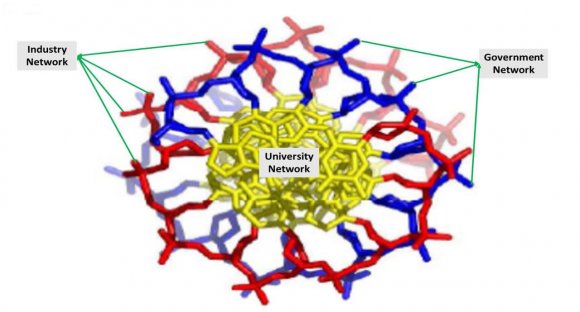
riple Helix theories building on the deductions from Lowe (1982) and Etzkowitz (1993), to proceeding works (Etzkowitz, 1993;Etzkowitz & Leydesdorff, 1995;Etzkowitz & Ranga, 2012), marked the beginning of the appreciation of the role and synergies between knowledge generation, government and industry and how this impacts on innovation generation, and, in an extended analysis; national and regional development. The proposed models hinged on mathematical models of networks structures (Boland Abstracting concepts from diverse fields into social and organizational studies has helped in explaining, sometimes complex systems, as simple as possible by reducing the interaction to mathematical deductions infused with dynamic logic of decision making and conclusions. Our approach is to consider organizational partnerships, development, and growth in T Preamble innovation as having the structure, characteristics and dynamics of a simplified DNA; where Universities are at the core of the system and Government and Industry serve as backbones of the partnership. The assumed approach presented thus fare is graphically expressed in Figure 1 below. ) and this innovation has the tendency to visibly showcase products rather than the knowledge that created them. Invariably, the trials and tribulations of professors, universities and research institutions in generating novelty, developing patent concepts and the diffusion mechanisms that result in the final product are minimally showcased in the marketing strategies of the product development network. The paper, based on this minimal presence of research work in product development and marketing strategies, therefore consideres the backbone of the helix to be Government and Industry; as showcasing systems, with the strength of helix partnerships being hinged University partners' ability to generate innovation. In tandem then, the appreciation of a Triple Helix relation as a DNA structured network of relations builds from the mechanical properties that influence the processes of innovation generation, diffusion, transmission, replication and feedback as a driving force for innovation and sustainability within the helix.
We first conduct a topological analysis of triple helix systems about the DNA structure of a living organism, we then continue to present the flexibility of partnerships that result from triple helix systems, as the strength and conditional influenced dynamics of such interactions. Building on these initial deductions, we propose the dynamic structure of helix partnerships and how they can be resolved using neural network approaches. We conclude by relating this to policy development and sustainability.
3. II. Topology
Building on the topology of DNA's, a triple helix system, can then be viewed as a collection of three continuous curves -graphical plots of internally interacting nodes in each partnered network.
Thus the axial curve of the backbone systems can be considered as curves passing through the focal individuals (centroids) of the base curve. In such a case, three curves?? 1 , ?? 2 and ?? 3 helps define coefficients of linkage (?? ?? ) that characterize the curves as they interweave with one another. Linkages should be seen as signals of a partnership established point or interactions between focal nodes across the three networks. Further, assume that the generic projection of the three curves on a plane, where the crossing of one curve with the others, is transversal.
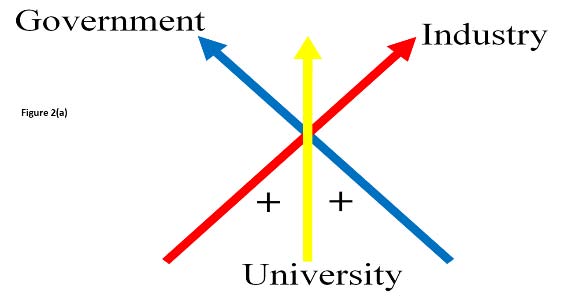
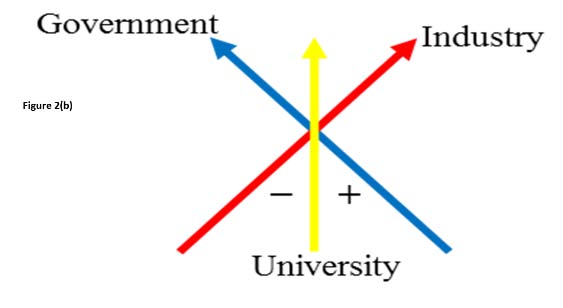
We begin by providing orientation as well as crossing signs to our networks as provided for in Figure 2 (a & b). The coefficient of linkages is then taken to be one half the sum of all signed crossings. In conformity to DNA modeling, we assign ?? 1 to the axial curve of Universities and ?? 2 and ?? 3 to the backbone chains of Government and Industry.
?? ?? (?? 1 , ?? 2 , ?? 3 ) = 1 4?? ? ? ? ??? 1 (?? 1 )×?? 2 (?? 2 )×?? 3 (?? 3 )?????? 1 (?? 1 )??? 2 (?? 2 )?+??? 1 (?? 1 )??? 3 (?? 3 )?? ???? 1 (?? 1 )??? 2 (?? 2 )?+??? 1 (?? 1 )??? 3 (?? 3 )?? 3 ?? 3 ?? 2 ?? 1 ???? 3 ???? 2 ???? 1 [1]Where ?? ?? is defined by giving its position ?? ?? (??) in space as a function of the arc-length ??, and ?? ?? (??) = ?? ?? ? (??) = ???? ?? (??) ???? ? . Cognizant of two critical properties of curves that are related to a linkage, we proceed by deducing the writhe and twist of the individual networks in a triple helix interaction.
4. Writhe(????):
This characterizes the amount of chiral within a single curve in a helix. To help define the ????, we beginning by assigning to each curve orientation; as shown in Figure 1, and subsequently computing the sum of signed crossings in a planar projection along every possible direction. ???? then becomes the average sum of all projections. Thus for a differential curve ??, a formula for ???? analogous to the deduced Gaussian integral can be considered as
????(??) = 1 4?? ? ? ? ???(?? 1 )×??(?? 2 )×??(?? 3 )??????(?? 1 )???(?? 2 )?+???(?? 1 )???(?? 3 )?? ????(?? 1 )???(?? 2 )???(?? 3 )?? 3 ?? ?? ?? ???? 3 ???? 2 ???? 1 [2]Twist (????): Measures the winding of one curve in space, typically around an assumed constant. In the case of a triple helix, we consider that the individual networks of the three players are in a dance of partnership. Thus the twist is deduced as the three networks being in a state of winding around each other in a given space. The twist analogy requires that the curves under consideration be differentiable, spatially close to each other and in the case of partnership occurrence; tangential. By considering that our three networks are in a Euclidean space of ? 3 , we can deduce the distance (??) between them as
?? = |?? ? ??| = ?? |?? ?? ? ?? ?? | 2 3 ??=1. Where one has to plot about actual distances of institutions in a triple helix, geographical proximity deductions could also provide similar results.
We continue, the twist of ?? 3 , ?? 2 and ?? 1 about each other given a determined distance (??) between them is observed as
????(?? 3 , ?? 2 , ?? 1 ) = 1 2?? ? [?? 1 (??) × ??(??)] ? ?? ? (??)???? ?? 1 [3] Where ??(??) = ??? 2 ???(??)? ? ?? 2 (??)? + ??? 3 ???(??)? ? ?? 3 (??)?is perpendicular to ?? 1 (??)Literature proposes that in modeling DNA helixes, the coefficients of linkage of closed curves reflect the sum of the writhe of one curve around the twist of the second curve about the first (C?lug?reanu, 1961;White, 1969;Swigon, 2009). In a triple helix involving three curves writhing and twisting round eachother, we can then deduce the above proposition as
????(?? 1 , ?? 2 , ?? 3 ) = ????(?? 1 ) + ????(?? 3 , ?? 2 ) [4]The importance of this deduction in innovation linked systems like a triple helix is that any change in ???? that results in variations in the performance of universities will induce corresponding changes in ????. Thus, it is expected that as the chirals grow thicker and denser, with the distance between the individual systems approaching zero, the probability of interinstitutional partnerships should increase. Secondly, this also helps to model the ripple effect of external events on the triple helix in general. In continuation of our theoretical analogy, we adopt discrete mathematics, to model performance dependent flexibility of partnerships in such a way as to closely depict the structure of Triple Helix relations. Our approach is to consider that for 2-nodes in a university network, indexed as ??, their location of ?? ?? in Cartesian space with a determined direction can be defined by the frame (?? 1 ?? , ?? 2 ?? , ?? 3 ?? ). The defined frame, allows for the relative orientation and position of university actors (researchers) and the subsequent institutional growth to be kinematically deduced as
(?? 1 ?? , ?? 2 ?? , ?? 3 ?? , ?? 1 ?? , ?? 2 ?? , ?? 3 ?? ).Thus the network helix of a University considering performance can be systematically revealed as tilting, rolling, twisting, shifting, sliding and rising. The flexibility of university performance ?? can be viewed as an average of the sum of the base networks performance ? ?? , per given period (??) both being functions of the kinematical variables that is
?? = ? ? ?? ??? 1 ?? ,?? 2 ?? ,?? 3 ?? ,?? 1 ?? ,?? 2 ?? ,?? 3 ?? ? ?? ?1 ?? =1 ? ? ?? ??? 1 ?? ,?? 2 ?? ,?? 3 ?? ,?? 1 ?? ,?? 2 ?? ,?? 3 ?? ? ? ??=1 [5]We suggest that researchers consider the function of ? ?? as dependent on the University Network being of the ??th nodes and edge configuration with a quadratic function. The generic flexibility of partnership is quadratically expressed as
?? ?? = 1 2 ? ? ?? ???? ???? 3 ?? =1 ? ?? ?? ?? ? ?? ?? ?? + 3 ??=1 ?? ???? ???? ? ?? ?? ?? ?? ? ?? ?? + ?? ???? ???? ? ?? ?? ?? ?? ? ?? ?? [6]Where XZ is the direction of change of the ??th performance of each network.
Thus In the ideal, the ?? ? ???? ???? and ?? ? ???? ???? will have no bends, twists, rolls and, writhes. The flexibility of partnerships will inherently rest on the performance of the university network and its impact on innovation generation as well as diffusion.
5. IV. Structure based on Generic Principles of Helicoids
Helices are generically curved coils for which the tangent makes a constant angle with a fixed line. Organizational helices are expected to be right-handed, thus coiling clockwise just like DNA strands. Per our deductions so far, we proceed by considering the following: i. The differential curves of the helixes partnership of ?? ?? (?? 1 , ?? 2 , ?? 3 ) = ?? ???? ii. Writhe of curves as they coil around each other is ????(??) = ?? ???? iii. The combined twisting nature of the partnered system of ?? ?? (?? 3 , ?? 2 , ?? 1 ) = ?? ???? Thus, the triple helix system being a combination of twists, writhes, and performance (??) determined bonding in a directed interaction per a given period can be deduced as:
?? ???? ?? = ?? ???? + ?? ???? + ?? [7]However, helixes are generically curves with parametric equations thus for the structure of a triple helix, we obtain the parametric conditions where ?? ???? provides an extrapolated nature of the density of the partnership while the ?? ???? helps explain the dependency nature of each partner within the helix. Conditionally then, the performance linked assumption provides that, the denser the writhes and narrower the twists the stronger the institutional partnerships that will evolve. Again, this helps in computing the probability of innovation diffusion using simple diffusion theories in small world networks. Where the rate of infection is synonymous to the rate of spread or diffusion; just as extinction or death of nodes is synonymous within ability to innovate within the system as the system evolves.
Continuing, we seek to deduce the parametric nature of triple helices in a given space. The considered model for any system to evolve into a helix is given as (Weisstein, 2017):
?? = ???????? ?? ?? = ?? ?????? ?? ?? = ?? ?? [8]So far, we have assumed that our partnership model is based on three systems starting at varying positions in a Cartesian plane and growing in a given direction (right-handed and upwards: +, +) we can assume that the partnership system forms an interweaving triple helix of curves in form ?? (??,??,??) , ?? (??,??,??) , ?? (??,??,??) . In the above equation, the tangents (??) are determined as ?? ? [0,2??] where r is the radius of the helix and 2???? is the given vertical separation in the loops of the helix. We then consider the constant (??) of the helix of any of the systems to be a fixed probability to innovate calculated as the average of such probability over a given period (Tian and Zhang, 2008), and submitted as:
?? = ?? ?? ?? = ? ?? ?? ?? ?? ?? ??????+1 ?? [9] Where: i. ?? ?? ?? denotes an agents stock of innovation knowledge at period ??. ii. ?? denotes agent seeking innovation. iii. ?? ?? the conditional probability of agent ?? innovates per given performance knowledge level, in the instance that the agent has not innovated already.
Basing the constant of loops on the individual probabilities to innovates helps to determine individual writhes and twists within each system. A partnership helix is expected to occur at the point where all three systems intersect. The intersection of all three systems is determined as their tangent, and expressed as: [10] Proceeding growths and mergers can then be extrapolated based on prior information on performance, individual system characteristics and perceived gains when one considers that the system can grow and evolve.
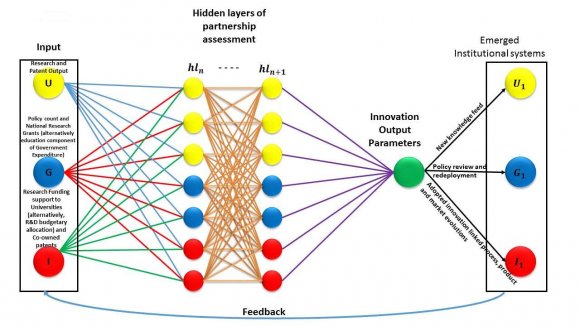
?????? ?? = ??????(?? + ?? + ??) = ???????? +???????? +???????? ????????????????????????? 1????????????????? ????????????????? ?????????????????Structurally then, the extrapolated model of a triple helix will be the integration of ?? ???? ?? with an initial systemic tangent of tan? calculated as the innovation probability of all three systems having integrated based on a combined average of ??. If this assumption holds, then the Triple Helix partnership of Universities, Government and Industry attains the graphical characteristics of a DNA and mathematically can be expressed the same. By using conditional probability deductions to showcase the union of the individual helixes in relation to the points of tangent being contingent on the probability of innovation as an indication of performance and growth opportunities, the triple helix is presented as a network of partnership infused with learning. Seeing triple helix systems as learning and evolving systems allows us to review it as a neural network of interactions that predicts system growth and evolution as well as innovation generation as shown in Figure 2 Our deductions thus far havefocused on mimicking helix partnerships a living organism with core members serving as its DNA. In Figure 3, we further extend our living organism assumption to the level of learned sustainability, thus rendering the system susceptible to growth, evolution, and development. The model proposes the adoption of the factors of organization assessment as a means of deducing innovation output parameters. University performance could be reflective of its patent and research output, whileGovernment is assessed using policy count and proportionate contribution to academic research grants. Industries co-joined research output with university vis-à-vis contributions to research, allows for neurally extrapolating innovation performance. Eventually, the feedback from the innovation performance parameters will inform further activities within the system, with universities producing new knowledge that pushes the whole cycle to repeat itself. The concept of feedback allows for flexibilty of partnership bonds, while providing the contingent conditions for sustained participation of all members. Thus where feedback yields weak or no results, the partnership, may over time, eventually break up and in biological terms die.
6. V. Plotting Suggestions
There is the observed influence of Government in virtually any Higher Education System in the world. We assume that the partnership being of a clockwise nature will fall in the three dimensional Cartesian plane of 0?U,G,I?1. If we assume that the systems will start at different points in the plane with a given distance that narrows, vanishes and separates; as partnerships are formed and or dissolved then we can plot University systems to Government system with an initial separation 0>.5. Since Industry, tends to be a coaxed member in the partnership contingency, with calculated benefits as the enticing carrot at the end of the partnership stick, it would be recommended to plot Industry as having the relative starting separation of 0.5?1 Cartesian points from university. Ideally plot government and industry to start from opposing points of University. We suggest that plotting algorithims retain university systems in the middle with government and industry on either side of it. Allow for partnership development to be contingent on university performance increases.
7. VI. Conclusion
The appreciation of innovation partnerships transcends the boundaries of simple analogies. The dynamics, evolutions, and implications for institutional growth have been expressed in prior works. This paper has tried to adopt deductions from the field of biology to try and explain the complex interactions between innovations partnered networks. The knowledge we hope will provide clarity on the internal mechanism that results in the twists, turns and collusions within and among innovation partners. Future works could review this in relation to the proposed quadruple helix, by considering the fourth dimension (social stakeholders) of the partnership as the nuclei walls within which the partnership operates.