1. Introduction
ince 2002, there has been improvement substantial price for both producers and consumers in Turkey. For example, average producer inflation was 64% in the period of 1980-2002 and 8% in the period of 2002-2013 (Central Bank Republic of Turkey, Electronical Data Distribution System, EDDS). On the other hand, the producer inflation increased again in recent years. According to the economic and political arguments exchange rate is one of the causes of this situation. The increase in the exchange rate has negative impact on production costs, which means the increment of the prices of imported inputs. According to the economic theory in this area, the increase in the real exchange rate raises the cost of domestic production of import-dependent industries, which limits the industrial production and also leads to increased prices in the domestic market. This is the socalled pass-through effect of the exchange rate on the general prices level.
Central banks use several policy tools in order to avoid the impact exchange rates on general price levels. The most powerful of these tools is the interest rate. The relationship between interest rate and inflation may differ according to the source of inflation. When there is demand-side inflation, the high interest rate policy will be successful for decrease consumer inflation. However, when there is supply-side inflation, higher interest rates may lead to higher producer prices.
Author: Nuh Naci Yazgan Universitiy. email: [email protected] This is because of the rise in payments of production factors such as wage, interest rate and energy prices.
In this study's time period, for 2004-2013 periods in Turkey, the Central Bank raised the interest rates, in order to compensate the negative impact of inflation for the exchange rate. However, due to the continued increment in the exchange rate, the expected improvement in inflation has not been achieved. This situation has also affected the reliability of the monetary authority negatively. As considered by politicians, high interest rate is a main negative effect for the investment environment and this situation may lead the cost inflation.
Our study is seeking answers to the following questions: In the analyzed period in Turkey, did producer prices affect the exchange rate? When the interest rate rises, how do the producer prices change? As the free capital flows in emerging economies under a flexible exchange rate regime, is the effectiveness monetary policy weak in Turkey as a developing country. The contributions of the study to the literature are as follows; in the literature, effect of the exchange rate to the inflation rate or the relationship between interest rates and inflation are generally separately discussed. This study examines the relations between three variables specified. However, as the dependent variable, consumer price index (CPI) is oftenly used in previous studies. The purpose of the study is determined the impacts interest rate and exchange rate on producer prices. Secondly, for the period covered by the study successful balanced budget policy was applied in Turkey. In the literature positive correlation relations between public spending and inflation rate are determined for developing countries. However, producer inflation environment on the balance budget in Turkey is discussed in this study. Thirdly, the Relative Sensitivity Analysis (RSA) is not used before in this area. This method is widely used in engineering and health care. In the social sciences, it is utilized in some studies about investment and finance. Besides RSA, the methods used in the study are as follows; Johansen Cointegration, Vector Error Correction (VECM) and developed depending on the VECM, Granger Causality tests.
In the introduction section the economic relations between the variables are studied. The second part of the study is a review of the literature. Variables and economic expectations are defined in the third section, application methods are explained in the fourth section and fifth section covers evaluated application results. The study is completed with the conclusion section.
2. II.
3. Literature
Studies about relationship among interest rate, foreign exchange and inflation rate studies in the literature can be classified in three groups. The first group of these studies analyzes the effects of exchange rate fluctuations on the inflation rate. In these studies different conclusions are reached according to the development of the country and applied exchange rate regime (Frankel, Parsley and Wei, 2005;Ito and Sato, 2006;Mc. Carty, 1999;Mihaljek and Klau, 2001;Sekine, 2006;Stulz, 2000). In Frankel, Parsley and Wei (2005) exchange rate pass-through effect to the consumer price is high and speed, but in parallel with the global decline in inflation in these countries period of 1990-2001, these effect is determined low on the prices. Sekine (2006) have found that the exchange rate passthrough effect on prices is low relationship on the import and consumer prices for developed countries. In Ito and Sato (2006) strong between prices of imports and the exchange rate are found but consumer prices is less affected by the exchange rate. Mc. Carty (1999) found a positive relationship between exchange rate and import prices, but the impact on the exchange rate of domestic inflation are weak. Mihaljek and Klau (2001) have examined the relationship between foreign exchange rates, import prices and domestic inflation for 13 countries including Turkey for the period 1995-2000. As a result, the relationship between exchange rate and inflation are more powerful than the relationship between exchange rate and import prices, besides this, the exchange rate impact on the inflation is high for the first of four periods and countries more than a year. On the other hand, consumer price is more effected exchange rate than producer prices. Stulz (2007) examined the impact of the transition to the exchange rate in Switzerland for the period from 1976 to 2004 and stated that the exchange rate decreases gradually from the pass-through effect on consumer prices. Bayraktutan and Arslan (2003) found bidirectional causality between producer prices, exchange rate and import volume for the 1980-2000 periods in Turkey. Is?k, Acer and Is?k (2004) have reached the conclusion that the cointegration of inflation and exchange rate for the 1982-2003 period. Kara et al. (2005) determined the reduced impact from exchange rate on consumer prices for the 1995-2005 periods in Turkey, according to the antiinflationary policy with a floating exchange rate applied since 2001. Gül and Ekinci (2006) In the studies of the third group, which is also subject of this study, relations between inflation rate, interest rate and exchange rate are investigated. Precursors of these studies are Taylor (1993) and King and Wolman's (1996). Taylor (1993) examined these variables in the United States for the 1987-1992 periods. His study results shows that, the effect of exchange rate on inflation is very low, the main monetary policy tool affecting inflation that the interest rate. King and Wolman (1996) have determined interest rate and money supply effective on inflation, in the United States for the 1915-1992 period, but the exchange rate is not effective. Similar to these studies, in Turkey, Fisuno?lu and Çabuk (1997) For example, Yaprakl? and Kaplan (2012) found the twoway causal relationship between these indicators, according to the co-integration and error correction model results, beside this interest rates effect to the inflation rate in the short and long term and smaller than even if the exchange rate had determined that negatively affected.
4. III.
5. Material and Methods
In this study, Johansen Co-integration, Vector Error Correction, Granger Causality and Relative Sensitivity Analysis (RSA) are used. Firstly, the structure of stability variables were examined (Gujarati, 1995: 750). For this purpose, ADF (Augmented Dickey-Fuller) and KPSS (Kwiatkowski, Phillips, Schmidt, Shin) unit root tests are used. ADF test, delay values of the series involves regressing over the delay difference (Gujarati, 1995: 720). Equation of the test is seen in equation (1).
? = ? + ? + + + = ? m i t t t t t Y Y Y 1 1 1 1 0 ? ? ? ? ? (1)According to equation ( 1), Yt is the first difference of the variable being tested; t is the trend variable, ?Yt-1 is the difference term, ?t is the error term which is stationary. Model, the error term, to ensure that successive independent until lagged difference terms are added (Gujarati, 1995: 720). According to the ADF test, H0 is a unit root, HA is stationarity. H0 is statistically tested whether the coefficient ? is equal to the zero. In the literature, because ADF test is sensitive to the length of delay, the KPSS tests are also used. KPSS test was developed by, Kwiatkowski, Phillips, Schmidt and Shin (1992). KPSS with ADF test's null hypothesis are the opposite of each other. According to the ADF test's null hypothesis, there is the existence of the unit root (series is nonstationary), but the null hypothesis of the KPSS test, H0 is stationary, HA is a unit root. KPSS test statistic is given with equation ( 2) (Kwiatkowski et al., 1992: 54).
? ? ? = T t T u l s S T 1 2 2 2 ) ( / ? (2)Where t = 1, 2, ..., determined for consistency for
) ( 2 l s , ? ? l . TS shows the total process of partial remains.
The H0 is compared calculated value with the critical value. KPSS test is the effect caused by the presence of a unit root problem deterministic trend which was revealed on adjusted by means of lifting the middle deterministic trend. In this respect, it differs from other conventional unit root tests. Another important aspect of the KPSS test is specify the reason for stagnation of the H0 hypothesis is that the variance of the random walk hypothesis zero (Kwiatkowski et al., 1992: 159-178).
If the first difference of variables is stationary, it can be a long-term relationship between these variables. Beside, error terms should not be contain unit root, mentioned long-term relationship between the variables (Engle-Granger, 1987: 271-272). In this study, long-term relationship between the variables using Johansen Co-integration Test (1988) is analyzed. This Co-integration analysis uses the maximum likelihood method for estimating Co-integration vector and parameters (Kad?lar, 2000: 119). Johansen Cointegration equation is described as in equation ( 3) (Üçdo?ruk, 1996) where Xt, N×1 is a vector time series:
t t t v Q c x L A + + = ? ) ((3)In equation ( 3), c is the fixed term, Q t is the deterministic dummy variables, v t is the error terms whose average is zero, variance is constant and normally distributed.
N N L A L A L A I L A 1 2 1 1 ... ) ( + + + + = (4)According to the equation ( 4), numbered delay processor is a L's matrix polynomial. Vector auto regression (VAR) model using all variables, their delay values and by conditioning it can be stated on the deterministic variables.
) ,..., , ( ), , , | ( 2 1 1 1 t t t t x x x X Q X x D = ? ? µ (5)After equation ( 5), Johansen model is described in equation (6).
? ? = ? ? + + + + + ? = 1 1 1 1 P i t t t t dQ t c x iDx Dx ? ? ? (6) ? ? ? ? ? ? ? ? + ? = ? ? ? ? ? ? ? ? + = ? ? = = i j j N i j j N i A I A I 1 16. , ? ?
Firstly, for Johansen Co-integration analysis, optimal lag length without autocorrelation between the error term is calculated. There are a number of lag selection criteria in the literature (Johansen, 1995;Enders, 1995). From them, Akaike and Schwarz information criterion were used in the study. Based on these two criteria, the optimum lag length is four delays. There is no autocorrelation and heteroscedasticity in this delay. Johansen Co-integration lag length is also four delay. ? = ??? is long-term response matrix. ? and ? matrices are (Nx) sized and N is the shows number of variables r the number of Co-integration vectors. 7), S00 is the residual moment matrix obtained from regression on the ?Xt -1, ?.., ?X t-k-1 and S kk is the residual moment matrix is obtained regresion on X t-k 'n?n ?X t-k-1 . S 0k, is the cross product moment matrix. Using these eigenvalues Co-integration vectors number of similarities test statistic is tested using the following equation. Trace test is described as-T?
????(1 ? µ???) ?? ??+1. According to this description; µ?r+1, ?.., at µ???, p-r number, smallest eigenvalues. However, the maximum eigenvalue test describes as (-Tln(1-µ?)). The critical values of these tests are tabulated by Johansen and Juselius (1990). In maximum eigenvalues test is analysis the presence of cointegration vector maximum number of r; to the alternative hypothesis which is claims the presence of co-integration vector maximum number r + 1 (Kasman ve Kasman, 2004, s. 127).
After determining the long-term relationship between the variables, error correction model (VECM: Vector Error Correction Model) is applied. VECM producing accurate parameters, if all variables are I(1) and there is a nonzero vector co-integrated (Üçdogruk, 1996). Estimated regression error term is called the error correction term and then Least Squares Method is applied. The causality relationship between variables can be examined depending on the VECM (Granger, 1988). This is because, if Co-integration relationship between variables, there should be at least one-way causality. The equations used to depend on the VECM Granger causality analysis in this study:
t t i n i t i n i t i n i t i EC INT EXC PPE PPE µ ? ? µ ? ? + + ? + ? + ? + = ? ? = ? = ? = ? ? ? ? 1 1 0 1 1 0 1 1 1 1 1 1 (8) INT - EXC - - PPE = EC 2 1 0 t 1 - t ? ? ? t t i n i t i n i t i n i t i EC INT PPE EXC EXC µ ? ? µ ? ? + + ? + ? + ? + = ? ? = ? = ? = ? ? ? ? 1 2 0 1 2 0 1 2 1 1 2 1 (9) INT - PPE - - EXC = EC 2 1 0 t 1 - t ? ? ? t t i n i t i n i t i n i t i EC EXC PPE INT INT µ ? ? µ ? ? + + ? + ? + ? + = ? ? = ? = ? = ? ? ? ? 1 3 0 1 3 0 1 3 1 1 3 1 (10) EXC - PPE - - INT = EC 2 1 0 t 1 - t ? ? ?In this analysis; delay values of the independent variables are indicates short-term causal effects. The error correction term is explaining long-term causal effects (Love and Chandra, 2005: 136). Another method used in this study is RSA which is just used in the literature in this area. RSA exposes comprehensive relationship between the variables and it possible for interpretation. It is capable to show the relations, depending on the coefficient values calculated for each period. In this study, the relative sensitivity coefficients of each variable were calculated on a monthly basis. In the years that the high value of the relative sensitivity coefficients between variables high, low relationship between variables is lower in recent months, it said that the value of the coefficient is zero and no relationship between the variables in the year. In some months the relative sensitivity coefficients could not be calculated. The reason for this is as a zero value of the denominator in the calculation steps.
RSA is widely used especially in health and engineering science (Isenring, Banks and Gaskill, 2009). In the literature, many local and global sensitivity analyses of the microeconomic and macroeconomic problems also exist for application. For example Borgonovo and Peccati (2004) in their work, they apply the absolute sensitivity on investment decisions and sustainability risk assessment investigated in this way. Similarly, in theirs another study, they use this analysis to evaluate investment decisions in the energy sector (Borgonovo and Peccati, 2006).
In comparative statistical analysis, changes in endogenous variables are investigated in connection with the change in exogenous variables. In other words, changes in an economic outcome are investigated and then the influences on the other economic parameters are determined. The research on the changes of economic inputs and outputs can be viewed as a branch of a more general statistics area called sensitivity analysis. Elasticity is also a subset of sensitivity analysis, which is given as the sensitivity measurement of an economic variable such as the demanded quantity to one of its determinants such as income.
In statistics, basically three types of sensitivities can be calculated in order to provide insight to the analysts, namely absolute sensitivity, semi-normalized sensitivity and the normalized (relative) sensitivity. Let the outcome of a model be y, which is a function of input variables such x1, x2,...., xn as shown in equation 11.
) ,..., , (
2 1 n x x x f y = (11)Absolute sensitivity is defined as the absolute change in the output y with respect to the change in one of the input variables, x.
Semi-normalized sensitivity includes the change in the output variable with the ratio of the changes of output and input variables as given in equation 13.
Relative sensitivity differs from absolute sensitivity in two ways. The first difference is that relative sensitivity considers the values of the input and output variables such that the effects caused from the amounts are taken into account. While absolute sensitivity is merely a ratio of the change of input and output variables, relative sensitivity gives a better understanding of the effects of input variables on the output variables. Secondly, it is easier to obtain the time dependent sensitivity with the relative sensitivity concept. Hence, because of these reasons, it is logical to use relative sensitivity as well as absolute sensitivity for econometric applications.
IV.
7. The Data and the Economic Expectations
The purpose of the study is the determination of the relationships among producer prices, the real exchange rate and the commercial interest rate. Therefore, error term represents the effects of other factors affecting producer inflation. The dependent variable of the study is the change in the producer price index, PPI inflation base year the 2000. variables are the 2000 PPI-based real effective exchange rate index (rise of this index is shows Turkish lira appreciation) and weighted average interest rate applied to the commercial loans by banks. All variables have been obtained from the Electronic Data Dissemination System of the Republic of Turkey Central Bank. Monthly data were used in models. Calculated annual percentage change of all of the data and seasonally adjusted using the Exponential Smoothing Method.
In the previous studies it is indicated that decrease or increase in the exchange rate affects occur to the supply side inflation and the deterioration in inflation expectations (Agenor and Montial, 2008). If exchange rate increases cost of production is high. Therefore, we know that interest rate is an input cost for producers. An increase interest rate can be accusing an increase on the producer prices. So economical expectation between these two variables is positive.
V.
8. Results and Discussion
In this part of the study are presented stability tests, Johansen Co-integration, weak externalities test, VECM, Granger Causality analysis, and RSA analysis results. Firstly, in the Table 1, the variable stability tests are given. In Table 1, according to the ADF and KPSS statistic, variables are not stable in the level. Therefore, the first difference is taken of variables. All variables's first differences are stationary. Depending on these results was examined the Co-integration relationship between variables.
In Table 2, trace and maximum eigenvalue is greater than 5% critical value. Hence, there is a Cointegration relationship between variables. Normalized co-integration equation has been estimated as in equation (15). Equation (15) shows that if the effective exchange rate index is 1%, producer inflation is increase
9. Global Journal of Management and Business Research
Volume XVI Issue VII Version I Year ( )
10. 2016
11. B
The Effects of Exchange Rate and Interest Rate on Producer Prices in Turkey average 0.09% and if the interest rate is increase 1%, producer inflation is increase 0.06%. This result shows that variables effective on producer inflation, but also the real exchange rate is the more impact on inflation than the interest rate. For the normalization of the Cointegration testing is made weak externalities test. In Table 2, trace and maximum eigenvalue is greater than 5% critical value. Hence, there is a Cointegration relationship between variables. Normalized co-integration equation has been estimated as in equation (15). Accepted as the speed parameter ECt-1 has negative sign, different zero and statistically significant. According to this parameter, the deviation between the the long-term value and the actual value of inflation is eliminating 14% of each period. The exchange rate and the interest rate are effective variables on producer inflation in the short run. Because these parameter's coefficients are statistically significant. In order to determine the error correction model stable, CUSUM (Cumulative Sum of The Recursive residuals: the cumulative total of successive error) and CUSUMQ analyses are utilized.
Equation (16) shows that if the effective exchange rate index is 1%, producer inflation is increase average 0.09% and if the interest rate is increase 1%, producer inflation is increase 0.06%. This result shows that variables effective on producer inflation, but also the real exchange rate is the more impact on inflation than the interest rate. For the normalization of the Cointegration testing is made weak externalities test.
12. Table 5: Granger causality analysis
Figure 1 shows that as stability diagnostics tests results CUSUM and CUSUMQ tests in the VECM. There is no structural breakage on the VECM.
According to the improved Vector Error Correction-Granger Causality (Table 5), all of the ECt-1's coeficient values are between zero and one. Morever their signs are negative. Depending on these results, the effects of independent variables on the dependent variable was significantly improved in the long term. However, there are long-term causal relationship between the variables. When looking at the short-term causal relationship, there is a two-way causal relationship between exchange rate and producer inflation. There is a one-way causal relationship between interest and inflation rates, which is to the rate of inflation from interest rate. Between exchange rate and interest rate, there is one-way causal relationship, which is to the interest rate from exchange rate.
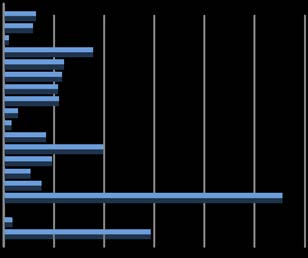
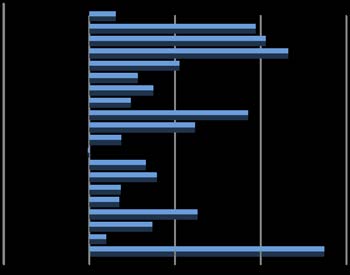
After obtaining the co-integration and causality relationship between variables, RSA was performed. This analysis has endles to see the relationship among variables on a monthly basis. Thus, it could be seen monthly value of variables's relative sensitivity coefficients, relations between variables are in what month high / low or not. This analysis allows to carry out in the corresponding month exchange and / or interest amendments, as can be seen the impact on producer prices. It also enables will allow to see the effects of the currency and interest rate policies on producer prices in the monthly scale. 11) periods, the effect of changes in the inflation rate are higher than in other periods. In particular, 2009: 04/2010: 02, during the real effective exchange rate increases, the sensitivity producer inflation to the exchange rate has increased (-130 / -140 range). For some years, the relative sensitivity coefficient between inflation and the exchange rate is zero. In this case can be interpreted there are not a relationship between these variables. On the other hand, if we compare the exchange rate and interest rate effects on the inflation rate; the period of high sensitivity coefficients of both variables appear to be different from each other. For example, where high sensitivity between inflation and real exchange rate in the 65-75 (2009: 04/2010: 02) period, the relationship between interest rate and inflation is low. Or when the relationship between interest rate and inflation rate are the strongest, in the 103-105 (2012: 06/2012: 08) period, the relations between inflation and real exchange rate are the weak. Based on these results, it was investigated in the exchange rate between the real interest rate relative sensitivities.
13. Conclusions
In this study relationships between the inflation, exchange rate and interest rate are examined, during the period 2004-2013, using monthly data, in Turkey. To the determine relationships between variables are used Johansen Co-integration, Error Correction, Granger Causality and Relative Sensitivity Analysis (RSA). RSA, in studies in this area have not been used before. In this context, the dependent variable is producer inflation and independent variables are real effective exchange rate and for commercial loans interest rate. The results of the study are as follows: According to the Johansen and VECM analysis; there are long and short term relationships between producer inflation, exchange rate and interest rate. According to normalized cointegrated equation; 1% increase in the real exchange rate leads to 0.09% increase on producer inflation and 1% increase in interest rates leads to 0.06% increase in producer inflation. These results indicate that exchange rate and interest rate are effective on the producer prices. Beside this, the real exchange rate is more effective than the interest rate on producer inflation. According to the VECM, each time, are eliminated 14% the real value of the inflation deviation from the long-term value. According to a VECM-Granger causality analysis; there is a bidirectional relationship between the exchange rate and inflation. However, there is a unidirectional causality towards the interest rate to the inflation and towards the exchange rate to the interest rate. The values for the other months, in general, is higher than the interest rate. In some months, the relative sensitivity coefficients between the exchange rate and producer inflation is zero. In this case, in the related month, it was not disclosed as the relationship between the exchange rate and producer inflation. On the other hand, if we compare the effects of exchange rate and interest rates on producer inflation; the sensitivity coefficients periods between these two variable and producer inflation are different. For example, where high inflation sensitivity between the real exchange rate during the 2009-2010 periods, the relatively weak association between inflation and interest rate or where the highest interest rates in the last months of 2012, the relationship between inflation and exchange rate impact of producer inflation is low. At this point, whether interest rate is effective tool for to use in order to eliminate the impact of exchange rate on inflation can be discussed.
The effect of the interest rates on the exchange rate is lower. Although higher values for the period 2004-2005, can be specified the weakening of the relationship between two variables for the 2005-2013 period. In this case, while using interest rate as a policy tool for prevent to the inflation must be considered all impacts on the economy. As observed in 2013, despite the high interest rate policy for prevent the depreciation of the Turkish lira, the exchange rate continued to increase. As an economic policy proposal to prevent the increase in producer prices is said that need real measure in Turkey, more than monetary measures, like the increase the foreign exchange earnings/reducing expenses. As a matter of the fact, if relationships among interest rate and producer inflation rate is low, which is mean low proportion of interest rate in the production cost in Turkey, to ensure stability in the exchange rate can protection from producer inflation.



| ADF, Level | KPSS, Level | |||
| Cons. | Cons.&trend | Cons. | Cons.&trend | |
| INT | -3.45 | -3.24 | 0.46 | 0.47 |
| (-5.15) | (-6.14) | ( 0.35) | ( 0.15) | |
| EXC | -4.89 | -4.65 | 0.36 | 0.37 |
| (-5.92) | (-6.02) | (0.33) | (0.12) | |
| PPI | 0.29 | 0.50 | (0.47) | (0.46) |
| (-2.00) | (-2.17) | (0.35) | (0.11) | |
| ADF, First Differences | KPSS,First Differences | |||
| Cons. Cons.& trend Cons. | Cons.&trend | |||
| INT | -8.66* | -8.69* | 0.18* | 0.17* |
| (-3.47) | (-5.04) | (0.74) | (0.7) | |
| EXC | -6.09* | -3.72** | 0.16** | 0.142** |
| (-3.49) | (-3.25) | ( 0.24) | (0.22) | |
| PPI | -7.38* | -7.33* | 0.20* | 0.13* |
| (-3.49) | (-4.05) | (0.73) | (0.72) | |
| Variables | LR Test | p value |
| PPI | 12.76* | 0.00 |
| EXC | 2.01 | 0.11 |
| INT | 1.36 | 0.23 |
| Co-integration | |||||
| Eigenvalues | Trace Statistics | %5 critical value | hypothesis | Results | |
| H 0 | H a | ||||
| 0.443 | 55.768 | 35.010 | r=0 | r?1 | Accept |
| 0.153 | 18.834 | 20.398 | r?1 | r?2 | Rejection |
| 0.109 | 12.064 | 16.641 | r?2 | r?3 | Rejection |
| Eigenvalues Statistics | Max. Eigenvalues statistics | %5 critical value | Co-integration H 0 H a hypothesis | Results | |
| 0.244 | 32.481 | 24.252 | r=0 | r?1 | Accept |
| 0.101 | 12.090 | 18.943 | r?1 | r?2 | Rejection |
| 0.092 | 11.062 | 3.840 | r?2 | r?3 | Rejection |
| PPI | = | 822 . 7 | + | EXC 0891 . 0 | + | 0612 . 0 | INT |
| Stand. Eror | (0.04) | (0.02) | |||||
| Equations no | Dependent Variable | Independent Variables | F ist. (p value) | EC t-1 Coefficient | t ist.(p value) EC t-1 | 21 Year | |
| 8 9 10 | ?PPI ?EXC ?INT | ?PPE ?EXC ?INT ?PPE ?EXC ?INT ?PPE ?EXC ?INT | --4.6 1.33 5.21 -2.08 3.09 -5.04 - | -(0.05) (0.54) (0.02) -(0.15) (0.00) (0.00) - | -0.12 -0.88 -0.14 | 5.58 20.91 (0.00) (0.00) 4.55 (0.02) | Volume XVI Issue VII Version I |
| ( ) | |||||||
| Global Journal of Management and Business Research | |||||||