1. Introduction
e all have many dreams, dreams of becoming a successful person and lead a peaceful life. But in order to turn dreams into reality, it require an awful lot of determination, hardworking, dedication, struggle, self-discipline, and effort that's why we chose our topic name "The winner never quits and quitter never wins".
When talking about a student life then academic stress is considered the most common stress amongst this class. The idea of entering in professional fields just after few years of study not only is a source of delight, that an individual would finally be considered an independent and responsible member of society, but also a source of distress and tension about the economic pressure, financial status and competition.
To accomplish the future goals of having a good job and a luxurious lifestyle, a student suffers from the urge of getting good grades in his graduate examinations. Due to the increasing competition, he goes through several mental tensions including the stress of competition, meetings deadlines and mastering a number of books in a small fraction of time. They tend to surpass there challenges by the power of social support, leisure activities and changing methods of study.
To meet these challenges the main factors contributing towards his performance are teaching methodology, motivation, passion, concentration, energy crisis, interpersonal relationships with friends, family and teachers, financial barriers and economical hurdles.
Motivation is a psychological feature that is responsible for achievingcertain goals. University Students are more motivated to Study, hard work and struggle if they know what goals they are working for Student's outcomes is greatly influence by the way teachers deal them and motivate them towards their targets. For this teachers should keep in touch with their students to know their worries, help them to get out of it and make them mentally relax and focus towards their goals.
Students may does not perceive the lecture and classroom's climate as supportive and favorable due to which they cannot concentrate and cannot deliver as it should be delivered.
A university's physical and emotional elements have major influence on student's learning, ethical, emotional development and academic performance. When students find their university's environment supportive and easy to cope with, they are less likely to get involve in violence and will not cause behavioral problems. They are more likely to have positive attitude towards others and will show better academic result.
2. II.
3. Literature Review
Darling (2005) and Galiher (2006), utilized GPA to gauge understudy execution on the grounds that they fundamental concentrate in on the understudy execution for the specific semester. Some different analysts utilized test outcomes or earlier year result since they are mulling over execution for the particular subject or year (Hake, 1998 andHijazi andNaqvi, 2006).
The system urges the understudies to hunt down applicable information as opposed to the teacher consuming the transmission of data to the learners. All things considered, examination confirm on showing methodologies keeps up that this showing system is viable in enhancing understudies' scholastic execution (Rengarajan&Damodharan, 1999).
Stress is defined as an emotional state of distress and pressure in which a person is unable to achieve the state is eustress and is unable to make an equilibrium between the demands placed by his environment and his personal capabilities. On the other hand, stressors are the stress causing materials.Many There are two sorts of variables that influence the understudies' scholastic execution. These are inner and outer classroom variables and these elements firmly influence the understudies' execution. Inner classroom components incorporates understudies ability in English, class timetables, class size, English reading material, class test outcomes, learning offices, homework, environment of the class, intricacy of the course material, instructors part in the class, innovation utilized as a part of the class and exams frameworks. Outside classroom elements incorporate extracurricular exercises, family issues, work and money related, social and different issues. Bogart, Wheat &Kernan(2011), scholarly accomplishment of graduate understudy will be upgraded if the ideal wellbeing related obstructions are low. There is negative relationship between college credit and push however frail relationship between Grade Point Average and anxiety. (Espenshade, Lynch and Zajacova, 2005). Some examination finds that when the social foundations of understudies are considered, school qualities don't appear to impact understudy results, proposing that schools don't serve as parkways for upward portability, however rather strengthen existing social and financial disparities (Coleman et al., 1966;Jencks et al., 1972). Different scientists fight that school attributes can have a more noteworthy impact on understudy results than would be normal based upon understudy foundation (Lee, Bryk and Smith, 1993).
From the last 5 to 10 year in Pakistan literacy rate and education system is improved and many of the institution in Pakistan had improving the educational level and produce educated, and highly skilled people (Muhammad Saqib Khan & Ahsan Ahmed, 2015).
If didactic or interactive teaching methods are more effective in teaching elementary school children. They find that interactive teaching is associated with higher gains in test scores (Smith, J. B., Lee, V. E., and Newmann, F. M. (2001).
4. III.
5. Research Significance
The aftereffects of this study will give valuable bits of knowledge on the differential adequacy assorted showing routines have on student's academic performance. It encourage educating foundation to actualize the enhanced arrangements which upgrade the understudy's performance and nature of educating by changing the state of mind of understudies towards learning and encouraging. It additionally give the data that how much teaching methodology, depression, energy crisis and motivational factors had impact on the study of students.
6. a) Contribution
Different researchers analyze diverse variables however this examination paper is distinctive along these lines that it is the first research in which we investigate the four elements which are teaching methodology, energy crisis, depression and motivational factors that influence the educating accomplishments.
7. ? Hypothesis
There are four hypothesis which have to analyze and they are: H1: There is relationship between Energy crisis and student performance H2: There is relationship between teaching methodology and student performance H3: There is relationship between student motivation and student performance H4: There is relationship between depression and student performance b) Research objective
The fundamental concern of directing this examination is to locate the variables that has positive and negative connection with scholarly execution.
8. Question:
Exploration inquiry is: what are the elements which impact the scholarly execution of universities understudies of Islamabad?
IV.
9. Theoretical Framework
Factors: Independent variables Dependent variable
V.
10. Methodology
In this we will analyze the variable choice, specimen determination methodology, model utilized for the examination and the statistical tools.
11. a) Measurement
Variables in this examination are measured on the 5 focuses Likert scale from strongly disagree to strongly agree. Extending from "strongly disagree ""disagree", "neutral", "agree" and "strongly agree" and marked as 1, 2,3,4,5 accordingly.
12. b) Data set
The data for this research is primary data get form questionnaires
13. c) Statistical tool
Mean, median, standard deviation, Correlation, Regression ANOVA used for analysis.
14. VI.
15. Result and Conclusion
Discoveries of the study are examined as under.
16. c) Descriptive Analysis
Descriptive statistics represents the calculated means and standard deviations for the dependent variables, Study shows that mean of student performance is 3.4467 and standard deviation is .56919.Mean of Energy crisis, Motivation, Depression and Teaching Methodology are 3.3267, 3.9644, 3.4000 and 4.1716 respectively, which shows that respondent are agree that these variables effect student performance and standard deviation for these independent variables are 0.69992, .70170, .71344 and 0.58028 respectively.Which is shown in Table 3:
17. d) Correlation
There is a level of relationship between Teaching Methodology and understudy execution that is 34 percent furthermore there is level of relationship between Depression, Motivation and Energy crises with understudy execution are 13 percent, 20 percent and 2 percent individually as indicated in Table 4.
18. f) Coefficient and Hypothesis testing
On the basis of Beta coefficients the model shows that Teaching Methodology causes 18% variation in student performance and t -value is also significant. So we accept H1 which states that "there is positive relationship between Teaching Methodology and student performance. Depression causes 25% variation in student performance. Here t-value is also significant. So we accept H2 which states that that "there is relationship between Depression and student performance, Motivation causes 60% variation in student performance in positive direction and t -value is also significant. So we accept H3 which states that that "there is positive relationship between Motivation and student performance and in last Energy crises causes 17.5% variation in student performance but in negative direction and t -value is significant. So H4which states that "there is negative relationship between Energy crises and student performance.
19. Discussion
This study was directed to investigate the vital elements that influence the understudies' scholarly execution. Exploration was led on schools, colleges in Rawalpindi and Islamabad. Four theory utilized as a part of the study to check the impact of free variables on ward variables. By utilizing the proper measurable bundle it is found that motivation, depression, teaching methodology and energy crisis are the variables that influence the understudy execution.
20. VIII.
21. Acknowledgement
Completion of this work could not have been possible without participation and assistance of so many people. Their contributions are sincerely appreciated and gratefully acknowledged. However our group would like to express their deep appreciation to

| b) Reliability of the Scale | ||
| Reliability or unwavering quality of aggregate or | ||
| total Items is 0.793 in Table 2 which demonstrates its | ||
| importance. | ||
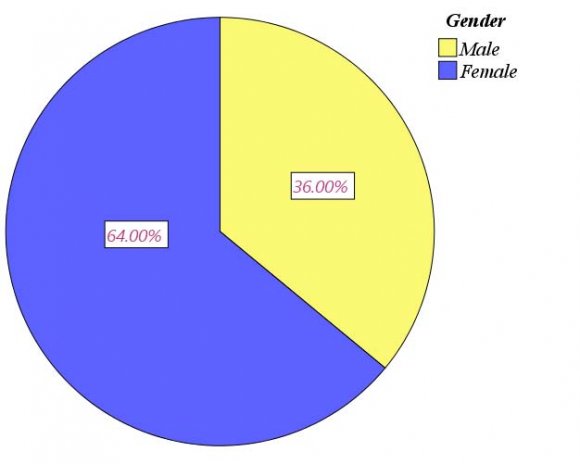
| Gender | Frequency | Percent |
| Male | 54 | 36% |
| Female | 96 | 64% |
| Total | 150 | 100% |
| Cronbach's Alpha | N of Items |
| .793 | 23 |
| N | Minimum | Maximum | Mean | Std. Deviation | |
| Teaching methodology | 150 | 1.43 | 5.00 | 4.1716 | .58028 |
| Depression | 150 | 1.00 | 5.00 | 3.4000 | .71344 |
| Motivation | 150 | 1.00 | 5.00 | 3.9644 | .70170 |
| Energy crises | 150 | 1.00 | 5.00 | 3.3267 | .69992 |
| Performance | 150 | 1.00 | 5.00 | 3.4467 | .56919 |
| Valid N (listwise) | 150 |
| A Winner Never Quits and Quitter Never Wins | |||||||
| 2015 | |||||||
| Year | |||||||
| 26 | |||||||
| Volume XV Issue IX Version I | |||||||
| ( ) A | |||||||
| Global Journal of Management and Business Research | Performance Teaching methodology Depression Motivation | Pearson Correlation Sig. (2-tailed) N Pearson Correlation Sig. (2-tailed) N Pearson Correlation Sig. (2-tailed) N Pearson Correlation Sig. (2-tailed) | Performance 1 150 .348 ** .000 149 .489 ** .000 150 .351 ** .000 | Teaching methodology .348 ** .000 149 1 149 .324 ** .000 149 .539 ** .000 | Depression .489 ** .000 150 .324 ** .000 149 1 150 .514 ** .000 | Motivation .351 ** .000 150 .539 ** .000 149 .514 ** .000 150 1 | Energy crises .423 ** .000 150 .264 ** .001 149 .488 ** .000 150 .361 ** .000 |
| N | 150 | 149 | 150 | 150 | 150 | ||
| Pearson Correlation | .423 ** | .264 ** | .488 ** | .361 ** | 1 | ||
| Energy crises | Sig. (2-tailed) | .000 | .001 | .000 | .000 | ||
| N | 150 | 149 | 150 | 150 | 150 | ||
| **. Correlation is significant at the 0.01 level (2-tailed). | |||||||
| © 2015 Global Journals Inc. (US) 1 | |||||||
| Model | R | R Square | Adjusted R Square | Std. Error of the Estimate |
| 1 | 0.819 a | .672 | .293 | .47909 |
| a. Predictors: (Constant), Energy crises, Teaching methodology, Depression, Motivation. | ||||
| Model | Unstandardized Coefficients | Standardized | T | Sig. | ||
| Coefficients | ||||||
| B | Std. Error | Beta | ||||
| (Constant) | 1.227 | .316 | 3.886 | .000 | ||
| Teaching methodology | .180 | .081 | .183 | 2.225 | .028 | |
| 1 | Depression | .254 | .069 | .319 | 3.666 | .000 |
| Motivation | .603 | .074 | .008 | .084 | .933 | |
| Energy crises | .175 | .065 | .215 | 2.683 | .008 | |
| a. Dependent Variable: Performance | ||||||
| VII. | ||||||