1. Introduction
hailand's reliance on tourism and hospitality industry is significant in that 16.9 percent of its gross domestic products is yielded from tourism Author : College of Tourism and Hospitality, Rangsit University, Patumthani, Thailand. e-mail: [email protected] economy representing 11.9 percent of total employment of the country (Blanke & Chiesa, 2013). The sector has witnessed a continual growth with the expected growth rate of 6.4 percent from 2012 through 2022. Despite its 43 rd rank in overall travel and tourism competitiveness, various sub-indicators have indicated its higher potential. Its government has prioritized this sector (ranked 27 th ) and succeeded in marketing campaigns to attract visitors to the country (ranked 11 th ). Thailand has good tourism and infrastructures as well (ranked 13 th for airline seats per kilometers for international tourists and 31 st for travel and tourism infrastructure) (Blanke & Chiesa, 2013). The aforementioned ranks showed that Thailand has greater potential than its overall ranks if it manages travel and tourism sector well.
Facing an ever intense competition and fluctuating, price sensitive, and seasonal demand of leisure market, Thailand and other established tourism destinations have diversified its marketing focus towards other lucrative markets including business travel, MICE, and other markets. Despite priority given by the government and high potential, Thailand's meeting and exhibition industry is still relatively less competitive as compared to other countries in the region. Table I reported the performance of Thailand vis-à-vis its major ASEAN neighboring countries. Table I reported the performance of Meeting and Exhibition sub-industries of Thailand and other ASEAN neighboring countries depicted and adapted from Barnes Report (2010) using sales per employee as the performance indicator. As the five available countries have different levels of cost of living making sales per employee incomparable, purchasing power parity has been adopted to convert the per employee sales of these countries more comparable (Barnes Report, 2010). Despite the fact that Thai meeting and exhibition sector is on par with those of Malaysia and superior to Indonesia and Philippines in regards to productivity, the country still lagged behind the performance of Singapore (18.08 times less productive), the most prominent MICE destination in the region. Should Thailand aim to excel MICE market, it should strive on increasing its competitiveness in this regard.
The comparatively inferior productivity of Thai Meeting and Exhibition sectors as compared to Singapore and Malaysia can be attributed to several factors. One undeniable underlying factor is employees' competence and productivity. Heightening the performance standard and productivity of employees in the industry would surely increase the competitiveness of the country's MICE industry as a whole. This article explores the minimum standard performance and its associated competencies of sales executive in exhibition industry. The standard performance and competency set will be used as the basis for competency-based hiring in order to make sure that truly competent and productive to perform the tasks up to the expected level of stakeholders while being competitive to other MICE destinations.
In the near future where conditions of ASEAN Economic Community-AEC will fully be enacted, it is expected that there will be both threats and opportunities present to Thai MICE business operators both regarding to market opportunities, threats, potential hostile merger and acquisitions (Economic Ingelligence Center: Siam Commercial Bank, 2011). In such lights, productivity of firms partially derived from employee's performance is highly critical.
In the new environment where uncertainties become normalcy of business operation (The ASEAN Secretariat: Public Outreach and Civil Society Division, 2012), organizational competitiveness and adaptability to changes need to be the core of business decision and planning. Recruiting and developing organizational talents to fit to the competitive landscape is highly important for modern organizations (Kotler, Kartajaya, & Huan, 2007). Organizational talents which are contributively and synergistically aggregated from individual employees need to be planned, managed, nurtured, and enhanced in order to assure its fit to the fast changing and volatile business environments, especially in tourism and hospitality labor markets (Baum, 2008). Hiring process to ensure that individuals with desired talents are hired is highly important.
In tourism and hospitality industry, it is hard to recruit, train and retain employees with right talents due to several factors including the lack of hiring standard, multiple points of entry to the industry, low skill specificity, variance of pay differential and flexible roles and responsibilities (Baum, 2008). Coupling with more volatile and less predictable business environments, these factors have commanded hospitality firms to revisit the task-based human hiring process to competency based hiring (Soderquist, Papalexandris, Ioannou, & Prastacos, 2010). There are a number of reasons justifying the need for human resource management paradigm shift. First, job specification of a position can easily be obsolete due to fast moving external environments and business practices. Second, employees need to be ready for position and functional mobility in order to keep pace with the fast moving competitive landscape. Competency-based hiring is undoubtedly a tool to increase a firm's competitiveness in the present environment. The question that still needs to answer is how an exhibition firm can adopt competency based hiring in such a manner that optimally strengthens its fit to the competitive landscape.
This paper aims, therefore, 1) to explore the competency sets necessary for sales executives in effectively, and 2) to propose the a method for competency based hiring. Next part of this paper addresses exhibition business as well as the concepts of competency and competency based hiring.
2. II.
3. Related Works
To address research objectives mentioned in the previous part, conceptual frameworks related to the context of the study, exhibition business, as well as the parent disciplines, competency and competency-based hiring, is hereafter discussed.
4. III.
5. Exhibition and Tradeshow
Tradeshow and exhibition is another section of MICE industry. It is, in fact, a marketing communication tool available for both trade and consumer firms to communicate, sell, and negotiate with clients, buyers, and other trade partners through direct interaction without interruption (Blythe, 1999;Herbig, O'Hara, & Palumbo, 1998). As there is no clear measurement of the effectiveness of exhibition and tradeshow, companies might be reluctant to pour in their marketing budget in participating and decorating their exhibition booths (Blythe, 1999). Besides, the tendency for companies to invest in tradeshow participation is proved to be cyclical depending on the economic cycle of particular markets (Herbig, et al., 1998). It is the duty of exhibition and tradeshow sales executives to convince potential exhibitors of the benefit of tradeshow and exhibitions especially in the time of economic slowdowns.
Benefits of tradeshow and exhibition are varied. First, Tradeshow helps promote new products to prescreened audiences without interruption from other stimulus. Second, it allows firms to uncover new prospective customers who self-screen to attend the tradeshow and to discover potential trade partners, suppliers and buyers. Third, it yields several benefits to the host destinations in forms of local spending, distribution of wealth, attraction of foreign income, stimulation of local business, and destination image. Fourth, exhibition and tradeshow help enhancing image of exhibitors in regards to their respective technological breakthroughs, good causes or other aspects of corporate image. Fifth, it helps manage and strengthen relationship between trade partners. Finally, it serves as additional selling opportunities for firms (Blythe, 1999;Firoiu, Dodu, & Patrichi, 2011;Herbig, et al., 1998). From the benefits as stated, tradeshow and exhibition are evidently important for hospitality industry, local economies, and host destinations alike.
Despite these benefits, certain firms still hesitate to participate in tradeshows and exhibitions due to their unrealistic and short term oriented expectations. The unmatched expectations of exhibitors and tradeshow attendees tend to be the most critical factors that make firms reluctant to participate in tradeshows. While attendees update themselves about players in the market, technological breakthrough, and information gathering forum for further purchase decisions, exhibitors tend to focus on sales and order taking (Blythe, 1999). Sales executives of exhibition companies who can realistically shape expectation of exhibitors should not only increase sales of the exhibition space but also assure satisfaction and repeated participation in the future.
Considering the semi custom-made nature of exhibition and tradeshow, exhibition firms can maximize the value of each client by selling largest exhibition space as well as other services to them including venue decoration and other supporting services. Sales executives' skills in selling and managing the project are crucial for a firm's success and competitiveness.
Critical success factors of a tradeshow highly depend on sales executives' performance especially in regards to expectation shaping and persuasive communication (Friedman, 2002). From the beginning of sales process, sales executives must shape the most realistic expectation to exhibitors and inform them of what to be expected and what is not. Consultative dialogue about how to increase exhibition effectiveness in regards to relationship management and marketing communication also helps increase per transaction sales of exhibition as well as strengthening long-term relationship (Friedman, 2002). It is clear that sales executives play an important role in making a tradeshow successful. Hiring sales executives with competencies that allow high performance is, therefore, highly critical for its competitiveness.
IV.
6. Competency
For decades, the concept of competency has gained recognition from both human resource practitioners and academics due to its role as underlying enabling factors of expected performance (Melaia, Abratt, & Bick, 2008). Using competency as the core of human resource decision also allows firms to better embrace changes and adapt themselves successfully (Baum, 2008). Competency can be defined as allied inherent and developed skills, knowledge, and other attributes that allow a job incumbent to perform his/her tasks adequately or superiorly within a working context (Baum, 2008;Bhatawdekar & Bhatawdekar, 2012;Soderquist, et al., 2010). It can be seen from the definition given that competency must be set against certain set of standard either for job adequacy or task superiority. Besides, competency sets should be adjusted according to each firm's working environment. One can assume, therefore, that there is no universal set of competency standard that fit in all organizations in an industry.
Competency can be approached from different angles. Certain scholars divide competency into categories namely hard and soft skill competencies (Weber, Finley, Crawford, & Rivera Jr., 2009). While hard skills are important for technical aspect of task performance, soft skills are precursors high performance of individual employees (Testa & Sipe, 2012;Weber, et al., 2009). Despite its indirect relevance to task completion, soft skill competency which covers four aspects namely relationship skills, management and organization, communication and cognition skills, are indispensable for a firm's competitiveness and productivity (Weber, et al., 2009). From this approach, it can be argued that individuals need to possess soft skill competencies to master well the hard skills.
Competency can also be approached from a more function oriented perspective. Testa and Sipe (2012) categorized competency into three groups namely business savvy competencies, people savvy competencies, and self-savvy competencies. Business savvy competencies concern mainly skills and thinking process that allow employees to make astute business decisions such as number wise, planning, strategic decision, system thinking (Testa & Sipe, 2012). People savvy competencies mainly deal with interpersonal skills that allow individuals to create positive and constructive rapports with others (Testa & Sipe, 2012). This competency is highly important for hospitality industries due to high contact nature of the industry (Kay & Rusette, 2000; Lovelock, Patterson, & Walker, 2001). Self-savvy competencies deal with ethics, disciplines, self-locus of control, accountability, professionalism, time and change management (Testa & Sipe, 2012). It can be seen, here, that self-savvy competencies make an employee an organic member of the organization. Other two types of competency help ensure high performance and organizational competitiveness.
Cappallen, and Jassens (2008) group competencies into three categories namely know-why competencies, know-how competencies, and knowwhom competencies. Know-why competencies concern mainly personal identification to the profession, motivation to work, and the match between the organizational and personal goals of employees (Cappellen & Janssens, 2008;Defillipi & Arthur, 1994). Know-why competencies determine how devoted an employee is. Without this quality, an organization cannot be assured that employees put their maximum efforts to the work assigned. Apart from the job identification, know-why competencies also include other transferable skills that allow a person to be better motivated and identify him/herself to the profession while making more astute decisions.
Know-whom competencies reflect career relevant networks inside and outside a firm (Defillipi & Arthur, 1994). This type of competency is highly important for sales and marketing functions due to the high contact nature of the functional area (Melaia, et al., 2008). It is also related to certain inherent qualities such as personal traits and social skills as well as work experience (Asree, Zain, & Razalli, 2010). Consequently, know whom competencies in this particular study also embrace knowledge, skills, and other attributes that allow better network enhancement and development. Therefore, a sales executive in exhibition business needs to possess know-whom competencies in order to close sales and make things possible for the project.
Know-how competencies concern task completions according to what specified in the job description (Cappellen & Janssens, 2008). This type of competency is highly technical by nature. However, employees need to possess other transferable skills ensure high performance of this competency (Koenigsfeld, Perdue, Youn, & Woods, 2011). This particular study will use know-why, know-whom, and know-how competencies to group the competency.
V.
7. Competency Model
To identify competencies required in a job position, competency model must be developed. Competency models conventionally used now in most industriesare models and matrices that overstress technical skills while downplaying the importance of know-why and know-whom competencies (Langdon & Marrelli, 2002;Testa & Sipe, 2012). While certain models identify competency for expected performance, others identify competencies in forms of knowledge, skills, and attributes that underlie superior performance (Duad, Ismail, & Omar, 2010;Purdue, Ninemeier, & Woods, 2002). Good competency models must, hence, include both soft and hard skills while giving more weight to soft competencies (Chapman & Lovell, 2006).
To identify a competency model, job descriptions must be first studied and analyzed. Unfortunately, most job descriptions are vaguely written with debatable loopholes and do not specify the task standard. Like competency models, job descriptions tend to over-stress the importance of technical part of job fulfillment. Therefore, they cannot serve as a salient basis for recruiting, appraising, and developing the job incumbents (Soderquist, et al., 2010). Despite such flaws, job description is a starting point of a competency model development as it specifies that is expected from an employee assuming a job position given an organizational context (Soderquist, et al., 2010).
Another problem with conventional competency models is that they are developed from data collected from only one group of job stakeholders which might not cover all angles of the job. A good competency should, therefore, be developed from data collected from various stakeholders to the job position both inside and outside an organization (Langdon & Marrelli, 2002). Given the fact that changes are fast and unpredictable, a good competency model must also embrace competencies that allow job incumbents to be adaptive to change (Rowe, 1995). Ideally, competency models developed for several positions in an organization should be based on organizational strategies and their required competency to ensure that they have developed and recruited employees with needed competencies for competitiveness (Hamimi Abdul Razak, Kamaruddin, & Abdul Azid, 2012).
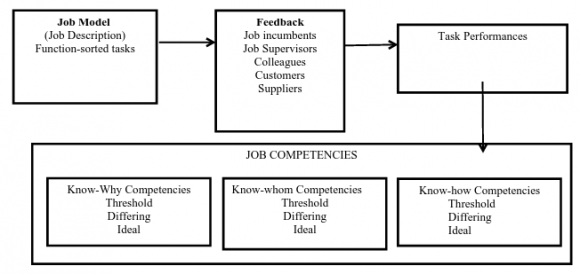
As for this particular study, the competency model to be used is adapted from "Language of Work-LOW" model developed by Langdon and Marrelli (2002) due to the context of the study which aims to set competency-based hiring criteria for sales executive position for the whole Thai exhibition and tradeshow industry. It, consequently, excludes organizational factors out of the consideration. After grouping and sorting tasks, data from informant groups including persons assuming sales executive position in the tradeshow and exhibition themselves, job supervisors, colleagues, suppliers, and customers, were collected about their expected performance of tasks included in the job description. Associated to the performance standard, they were also asked to report their believed underlying competencies in the forms of knowledge, skills, and other attributes. Competencies reported were further sorted into three groups namely know-why, know-whom, and know-how. The competency set acquired from this model will be used as the basis for competency-based hiring for this particular position.
8. VI.
9. Competency-based Hiring
Due to volatility of the work environment as well as fast borderless and directionless external environment, mobility of career path and change adaptation becomes the core of the human resource decision (Asree, et al., 2010;Baum, 2008). Consequently, the conventional task-based human resource management is now being replaced by its competency-based counterpart (Soderquist, et As human resource is now an integral part of an organization's strategy (Jain & Haley, 2009), all firms should identify the gap between their current organizational competencies and the needed competencies given the strategies stated (Soderquist, et al., 2010). The gap identified can actually assure the alignment of firms' strategies and their human capital (Priyadarshini & Dave, 2012). As this present study does not study one particular exhibition firm, the proposed competency set should be adapted to each organization's working environment and strategies.
As certain competencies tend to precursor the mastery of others, recruitment, interview, hiring, compensation, and development policies and practices should be based on competencies not the performance of tasks included in a job description (Chapman & Lovell, 2006;Testa & Sipe, 2012). However, employers should place more importance on less observable and inherent skills than technical ones (Chapman & Lovell, 2006). Besides, as certain competencies are inherent to individuals while others can be developed, hiring practices and policies should focus on the former while HRD policies should focus on the patter (Bhatawdekar & Bhatawdekar, 2012; Chapman & Lovell, 2006). Consequently, the hiring policies of exhibition sales executives should focus on know why and know whom competencies than know how competencies.
Candidate screening process based on competencies that underlie the expected performance became a challenge to employers given the conventional recruitment practice where candidates are selected from their curriculum vitae and job interview which are short and parsimonious in nature (Cappellen & Janssens, 2008;Jauhari, 2006). These practices do not allow employers to observe qualities that are inherent to the candidates such as observance, ethics, attitudes, and work disciplines. Besides, candidates can fake their qualities to appear more desirable for job interviewers as well. Alternative forms of job interview should be used such as case studies that simulate real working situation of a position should be used in order to observe and evaluate how effective a candidate perform in such a situation (Bleedorn, 1993). Apart from case study base screening, it is advised for employers to assign as much work to newly recruited employees during probationary period as well in order to assess the inherent qualities that are important for the positions.
Fortunately, there are a myriad of aptitude and evaluation scales commercially available for a number of skills including thinking, social, communication, interaction, and cross-cultural skills ( Of course, all these measures make recruitment harder and time-consuming. However, it better ensures the success of recruitment and hiring of employees who would finally contribute their respective talents to the organizational effectiveness.
Compensation policies of most firms tend to be based on the job experience the candidate has in the industry and other qualifications such as education, proficiency of English etc. Taking a long-term perspective to human resource management where an employee hired must progress along the managerial path and mobile across functional areas, compensation must also be based on the competencies or potential of a person in the future as well (Bhatawdekar & Bhatawdekar, 2012).
10. VII.
11. Methods
To come upsets of competency necessary for hiring a sales executive in exhibition and tradeshow business in Thailand, a qualitative research design is adopted for two reasons. First, there are a very limited number of studies conducted in the area of competency in exhibition business. Inductive approach to fact finding is, thus, warranted (Hennink, Hutter, & Bailey, 2011; Neuman, 2011).Second, the researcher aimed to capture richness of information (Hennink, et al., 2011).This empirical study follows the model stated in Figure I. To start, interview question is developed from job descriptions of selected exhibition firms that were member of Thai Exhibition Association-TEA. Data collection was discussed followed by data analysis.
12. a) Development of Interview Frame
As discussed in the previous section, this study followed the competency model stated in Prepare and coordinate all job relevant documents Rank and riles Figure II reported tasks included job descriptions of sales executive from three Thai PEOs selected by Thai Exhibition Association based on business standard and reputation in the industry. To facilitate the data collection process, tasks were combined into mutually exclusive items, deleted in case of redundancy, and finally sorted into functions. The job description was the basis for the in-depth interview which is the major data collection method of this study. During the interview session, informants were asked to report their expectation of the performance of a sales executive for particular task at the threshold level. Following the report of performance, they were also asked to report the competencies that underlie such a performance in terms of knowledge, skills, and attributes. The researcher moved to differing performances and the underlying competencies. Differing performances referred to the differential performance of high performers from average performers. Finally, informants were asked to report their believed ideal performances for particular tasks and the associated competencies.
13. b) Research Design i. Recruitment of Participants
According to the model stated in Figure I, data in regards to the performances of tasks included in the job description of sales executives in Thai exhibition and tradeshow businesses as well as their underlying competencies were to be collected from five groups of feedback providers. To ensure the comprehensiveness of the competency model to be developed, five groups of feedback providers were included in this study. The feedback provider groups were job incumbents, their supervisors, colleagues, suppliers, and customers.
Purposive recruitment of informants was adopted to ensure the eligibility of the informants in providing data (Hennink, et al., 2011). As there are five groups offeedback providers or participants, TEA, the most recognizable exhibition and tradeshow professional association in Thailand agreed to be the gatekeeper for this present study. It helps pick five of its members who are leading exhibition firms. With the assistance from gatekeeper, the researcher reached job incumbents and job supervisors. Additional participants were recruited using snowball recruitment method via the network of job incumbents and job supervisors (Hennink, et al., 2011).
ii. In-depth Interview as Major Data Collection Method Due to the exploratory nature of this study, indepth interview which allows the participants to freely report their respective perception of threshold, differing and ideal performances as well as the associated competencies, standardized open-ended interview was selected as the major data collection method (Patton, 2002). The interview sessions were conducted according to the principles of Payne (1951); being single, being clear, being truly open-ended, and being neutral.
Participants were contacted by gatekeepers to request their permission for the interview appointment. The interview appointments were reconfirmed by the researcher before sending the interview frame to them beforehand. The objectives, nature of questions, length of time, natures of questions, statement of confidentiality, the freedom to withdraw, and voluntary participations were informed to the informants (Bouma, 2000).
14. iii. Validation of Finding Using Group Interview
The initial finding from in-depth interview was validated by triangulations of measures and observers (Neuman, 2011). The former refers to the collection of data from the same group of participants but using different methods of data collection. The latter refers to the collection of data from different groups of participant. The competencies reported by participants from in-depth interview sessions were further discussed in the group interview session.
Focus group interview is a qualitative method with primary goal of making attitudes, beliefs, behavior, attitude about particular issues in an informants explicit knowledge and is normally used in exploratory research to test ideas, solving specific problem and evaluation (Ezzy, 1999). Panelists who are board members of TEA were recruited for group interview. TEA Board Members were entrepreneurs and high rank executives in tradeshow and exhibition businesses in Thailand. Therefore, the eligibility of finding acquired from group interview can be assured.
In the group interview, panelists were given with the performance standard for three levels of performance and their respective underlying competencies. The researcher who acted as group moderator asked them to discuss that appropriateness, and the completeness of the task performances as well as the competencies. After the group interview, the competency set was adjusted accordingly. The finding from group interview will be analyzed using the priori theories.
15. iv. Data Analysis
The competencies reported and adjusted from in-depth, and group interviews were sorted into knowwhy competencies, know-whom competencies, and know why competencies as follows:
1. Competencies that lead to self-identification with the profession and motivation, transferable skills, and ethical considerations were coded into know-why competency.
2. Competencies that underlie the relationship management, enhancement and retention of professional network, and interpersonal interactions were grouped into know-whom competency 3. Competencies that are directly related to technical aspect of task completion were coded into knowhow competencies
The aim of this study is to develop a competencybased hiring guideline for the sales executive position in Thai exhibition and tradeshow business. Only competencies that are antecedents of threshold performance were included into the hiring set. Developable competencies were also excluded from the competency-based hiring criteria set as they can be trained and developed in a short period of time.
16. VIII.
17. Results
In-depth interview sessions were conducted with 21 participants who recruited from purposive recruitment and snowball recruitment methods. Among the 19 participants, 5 were job incumbents and another 5 were job supervisors. Four of them were colleagues to sales executives who work in other department yet had regular contact with them. Three of them were suppliers or representatives from third party service providers for exhibitions and tradeshows. Only two customers were recruited in the sample. They reported three levels of performance as well as their respective competencies. Due to the tightly scheduled obligations of participants, the in-depth interview sessions were conducted from March to October 2013.
After the in-depth interview sessions were completed, panels were recruited. Eight panelists who sat in the board of Thai Exhibition Association-TEA were recruited. Three of them were owners of major Professional Exhibition Organizer firms while other 5 were high ranked executives in large exhibition firms. During the group interview, panelists requested the researcher to move the level of performances. Most items were moved downward from differing performance to threshold performance. The same was done for competency as well. From the above table, it can be seen that for a sales executive in exhibition and tradeshow to perform the tasks included in the job description. They, hence, rely on knowledge about exhibition and tradeshow businesses as well as market intelligence and customer knowledge. Product knowledge and knowledge about other tradeshow components as well as their logistical and safety requirements are indispensable for effective sales performance as well. These competencies were categorized as "Know-how" competencies that are directly related to technical part of the task completion.
For exhibition firms to optimally utilize the knowhow competency, its sales executives rely on "know-why competencies" and "know-whom competencies" to master the job completion and know-how competencies.
Know-why competencies are selfidentification to the profession, motivation and other factors that other transferable skills that allow better astute decision making (Defillipi & Arthur, 1994).
For threshold performance of exhibition sales executives, sales executives depend on their respective thinking skills in the most logical, systematic, analytic, and critical manner to capture the situation. They also need to be able to pose questions strategically to get the information needed. To make a sales dialogue and to develop a sales proposal that intrigue clients' decision, they rely very much on problem solving, systematic planning skills, communication skills and acumen. To ensure the profitability of the project, sales executive also needs to have cost management skills. However, sales executives will only exert their maximum level of effort to work according to the job description, sales executives need right attitudes and approach to work. Goal oriented attitudes, honesty, adaptation to change, fairness, sacrificing, patience, and persistence all contributively make sales executive an organic member of the organization who tend to ethically work extra miles for the organizational success.
Know-whom competencies are not less in importance in making a sales executive successful in their task completion at the threshold or expected level from the stakeholders. Apart from communication skills at the verbal level, sales executives must be sensitive to all the non-verbal communications from both clients and colleagues. Interpersonal skills that are highly associated to their respective personalities (agreeableness and emotional stability), looks, manner, and business etiquette are also an indispensable part of sales executives to maintain, create, and enhance relationship with clients, colleagues, and suppliers. It can be seen that without Know-whom competencies and Know-why competencies, sales executives cannot perform their tasks according to what specified in the job description (Table II).
Considering that most "Know-how" competencies for the threshold level of performance are knowledge about exhibition and tradeshow as well as other related knowledge which can be acquired once sales executive are already in the industry, the screening process of candidates for the position should focus on qualities that are inherent to them or take time to develop (Bhatawdekar & Bhatawdekar, 2012;Chapman & Lovell, 2006). Hiring policies for sales executives in Thai exhibition and tradeshow industry should focus on inherent qualities of candidates such as thinking, communication and interpersonal skills as well as other qualities such as acumen, personality, professional network, look and manner, observance, and other ethical qualities. Table IV IV, it can be seen that candidate screening process should not limit itself to job-interview which normally lasts 30 minutes to 2 hours (Cappellen & Janssens, 2008;Jauhari, 2006). Several skills and qualities can be observed, despite the fact that they can also be pretended, during the interview sessions including communication skills, acumen, thinking skills, and other attitudes. Others such as attitudes, problem solving, cost management, honesty, interpersonal skills, sensitivity, work disciplines, and network in the industry tend to be hard to assess and verify during a short interview session. Case studies that simulate the real life situation of sales executives in exhibition and tradeshow industry should be developed to assess all aspects of inherent qualities required (Bleedorn, 1993). Along with case studies, employers in exhibition and tradeshow industry should invest in aptitude tests commercially available to test crucial transferable skills namely communication, thinking, social, and intercultural skills (Bhatawdekar & Bhatawdekar, 2012;Bleedorn, 1993;Jauhari, 2006).
The above table also showed that all inherent qualities desired in an exhibition and tradeshow sales executive in Thailand are "Know why" and "Know-whom" competencies. Therefore, it can be assumed that know-how competency mastery depends on the possession of know-whom and know-why competencies.
Considering that know-how competencies which are usually knowledge that can be taught or trained in schools and on-the job, they can be developed after hiring. On the contrary, know-whom and know-why competencies which are mostly skills and other attributes which are precursors of high performance tend to be inherent or hard to develop. Therefore, human resource management decisions should focus on know-why competencies, and knowwhom competencies.
Considering the critical success factors of tradeshow and exhibitions, the threshold competencies seem not to lead to such factors. Communication skills at this level, for example, would not lead to a sales dialogue with prospective customers that shape a realistic expectation or maximize sales value through cross-selling and up-selling. Competencies that support superior performance (differing performance) tend to be more valid in such as case. From Table V, it can be assumed that only high performers can contribute to an organization's competitiveness through the achievement of key success factors in the industry. Charismatic communication and high level of negotiation skills, for example, can shape realistic expectation of prospective exhibitors and cross-sell the products. Know-why, and know-how competencies reported in the above table should also be used in screening candidates to ensure high level of performance. However, it might be hard to find candidates that meet all these competencies in the labor market. Therefore, the differing competencies should be used together with threshold competencies in an additive fashion. All candidates should meet all the inherent competencies for threshold performance (minimum acceptable performance as reported by participants-Table IV)to be included in a short list of candidates. Final decision should be based on the "know why" and "know-whom" competencies for differing performance. Recruitment and hiring for the position of sales executive in exhibition and tradeshow industry becomes more difficult, complex and time consuming. However, the result should be beneficial for the whole organization in the long run.
18. c) Competency-based Hiring Methods for Sales Executive in Thai Exhibition and Tradeshow Industry
Both in-depth interview and group interview have revealed competency set necessary for hiring a sales executive in Thai exhibition and tradeshow businesses. From the discussion in the previous section, transferable skills related to decision making, communication, relationship management, and especially thinking as well as work and life values determine how a sales executive in tradeshow and exhibition industry in Thailand use their knowledge to perform their tasks effectively. Sales executives on "know-why" and "knowwhom" competencies to perform the tasks according to the expected level from stakeholders' perspectives. However, empirical data showed that competencies for threshold performance do not support the critical success factor of exhibition and tradeshow business. Differing competencies should, therefore, be brought into hiring consideration for this position. Hiring methods for the sales executive position can be proposed as follows;
1. Before job interview, employers should assess candidates for transferable skills namely communication, social, thinking, and intercultural skills using commercially available aptitude tests 2. Candidates should be evaluated using simulated case studies with situation complexities. Candidates must be observed through critical observation and interviewed for their decision justification 3. Job interviewers must ask questions that require candidates to use their acumen and skills to answer. Non-verbal communication should also be critically observed. 4. The decision process should be two folds. First, candidate shortlist should be developed by screening candidates with threshold "know-why" and "know-whom" competencies. Second, the final decision should be based on differing "who-why" and "know-whom" competencies. 5. Newly hired sales executives must be critically observed for their competencies during the probationary period by focusing on their "knowwhy" and "know-whom" competencies 6. Human resource development programs for newly hired sales executives should aim to develop "know-how" competencies or competencies that allow the mastery of technical part of the job 7. Compensation decision should be based on "knowwhy" and "know-whom" competencies IX.
19. Conclusion and Future Work
Exhibition and tradeshow industry is undoubtedly important for Thai tourism and hospitality sector and Thai economy overall, the sector still needs tremendous improvement to increase its productivity. Sales executives play crucial roles in the success of an exhibition and tradeshow firm in several regards including shaping realistic expectation, maximizing per transaction sales, and profitability. Hiring right sales executives can contribute greatly to a firm's competitiveness. Amid unpredictable changes and formless competition, competency-based hiring must be adopted. Competencies are underlying factors performances. They comprises three components namely knowledge, skills, and attributes. Some competencies are inherent to individuals or take long time to develop; others can be developed through human resource development and on the job training. Hiring decision should focus on inherent competencies of candidates while training decision should focus on developable competencies.
A qualitative study through in-depth interview with 19 participants who are stakeholders to the "sales executive" position in Thai exhibition and tradeshow industry was conducted with the assistance from exhibition professional association-Thai Exhibition Association, who acted as the gatekeeper to explore the competencies for three levels of performancethreshold, differing, and ideal performances. Focusgroup interviews with panels comprising TEA board members were conducted to triangulate the finding. The finding showed that "know-why" and "know-how" competencies were more in number and underlie the mastery of "know-how" competencies which covers the technical part of the job description. Hiring sales executives for Exhibition and Tradeshow industry should, therefore, be based on "know-why" and "know-whom" competencies. However, when matching the competencies that support the threshold performance with key success factors of the industry, it was found that they did not support one another. Employers should use threshold competencies to create short list while making a final decision using differing competencies. Hiring practices were proposed in this study as well.
Scholars and practitioners in the field interested in this topic should complete the study by developing evaluation tools for "know-why" and "know-whom" competencies that are practical for employers with limited access to aptitude tests that might be costly. Case studies should also be developed to support a hiring decision as well. Longitudinal studies that track the actual performance of sales executives recruited by competency-based method should be undertaken to validate the merit of competency-based hiring approach.
X.

| Country | Sales/ | PPP | PPP | Efficiency |
| Employee | Ratio | Sales/ | Ratio | |
| Employee | ||||
| Singapore | 340,631 | 1.377 | 469,048.89 | 18.08 |
| Malaysia | 15,191 | 1.966 | 29,865.51 | 1.15 |
| Thailand | 12,551 | 2.067 | 25,942.92 | 1.00 |
| Indonesia | 8,084 | 1.769 | 14,300.60 | 0.55 |
| Philippines | 4,601 | 2.006 | 9,229.61 | 0.36 |
| Depicted from: (Barnes Report, 2010) | ||||
| Functional Areas | Tasks |
| Sales and | Help plan, acquire insights, provide |
| Marketing | input and help team members in |
| planning and implementing tasks | |
| Make sales call with current and new | |
| clients | |
| Follow up with unclosed sales and | |
| negotiate the best deal | |
| Cross-sell/ up-sell where possible and | |
| appropriate | |
| Prepare bidding proposal | |
| Coordinate and follow-up the bidding | |
| procedures | |
| After confirmation from clients, conduct | |
| service level agreement with all | |
| concerned | |
| Assist the site inspection and report to | |
| sales | |
| Search, acquire information and | |
| specification about services needed by | |
| customers from 3 rd party suppliers | |
| Operation | Coordinate with relevant departments |
| internally and external partners | |
| Co-develop the action plan and timeline | |
| of the function throughout the process | |
| Be the center of coordination | |
| throughout the project implementation | |
| Verify the project readiness before show | |
| days | |
| Finance and | Verify bills and approve payment |
| budget | Follow up payment from clients |
| according to the contracts and policies | |
| Administrative |
| Competency | Sources | of | Component | Level | of | Types | of |
| Competency | Performance | competency | |||||
| revenue | |||||||
| Competency Social Skills appropriate for people from broad backgrounds Knowledge about characteristics, natures, and operation Stay neutral in conflict situations and reserve negative opinions parts of different types of exhibition and tradeshows Knowledge about customary procedures and practices Social acumen | Sources Competency of Inherent Developable Inherent Developable Inherent | Component Attribute Knowledge Attribute Knowledge Attribute | Level Performance of Threshold Threshold Differing Threshold Ideal | Types KNOW-WHOM of competency KNOW-WHY KNOW-HOW KNOW-HOW KNOW-WHOM | |||
| in the country Knowledge about customary procedure and practices in Systematic planning skills Planning Skills (Anticipate potential problems) international markets Customer knowledge about their business, goals, needs Planning Skills (With contingency plans) Correspondence preparation appropriate for document about tradeshows and exhibition, their critical success recipients factors and past events Knowledge about logistical limitation and safety Interpersonal skills Work experience in tradeshow and exhibition business requirements of the venues and exhibits Product (components) knowledge with regards to Work experience in both tradeshow and exhibition as well as other related businesses capacity, quality, cost, and availability Comparative product (components) knowledge (with Acumen Agreeable personality competitors) Knowledge about local current affairs Compromising Knowledge about international socio-economic current Charisma | Developable Developable Developable Developable Developable Developable Developable Inherent Inherent Developable Inherent Developable Inherent Inherent Developable Inherent Developable Inherent | Knowledge Skill Skill Knowledge Skill Skill Knowledge Skill Attribute Knowledge Attribute Knowledge Attribute Attribute Knowledge Attribute Knowledge Attribute | Differing Threshold Differing Threshold Ideal Threshold Threshold Threshold Threshold Threshold Differing Differing Threshold threshold Threshold Differing Differing Ideal | KNOW-WHY KNOW-HOW KNOW-WHY KNOW-WHY KNOW-HOW KNOW-HOW KNOW-WHOM KNOW-HOW KNOW-HOW KNOW-HOW KNOW-HOW KNOW-WHY KNOW-HOW KNOW-WHOM KNOW-WHOM KNOW-WHY KNOW-WHY KNOW-WHOM | |||
| affairs Goal oriented attitude | Inherent | Attribute | Threshold | KNOW-WHY | |||
| Market intelligence about customers and competitors | Developable | Knowledge | Threshold | KNOW-HOW | |||
| International market intelligence Optimism towards problems and obstacles | Developable Inherent | Knowledge Attribute | Differing Differing | KNOW-HOW KNOW-WHY | |||
| Accounting, costing, and pricing skills Persistence | Developable Inherent | Knowledge Attribute | Threshold Ideal | KNOW-WHY KNOW-WHY | |||
| Knowledge about suppliers with regards to quality, preparation time, working styles, and cost and tradeshow business Personal network and professional network in exhibition | Developable Inherent | Knowledge Attribute | threshold Threshold | KNOW-HOW KNOW-WHOM | |||
| Knowledge about working process within the organization industries Personal network and professional network in related | Developable Inherent | Knowledge Attribute | Threshold Differing | KNOW-HOW KNOW-WHOM | |||
| Relationship management skills with quality suppliers Emotional stability | Developable Inherent | Skill Attribute | Differing Threshold | KNOW-WHY KNOW-WHOM | |||
| and trade partners Emotional locus of control | Inherent | Attribute | Differing | KNOW-WHOM | |||
| Knowledge about working process of other departments Responsibility and devotion | Developable Inherent | Skill Attribute | Differing Ideal | KNOW-HOW KNOW-WHY | |||
| in the organization Look and manner that command trust | Inherent | Attribute | Threshold | KNOW-WHOM | |||
| Communication skills (Concise, Precise, Logical idea Self-esteem and confidence | Developable Inherent | Skill Attribute | Threshold Differing | KNOW-WHY KNOW-WHY | |||
| organization, Audience Appropriate) Good memory | Inherent | Attribute | Differing | KNOW-WHY | |||
| Sensitive to body language, facial expressions and other Observance and detail oriented | Developable Inherent | Skill Attribute | Threshold Threshold | KNOW-WHOM KNOW-WHY | |||
| non-verbal cues Meticulous and neat working style | Inherent | Attribute | Differing | KNOW-WHY | |||
| Thinking skills (Logical, Systematic, Analytical, Critical, Scrutinizing for perfection | Inherent Inherent | Skill Attribute | Threshold Ideal | KNOW-WHY KNOW-WHY | |||
| Conceptualization) Service minded | Inherent | Attribute | Threshold | KNOW-WHOM | |||
| Thinking skills (Creative, Synthetic, Comprehensive) Enthusiasm when encountering with others | Inherent Inherent | Skill Attribute | Differing Differing | KNOW-WHY KNOW-WHOM | |||
| Project management skills according to the contract and Work disciplines operational budgeting plan Comprehensive understanding of the project and ability Well-preparedness Patience and ability to work under pressure to anticipate problems High level of English proficiency Fairness Problem solving skills and accurate anticipation of Adaptive to change Honesty further effects of the problems Problem solving skills on an unplanned basis Business etiquette Comprehensive problem solving skills Sacrificing | Developable Inherent Inherent Inherent Inherent Developable Inherent Developable Inherent Inherent Developable Developable Developable Inherent | Skill Attribute Skill Attribute Attribute Skill Attribute Skill Attribute Attribute Skill Attribute Skill Attribute | Threshold Threshold Threshold Threshold Threshold Differing Threshold Threshold Threshold Threshold Differing Threshold Ideal Threshold | KNOW-HOW KNOW-WHY KNOW-WHY KNOW-HOW KNOW-WHY KNOW-WHY KNOW-WHY KNOW-WHY KNOW-WHY KNOW-WHY KNOW-WHOM KNOW-WHY KNOW-WHY KNOW-WHY | |||
| Negotiation skills | Developable | Skill | Threshold | KNOW-WHOM | |||
| Comprehensive negotiation skills that balance between | Developable | Skill | Differing | KNOW-WHOM | |||
| long-term relationship | |||||||
| Charismatic negotiation skills | Developable | Skill | Ideal | KNOW-WHOM | |||
| Strategic questioning skills | Inherent | Skill | Threshold | KNOW-WHY | |||
| Cost management and control skills | Developable | Skill | Threshold | KNOW-WHY | |||
| Business instincts especially with regards to cost and Inherent | Attribute | Ideal | KNOW-WHY | ||||
| From Table | ||
| Competency | Types | of |
| competency | ||
| Thinking skills (Logical, Systematic, Analytical, Critical, Conceptualization) | KNOW-WHY | |
| Comprehensive understanding of the project and ability to anticipate problems | KNOW-HOW | |
| Strategic questioning skills | KNOW-WHY | |
| Social Skills appropriate for people from broad backgrounds | KNOW-WHOM | |
| Interpersonal skills | KNOW-WHOM | |
| Work experience in tradeshow and exhibition business | KNOW-HOW | |
| Acumen | KNOW-WHY | |
| Agreeable personality | KNOW-WHOM | |
| Goal oriented attitude | KNOW-WHY | |
| Personal network and professional network in exhibition and tradeshow business | KNOW-WHOM | |
| Emotional stability | KNOW-WHOM | |
| Look and manner that command trust | KNOW-WHOM | |
| Observance and detail oriented | KNOW-WHY | |
| Service minded | KNOW-WHOM | |
| Work disciplines | KNOW-WHY | |
| Well-preparedness | KNOW-WHY | |
| Patience and ability to work under pressure | KNOW-WHY | |
| Fairness | KNOW-WHY | |
| Adaptive to change | KNOW-WHY | |
| Honesty | KNOW-WHY | |
| Sacrificing | KNOW-WHY |
| Competency | Types | of |
| competency | ||
| Knowledge about customary procedure and practices in international markets | KNOW-HOW | |
| Comparative product (components) knowledge (with competitors) | KNOW-HOW | |
| Knowledge about working process of other departments in the organization | KNOW-HOW | |
| Work experience in both tradeshow and exhibition as well as other related businesses | KNOW-HOW | |
| Knowledge about international socio-economic current affairs | KNOW-WHY | |
| International market intelligence | KNOW-WHY | |
| Relationship management skills with quality suppliers and trade partners | KNOW-WHY | |
| High level of English proficiency | KNOW-WHY | |
| Problem solving skills on an unplanned basis | KNOW-WHY | |
| Planning Skills (Anticipate potential problems) | KNOW-WHY | |
| Stay neutral in conflict situations and reserve negative opinions | KNOW-WHY | |
| Optimism towards problems and obstacles | KNOW-WHY | |
| Self-esteem and confidence | KNOW-WHY | |
| Good memory | KNOW-WHY | |
| Meticulous and neat working style | KNOW-WHY | |
| Thinking skills (Creative, Synthetic, Comprehensive) | KNOW-WHY | |
| Comprehensive negotiation skills that balance between long-term relationship | KNOW-WHOM | |
| Compromising | KNOW-WHOM | |
| Personal network and professional network in related industries | KNOW-WHOM | |
| Emotional locus of control | KNOW-WHOM | |
| Enthusiasm when encountering with others | KNOW-WHOM |