1. Competitive Intelligence Contribution to Gathering Knowledge of Nation
Abstract-In view of the fact that competitiveness of nations postulates the ability of nation to assure the best conditions to develop businesses and to enhance nation well being, it means that it is need to gather effort of nation to obtain good results, as well as to gather nation knowledge to elaborate goals and objectives of nation's competitiveness development. This paper brings to attention some aspects regarding how to organize a national body to summaries nation's knowledge necessary to formulate targets to enhance nation competitiveness. A part of this knowledge should be the contribution of competitive intelligence systems organized at national level at the government public institution sustaining decision makers with actionable intelligence about foreign environment and competitors.
In this respect, paper offer a general view about who is charged at national level to gather nation knowledge, how is possible to have the best results collecting knowledge and intelligence. Finally, paper propose a methodology to analyses competitive position of nation and information flow in rational decision making to elaborate competitiveness strategy and to implement policies at sector level.
Starting with cross transverse analyses in field of nation's competitiveness theory and practice in some countries found that valuing the advantages gained using the knowledge gathered institutionally by nation efforts and implying system and instrument of competitive intelligence means understanding the potential of knowledge as factor of production and as the most important element of a rational decision making.
Presenting some nation's model organizing own competitiveness coordination, paper shows that the role of state as initiator is decisive. By actionable intelligence delivered to national competitiveness strategy makers, the role of the government's public institution which has own competitive intelligence system is to facilitate the knowledge creation necessary to finalize the fitted competitiveness strategy. The second role as facilitator of government's public institution consists in implementation of policies drawn from national competitiveness strategy assumed by the government.
Knowledge learned by analysis help to understand experience gained by other state's national competitiveness systems functioning, and as well as help to understand the logic of strategy elaboration in this field. Paper has a character of correspondence using knowledge of previous experiences and similar projects. Public information found represents only a kind of guide to design national competitiveness body and competitive intelligence system.
2. I. Introduction
aper has two parts, the first is a critical analyze of nations practice in organizing national competitive systems and using competitive intelligence. Keeping the logic of best practices, the second part of paper presents general guide designing national competitiveness system for a fictive country. This part of paper has an exploratory character by designing analytical system and pyramid of competitiveness, showing basic conditions and main determinants of enhancing nation sustainable competitiveness.
Enhancing competitiveness of nation is a national effort influenced mainly by government. Following idea regarding to modernizing state apparatus using new conceptual elements and new mental models, systems and instruments of management science, as well as benchmarking with other states institution's best practices, paper examines through cross transverse analyze basic elements of nations competitiveness systems. This part of paper use knowledge of previous experience having a character of correspondence.
First of all using competitive intelligence system at state level is the role of government and should be part of the state modernization, but in the same time should put in work one of the most important productive force the knowledge. The main concept sustaining theoretical research on conceptual transfer of management systems to public institution is not novelty, it has theoretic base on some well-known remarks. One of this shown by Herbert Simon (1962) sustains that "the public institutions are similar entities like companies, eventually they have higher complexity." Following this logic, the public institutions management should use management systems and tools similar to the business organization. As it is known, public management and the new public management were only some attempts to change the administrative state without solving the main problems of state modernization, neither enhancing procedures efficiency or implementing knowledge management .
Paper sustains that implementation of competitive intelligence system at government entities should be an important step to the state modernization. The actionable intelligence produced by the competitive intelligence system at state level sustains nation competitiveness based on contribution to the nation gathered knowledge.
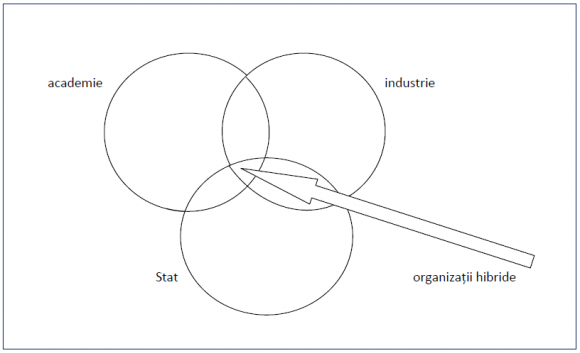
At organizational level, similar to the business organizations, competitive intelligence system at government's public institution collects information and performs analyses, delivering actionable intelligence to strategic managers. In capacity given by government, the public institution should deliver actionable intelligence to government and decision makers on national competitiveness strategy by using own competitive intelligence system. However, by paper opinion, using competitive intelligence system at government's public institutions is an important change in modernization of government practice, but it is not enough to enhance competitiveness of nation. Paper in this context, agree arguments of Dou (2006) that support theoretically increasing national performance for competitive objectives by creating "public-private" partnerships between institutions, meaning by that the joint organizational framework between state representatives, academia and industry leadership which results "hybrid organization" (Fig. 1). Organizations established as "hybrid" meat the best domain at the intersection of policies, research, and business, drawing on the expertise of these areas. According to Dou (2006), government contribution is decisive to develop competitiveness body at national level to gather knowledge by national effort and to formulate goals and objectives of increasing competitiveness. The contribution of government should be the initiative founding competitiveness body, financing activities and research, as well as, implying government's competitive intelligence systems. These activities fall within the government's function as facilitator ensuring the best performance conditions to all entities, as well as national related systems.
This activities of government's public institution as facilitator contains two directions of movement of financial funds. On the one hand, financing research and growing individual competence turn into knowledge, facilitating innovation. On the other hand, integrating industrial innovation transforms knowledge into financial values. Summarizing, the mechanism described above facilitates the creation of clusters by creating knowledge and their integration into the economy, which inside of an economic sector is a pole of competitiveness. In this logic, organizing nation competitiveness system by national efforts at the intersection of shown three domain and using competitive intelligence system of government's public institution, as well as financing some activities by government seems to be a kind of national pole of competitiveness.
At the intersection of the three fields should find together the necessary knowledge to formulate national goals and objectives of competitiveness. The most effective national model uses for this purpose "hybrid organization" what is a legal entity of a non-profit organization. There are states using government agency charged to gather national representatives from academy and industrial business management in workshops. Whatever the legal entity has been to use nation's knowledge gathering, the role of this platform is the summation of knowledge at national level, including competitive intelligence and based on to formulate goals and objectives for competitiveness of nation. Government should contribute to enhance knowledge of the platform with competitive intelligence collected in foreign countries by public institution's competitive intelligence systems. Final product of national hybrid organization's activities should be the proposal for national strategy for competitiveness. Strategy assumed by government turns to implementation by policies for economic sectors when the government public institution has the role of managing policies of sector of its portfolio.
3. II. Models of National Competitiveness Organizations and Competitive Intelligence Practice
Accessible information gathered regarding references to national competitiveness organizations and competitive intelligence systems at state level show different systems in use depending on the type of the state structure. In France, references to national competitiveness bodies and competitive intelligence system at state level reflect the centralized state structure, the "omnipresence government" (Smith and Koussou, 2008). In smaller and more flexible states, such as the case of Ireland, the notion of "nation competitive system" relates to the existence of a national competitiveness council, consisting by mixed structures where is taking part national agencies, the private sector, non-government organizations (NGO) and members of the academy. Specific local historian remarks the development of national systems of competitiveness, developed especially after 1980, marked by development of the concept of competitive advantage of nations in theory published by Porter (1980). One important aspect of the competitive advantage growth is related to the question how should the management use knowledge captured inside of value chain to enhance own company competitiveness. The knowledge collected, analyzed, and delivered, as actionable intelligence to decision makers about foreign competitors, it is known as competitive intelligence. The reforming term overshadows business intelligence express, used first by Luhn (1958) that understands on intelligence the ability of interaction of factors. The intelligence definition of Simon (1976) is more appropriate to competitive intelligence role, sustaining "that intelligence is a stage of exploring the environment in the decision making process". Theories and definitions of intelligence given global understanding and interpretation have different applications in countries, but all including concerns of the competitive advantages due to contribution of competitive intelligence systems.
Thus, in France there were surveillance systems to global technology development (Technology Watch). The "intelligence" captured contain a powerful technique used to anticipate the evolution of inventions and their spread in mass production. These issues revealed the interest to collect information about the advantages hold by competitors in mass production. Main targets have related to the emergence of unique and innovative technologies for the development of high-tech industries. The routine use of the concept and related activities neglected appearance of the English term of competitive intelligence and its contents. Evolution of activities in the French system gave a new dimension to the term renaming it as "economic intelligence". Content of term covers some other economic sectors not only technical ones, wearing a very practical message through actionable intelligence for research and technological development. Correa (2012) sustains that the system of economic intelligence is equivalent to that competitive intelligence used in English, without differentiating their content to the widely accepted today: understanding phenomenon watched, to anticipate of its development and to design own actions. These related issues are nothing else that shown by Simon (1976) in 1947 about "cognitive processes of making rational human choices". In this respect, intelligence gathered at national level from foreign environment sustains choices formulating national strategy of competitiveness.
Paper remarks on the practice of several states that national competitiveness bodies and competitive intelligence system use different type of organizational entities but having common targets, as delivering intelligence to decision makers. In this regard, firstly is important gathering national knowledge, implicitly by the competitive intelligence system and delivering the actionable intelligence from foreign countries. Some nations prefer to have permanent competitiveness body at the proper intersection of policies, science, and industry formulating competitiveness strategy, other use government institution for this purpose and gather national knowledge by annual conference. Both activities should contribute to the state modernization by using public-private partnership and some management instruments as well as, syntheses, comparative analyses, benchmarking, competitive intelligence instruments and other. This partnership may be beneficial for both parties, but from the point of view of paper, it continues traditional transfer of thinking and doing of the business activities.
As it is well known, strategic thinking and instruments used at nation level has origin in business strategic management. Correa (2012) shows that biggest companies nationally and globally without being aware of the term and content of competitive intelligence, gain experience in practice and earn competitive advantages using that. Private sector practice alongside theoretical research for own purpose of competitiveness and competitive intelligence surpassed the utilization of national structures of competitiveness, being this of state (France) or mixed (Ireland), or the type of non profit organization (USA, Japan, Germany). In this sense, national systems of competitive intelligence have developed practical models used in companies. Competitive intelligence delivered as actionable intelligence to national competitiveness body contributes gathering knowledge by national efforts including company's expertise and scientific proposal. In this sense, paper emphasizes that conceptual transfer of management from business organizations to government institutions started without theoretical support of state modernization. Working together as public entities and private ones means transfer implicitly of explicit and tacit knowledge, as we use to say, working together is the base of co-evolution. That is the main reason of the public-private partnership being a way of the state modernization.
Happening consciously or not, the importance of the emergence of national organizations for coordination and integration of nation knowledge and competitive intelligence is a qualitatively superior stage against discrete national programs carried out before. In this respect, the most eloquent conclusion on government activities enhancing competitiveness in France, between 1990 and 2002, shows that the poor national competitiveness performance is due to the insufficiency of SMEs support for economic growth and lack of knowledge coordination at national level (Martre, H. 1994). This report, edited by Office of Planning as a Department under the Prime Minister's Office, shows that there were no initiatives to capitalize knowledge of managers of large firms, the educational system did not integrated management system of economic intelligence, there were neglected global policies, knowledge capitalization by cluster have been neglected too and there were insufficient funding of competitive intelligence.
Remedy the situation led the French government and the French Presidency to establish the National Agency for Competitive Intelligence as Department in direct coordination of the Office of the Prime Minister. An important feature of a centralized state in the formation of national competitive intelligence is using the network representation of power in the territory and abroad, as well as the network representation of chamber of commerce. In France, the development of economic intelligence has been facilitate by the existence in economic field of branch network of chambers of commerce in counties and the presence of county prefecture as government representative. In this mode, there were establishing territorial committees for competitiveness. The internal network of chamber of commerce (153) have developed tools for monitoring regional development by providing information to the government, and in the same way external representations (112) provide foreign information about competitors. Territorial network structure "mobilize collective forces along with the necessary reform of the state apparatus and combine knowledge management with competitive intelligence" (Correa, 2012). The state structure facilitated the emergence in a conjugate mod of the foundation of national system of competitive intelligence. The system created delivers necessary intelligence elaborating the national competitiveness strategy and makes proposal for national targets upon comparative analyses of "competitors" as related to Great Britain, United States, Sweden, Germany, and Japan. In the same way, after understanding the phenomenon, system was able to "anticipate (the foreign) and influence the competitive environment" (Bournvis and Romani, 2000). As an important remarks formulating competitiveness strategy in France, is the fact that government's specialized agencies gather actionable intelligence and elaborate national competitiveness strategy. The final document has a public consultation and a debate at a Grand Conference Sociale, initiated by government and where are taking part trade unions, representatives of employers and managers.
The paradigm of French competitive intelligence system and elaboration of national competitive strategy has the specific of the grandiose centralized state apparatus and manifests itself in a suitable relational framework of high world powers.
Unlike the French system of national strategy of competitiveness formation, that of Ireland, developed by the Competitiveness Council includes government and private structures, characterized by ambitions of a relatively new state (independent since 1922), with modest resources and relating itself targets primarily to regional proximity, and the secondary to the US. In a coherent strategic thinking, Council Report from national progress relates targets and mobilizes internal latent potential for achieving them. A figure called pyramid of competitiveness shows logical scheme for activities taken for develop Competitiveness strategy and conditions to achieve targets. This pyramid chart is based on the basic conditions of developing competitiveness, as physical infrastructure, knowledge infrastructure and business environment, which can be influenced by regulations implemented by governmental actors. The next level includes the main determinants of enhancing competitiveness by business performance, productivity, prices and costs, respectively supplying work showing where the policies can operate.
National competitiveness bodies (agencies or non-profit organizations) use the actionable intelligence delivered by competitive intelligence systems organized at state level. Generally in Europe, national systems of competitive intelligence appeared in the first phase in reply to American intelligence agencies in many areas of interest since of the middle of the twentieth century. Large companies have developed their own intelligence structures tracking technological developments (Technology Watch) and competitive intelligence systems to provide actionable intelligence to strategic decision makers. The economic growth model facilitated by technology has involved intelligence agencies in the US. Focusing on collecting the most important inventions in the world and attracting scientists, the accumulation of knowledge in these forms in organized frameworks at university research centers has supported by external information collected through competitive intelligence system. In this process, two features stand out: the first is taking best practices of large firms and secondly US awareness of the importance of using national competitive intelligence system in order to increase international competitiveness.
European institutional reply to this targeted gathering knowledge potential to enhance economic growth and development is the Lisbon Agenda, issued in 2000. Today the most important competitiveness targets are shown at Strategy 2020. The European Commission coordinates the main competitiveness topics of Member States.
European states competitive intelligence systems at national level have no histories published, are less subject for public. We know only some aspects as trends and statements or adjacent functional aspects of use of competitive intelligence in government institutional environment. In this context, the German Institute for competitive intelligence supports in the field of competitive intelligence systems tailor-made design for business organizations and public institutions and training for increase individual competences without to be involved in enhancing the national system of competitive intelligence.
The importance of using national efforts to increase competitiveness by gathering knowledge at national level and implying competitive intelligence system is evident in the emerging economies evolution too. We know about particularly during economic ascendancy in South Korea from 1962 to 2000, with annual average growth rate of 8%, while it became from an agrarian country into an industrial one. The facilitator of results was the government, according to analysts, by sustaining the development of incremental innovation instead creative imitation, supporting technological developments at the state level alongside enhancing individual competencies.
China and Brazil have introduced competitive intelligence systems to government institutions (Dou, H. 2006). The literature notes the concern of emerging
4. a) Summing knowledge
Cross transverse analyses of all public information known until this time has shown that the government is the main actor to initiate national competitiveness strategy. Regardless of composition, public or private, the competitiveness body sums national knowledge, efforts, and expertise of government's institutions, managers of business organizations, and scientific representatives of academy. In this way, knowledge creation in field of national strategies of competitiveness should contain the best national goals and objectives. Best practices show that the state has supported the foundation of national structures of competitive intelligence, participating in their financing and providing state structures that have the expertise and capabilities to collect knowledge by internal and external network. The role of facilitator of national competitiveness is granted to government's agencies and departments, which have own foreign network and in this respect should collect the competitive intelligence abroad.
5. III. Logic of Actions to Elaborate National Competitiveness Strategy
Following theory of strategic management, all of actions taken in field of elaboration of national competitiveness strategy have to start with analyses of competitive position of nation. This should happen, consulting nation's competitiveness evaluators. Data captured in this way may show some relevant and objectively evaluated position of nation competitive position in top of states. Analyses reflect vulnerabilities and strengths of competitiveness of national level. The negative extremes have to be remedy in short time to start to enhance gradually nation competitiveness.
Next step in elaborating national strategy of competitiveness follows functionality of strategic mechanism through decision on objectives and targets, followed by assumption of development direction by Government, based on there should elaborate and implement policies. These are eloquent exercise of state governance through partnership in formulating policies on bottom-up axis. In logic shown, the government's public institution has a double role, as the facilitator in supporting and developing the essential conditions for sustainable growth of competitiveness, and twice facilitator implementing policies in economic sector of portfolio derived from the national competitiveness strategy.
In parallel of actions showed, collecting knowledge together with private actors is the main vehicle to transfer expertise from this organizations working together, knowledge as well, and models of thinking toward strategy formulation and procedural efficiency. Working together facilitates important steps toward modernizing the neo Weberian state.
To exemplify those exposed paper shows a fictive analyses of a state competitive position. In this regard, paper has drafted the Competitive position of state ,,R" in seven perspectives following the lessons learned by other states practice. Competitive position of ,,R" state published by global institutions shows position occupied in nations top by criterion established. The Figure 2 contains graphics in clockwise order as follows: Figure 2 shows that ,,R" state performance falls in 6 criterion inside of the first 60 countries in the World. The best position is held on showing conceptual opening strategy for attracting foreign investments ranking it at 4 position in the World. Weakest position hold is 69, corruption index. In order to increase the perception of R state on functional institutions, first need to act is to reduce corruption. A first step may increase dynamic discovery and trial of corruption cases, establishing by law to resolve these cases with maximum urgency.
By paper opinion, improving the competitive position of ,,R" state requires setting goals every criterion of competitiveness. First of all R state has to increase aggregate competitiveness treating two related topics, namely, increasing the reputation of institutions, which were presented for designing and monitoring of systems proposed strategy to increase competitiveness, respectively, increasing human development index by knowledge management in business organizations and public institutions. The implementation of these concepts in organizations and institutions developed for this purpose requires policies and actions. targeted outcomes of basic conditions and main determinants that will shape prerequisites for increasing the competitiveness (Figure 3). Bottom-up logic of actions means to grant priority for the base of pyramid to enhance business environment, to develop physical infrastructure and knowledge infrastructure. On the next flat, according to theory, policies need to increase briefly business performance, productivity, to balance system of price and cost, and to assure labor supply (work force and work places).
Figure shows how the national competitive intelligence contributes to gathered knowledge.
Government public institutions could deliver actionable intelligence to the government and so contribute to gather nation knowledge inside of national Competitive Council. Proposal made by the Competiveness Council for goals of nation competitiveness strategy are contained in national competitiveness strategy, which determines main objectives to enhance business infrastructure, physical infrastructure and knowledge infrastructure, and in the same time policies guidance in economic sectors. The first conclusion regarding organizing competitive intelligence system at national level by government in different states shows that actionable intelligence delivered about foreign economic environment and competitors to decision makers meets a national body (competitiveness council) used to formulate competitiveness strategy. This body should be a permanent council or a conference what gathers government's institutions, academy, and business. In this way, contribution of competitive intelligence system of government to the nation's knowledge has direct contribution.
Some information obtained from the public space show diversity of functional models developed at national level for gathering knowledge, according to national traditions and model of state system (centralized or decentralized). States support a central body of national competitiveness which activity contains evaluation and monitoring of progress of competitiveness, using facilitators from the government structure (agencies or departments) and indices of competitiveness of evaluation systems developed by global institutions.
The most important task in the process gathering national knowledge has the government: has to organize national consultation or national council to analyzes, monitors and proposes the direction of national strategy and policies for competitiveness. The government's public institutions having the role of facilitator of progress are dealing with complex activities using own competitive intelligence system and providing competitive intelligence to government, as well as to the competitiveness body. The assumed strategy of national competitiveness by the government follows actions at government's public institution by policies implementation in economic sector of portfolio. In this circle government initiate and sustain the activities gathering national knowledge to formulate goals and objectives of national competitiveness, and after assuming the strategy of competitiveness government as executive power in the state apply sector policies through government's public institutions.
Maintaining the above presented logic, based on nation's experience and good results enhancing competitiveness testify the best way in similar future practices.
Secondly, using management instruments from private companies by conceptual transfer and implementing them at government's public institution, as well as forming partnership with private organizations inside of national council for competitiveness are important steps for state structure modernization and steps to approach to participative democracy. Paper considers the most important gain in this direction is transfer of way of thinking from private companies following strategic mechanism through analysisdecision on objectives and targets -assumption of development direction and implementing policies in this sense. In the same time, public administration should learn about strategy formulation and procedural efficiency working together with civil organizations. These together are able to enhance institutions functional competitiveness and quality of results, and through them nation competitiveness. From the point of view of political sciences, steps made in direction to involve private actors in goals and policies formulation represent important evolution of future state administration, namely policies without politicians.