1.
more organizational domain like people, structure, and technology (Romanelli & Tushman, 1994). These types of changes occurring in the organization have a tendency to be formal, planned, and goal directed in nature. Organizational change is defined as the adoption of a new idea or behavior by an organization (Draft, 2005 b ). The organizations as a result focus on actively managing the processes and outcomes associated with the change (Pettigrew, Woodman, & Cameron, 2001), (Alvesson, 2002).
2. Management
within organizations is experiencing a lot of internal as well as external pressures for organizational change to occur. The external pressures triggering the change mainly include government laws and regulations, production and process, market place, labor markets technology, political & social events and also the Internationalization of business (Pfeffer, 1994). The internal factors which are present and generate change from within the organization includes internal business policies, employment policies, administrative processes and people problems (Lunenburg, 2010).
One of the most important and dramatic element of change for today's organization is the shift to a technology driven workplace and an emphasis on information and relationships. The discipline of change management deals primarily with the human aspect of change, and as a result is related to pure and industrial psychology. The organizational change is an iterative and complex process with unintended or intended outcome. The management of organizational change has become the leading concern for the managers so as to make the change program successful It is important for the industries to engage the employees in training and provide more work flexibility. Kotter (1995) describes eight step helpful models for understanding and managing change summarized as: Increase urgency, Build the guiding team, Get the vision right, Communicate for buy-in, Empower action, Create short-term wins, don't let up and Make change stick. The keys for successful change management include thinking holistically to understand all of the change implications, focusing on the critical success factors that facilitate implementations and striving to be equal partners with business implementing change (Bechtel & Squires, 2001), (Beckhard,1969), (Brown, 2005).
According to Nilakant & Ramnarayan (2003) there are various organizational characteristics or features important for a change process in an organization and are identified as Organizational Change Levers. It answers the most important aspect of organizational change that is 'What to Change?'. In order to bring about change in an organization the managers should pay attention on four primary/content areas which are Technology, Marketing, Quality and cost. Any changes in these four content areas will be accomplished by change in the structure, strategy and HRM practices known as the contextual areas or the context for change. The change encountered in these contextual areas will lead long-term and permanent change in the organization. The context for change will also result in facilitating change in the four content areas. The Leadership change lever/area is the most important and the foundation on which change is built. It is as a result also known as the primary driver of
3. a) Organization Commitment
Organizational commitment is the employee's psychological attachment to the organization. It can be contrasted with other work-related attitudes, such as job satisfaction, defined as an employee's feelings about their job, and organizational identification, defined as the degree to which an employee experiences a 'sense of oneness' with their organization. (O' Reilly & Chatman, 1986).
The three-component model of commitment by Meyer and Allen's (1990), prior research indicated that there are three "mind sets" which can characterize an employee's commitment to the organization. The "Affective Commitment" is defined as the employee's positive emotional attachment to the organization. An employee who is affectively committed strongly identifies with the goals of the organization and desires to remain a part of the organization. This employee commits to the organization because he/she "wants to". "Continuance Commitment" which is the individual commits to the organization because he/she perceives high costs of losing organizational membership including economic costs (such as pension accruals) and social costs (friendship ties with co-workers) that would be incurred. The employee remains a member of the organization because he/she "has to". "Normative Commitment" is the individual commitment to and remains with an organization because of feelings of obligation. These feelings may derive from many sources. The commitment of employees towards the organization is influenced by factors like organizational change, rewards, relationship with superiors and coworkers, conflicts, efficiency etc.
The employees spend major part of their time in organization so there are number of organizational factors that determine employee commitment (Bashir & Ramay, 2008). The employee commitment can be increased by organising and managing the organizational factors, which are wages and salary, nature of work, working environment conditions, job satisfaction, job content and opportunities for rewards & promotion (Altindis, 2011).
The commitment to change is very important in an organization because it is a force that helps to unite an individual to a course of action deemed necessary for the successful implementation of a change initiative". This commitment to change within the employee helps to support and make use of change effectively (Herscovitch & Meyer, 2002).
4. II.
Review of Literature a) Studies on Organization Change Carnell (1986) defined the Organization Change as an attempt or series of attempts to modify an organization's structure, goals, technology or work task. According to Weich & Quinn (1999) change always starts with failures to adapt and that change never starts because it never stops. Hultman (2007) in his research emphasized that the causes for change are often driven by variables that can't be controlled, such as the wants and needs of customers, investor expectations, the economy, global competition, etc. Wallace (2006) in his research highlighted that employees have become the key differentiator, as well as the driving force behind the success and ability to accept change. For long-term success there is a need to successfully train and develop employees for results on research conducted on senior executives The culture of an organization is the key to successful positive organizational change effort (Bushey, 1999). According to Vadi (2006) there is a need to understand influence of organizational culture on attitude towards change and learning in society under transition. Culture is important in an organization to stimulate change. Judson (1991) Pettigrew & Whipp (2013) emphasized the continuous interplay between the three strategic change dimensions, i.e., Content (objectives, purpose and goals)-what, process (implementation)-how and context (internal and external environment)-where the implementation of change according to them is an iterative, cumulative and reformulation in use process. Chapman (2002) stated in his study that there is a framework for planning change processes that are transformational in nature which is structured around three core issues in organizational change management that are the nature of organizations and what constitutes an improvement to them, appropriate strategies for levering change and change agent roles.
Benchmarking is the tool for change management which helps all organizations to be more effective in managing the change process (Clarke & Manton, 1997). It can be used at a number of levels within an organization in contrast to other tools, which are more useful at either a strategic level or an operational level within an organization.
According to research done by Smith (2002)
5. b) Studies on Organization Commitment and
Organizational Change Stuart (1996) and Lamsa & Savolainem (2000) in their research emphasized that organizational change can have negative consequences on the employees such as low morale, stress, loss of direction, anxiety, lack of loyalty and commitment. The employees with higher commitment have positive outcome like increase in job satisfaction level, motivation and regularity in work (Benette & Durkin, 2000). If the employees lack commitment it will lead to increase in absenteeism and affecting labor turnover. The committed employees will hence ease stress during organizational change process and will understand and cope with change so as to make it successful (
6. c) Hypothesis
The following Hypothesis was formulated for the study: H 4 : "Increase effectiveness of organization" is the most important reason for bringing change in the IT companies under study.
H 5 : "Providing motivation for change to the employees" is used as a method to implement and manage organizational change effectively in the IT companies.
IV.
7. Methodology a) Scope of the study
The current research was dedicated to assess organizational change and commitment of employees in the IT companies of Northern India. The study is dedicated to the top middle and lower level employees of the IT companies. Data was collected through multi stage sampling. In the first stage to select the IT companies, the companies having maximum revenue generation and employee number were selected for the study. The NASSCOM website was used to select the companies. The units of these companies which were situated in Northern India were selected. In the second stage, stratified random sampling was used to select the employees from top, middle and junior level totaling the 6 major IT companies and sample size of 400 employees.
8. b) Data Collection
The authors have individually collected the data from the respondents and at least one author was present during data collection process. The data was collected personally to understand the change initiatives
9. Global Journal of Management and Business Research
Volume XV Issue VI Version I Year ( ) in the Indian IT companies and the observations were recorded carefully. The data was collected from 212 employees in 6 major IT companies in Northern India. The target population of the research included top, middle and junior employees of six major IT companies in Northern India. The questionnaire was used in order to collect the primary data. The stratified random sampling technique was used to choose the respondents. A structured questionnaire comprising of two sections was distributed to 1000 employees. A total of 212 questionnaires were collected with final responses.
10. c) Measures
The questionnaire was prepared for the managerial employees in the IT companies under study, to study the organizational change and commitment of these employees. The questionnaire started with information relating to demographic profile of the respondents i.e. age, qualification, gender, marital status, experience in the present organization and total work and the level of management in the present organizations. The second part of the questionnaire comprised of two sections: the first part was used to understand the organizational change initiatives. The second section was used to understand the organizational commitment by Allen and Meyer. The first part of the questionnaire was prepared by Malhotra and Kaur (2007) and it included the organization change initiatives like reasons to bring organization change and methods used by managers to implement & manage change initiatives as part of the complete change process.. The second part was of Organizational commitment and was developed by Meyer & Allen (1997) had developed a three-component model of commitment and labeled them as affective, continuance, and normative commitment, which are distinguishable from each other and these were considered. The demographic information of the respondents was also collected. The above mentioned variables used 5 point Likert type scale anchored with Strongly Agree (5) and Strongly Disagree(1). The authors have individually collected the data from the respondents and at least one author was always present during data collection from the employees. The discussions with various levels of management helped to provide a better view of the organizational change initiatives in IT companies under study. The employees having work experience more than 4 years were considered for the research
11. d) Data Analysis
The research of the IT industry was broadly covered into two section: descriptive and inferential. The demographic analysis included percentage and frequencies, which was used to present the main characteristics of the study. The mean and standard deviation was calculated to present the description of overall sample.
In general, the male respondents were more than the female respondents. Specifically, the male respondents contribute 69.5% of the total participated employees and 30.5 were female respondents. Out of all the respondents, 57.3% were married, 25.6% were unmarried, 1.2% was single and 15.9% gave no response. The socio-economic background of the employees was mostly urban and semi urban. Specifically, 9.8% were from rural, 43.9% were from semi-urban, 45.1% from urban, 1.2% gave no response. The qualification of employees were asked and it was found that 46.3% were graduated, 43.9% were post graduated, 6.1% were professionals of some field and 3.7% gave no response. Among the respondents, the 19.5% were junior level employees, 59.8% were middle level employees, 13.4% were senior level employees.
12. e) Reliability Analysis
The reliability of the data was calculated and checked by performing Cronbach's test. Here, the values of alpha for all the variables came out to be greater than 0.07. The values are given in the table 1. The sample data was found to be reliable. The content validity of the instruments was ensured through an examination from the experts i.e. the academicians and the practitioners in the field. The instruments were than finalized and used for further analysis.
13. f) Correlation Analysis
The association between perception of employees regarding appropriateness of Organizational Change initiatives taken during the process and organization commitment of employees was examined using Pearson correlation test. during the process and organization commitment of employees was found to be significant and positive (Moderate correlation= 0.729) at 0.05 level of significance. Hence we accept the hypothesis H 1 . We can further draw the inference that respondents perceive organizational change initiatives ultimately leads to increase in the organizational commitment level in the IT companies under study.
14. g) Regression
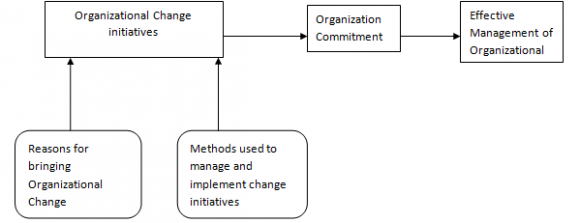
To explore the relationship between perception of employees regarding appropriateness regarding the reasons & manner in which Organizational Change initiatives were taken and Organizational Commitment in IT companies under study. The reasons and methods to manage and implement change were taken as independent variables in the study. The organizational commitment of the employees in selected IT companies is used as a dependent variable.
The mathematical representation of the research model for the above relationship is displayed as: The relationship between perception of employees regarding the appropriateness of the reasons & manner in which Organizational Change initiatives and Organizational Commitment was first investigated using Pearson Correlation. The preliminary analysis revealed that all associations were found to be significant at 95 percent level, with a positive association between reasons and manner in which Organizational Change initiatives were taken and Organizational Commitment.(r= 0.729, p<0.05).
? = ? xFrom the co-relational table it can be seen that there is moderate positive correlation among factors of Organizational Change initiatives and Organizational Commitment. 3 above summarizes the results of analysis of analysis of variance. The sum of squares, degrees of freedom and Mean Square are displayed for two sources of variation, regression and residual is displayed in the table. The significant value of F statistic is less than 0.05 which means that the variation explained by the model is not by chance.
V.
15. Perception of Employees as per the
Level of Managerial Hierarchy
The significance of the difference among the sample means was tested using ANOVA (analysis of variance). This is done by F-test for testing the significance of the difference of one measure in the IT companies' understudy. The results of the analysis through this test have been explained below: From the table 5, we can see that the probability of areas technology, quality, cost, strategy is more than 0.05. The values are non significant at 5 % level of significance. The inference is that there is no significant difference in the perception of respondents regarding the changes which have come in different areas except in Structure, marketing, managing people and leadership.
It can also be inferred that the employees in the IT companies perceive that the most important area in which change has occurred in the IT companies under study is Technology. Hence hypothesis H 3 is accepted. From the table 6, it can be inferred that the probability of perception of respondents regarding the reason for bringing about change in the IT companies is ? 0.05 at 5% level of significance is in "to change the image of the organization". In others reasons p< 0.05. The inference is that there is a significant difference in perception of respondents. There exists a significant difference between the perceptions of respondents regarding the reasons for bringing about organizational change in the IT companies under study.
It can also be inferred from the table that the employees in the IT companies under study perceive that the most important reason to bring change in the IT companies under study is to increase the effectiveness of the organization. Hence we accept the hypothesis H 4 . 7 it can be inferred that the probability of perception of respondents regarding the method used to implement & manage these change initiatives in IT companies under study is ? 0.05 at 5% level of significance in "involvement & participation of people". Whereas in other methods the p<0.05. The inference is that there is a significant difference in perception of respondents regarding various methods used to implement and manage the change initiatives in the IT companies under study.
It can further be inferred that the employees in the IT companies under study perceive that the most important measure used to implement and manage the change initiatives in IT companies under study is providing education and training to the employees. Hence we accept hypothesis H 5.
16. VI.
17. Hypotheses Testing
From the analysis, we infer that association between the perception of employees regarding appropriateness of Organization Change initiatives taken during the process and Organization Commitment. Hence we accept the hypotheses H 1. The study also supports the hypotheses H 2 i.e. there is an impact between the perception of employees regarding the manner in which organizational change initiatives are managed in during organization change and organization commitment. the study supports all the hypotheses i.e. H 3 , H 4 and H 5 . The hypotheses H 3 state that technology is the most important area in which changes have been brought in the IT companies under study. The hypotheses H 4 stating that the most important reason for bringing change in the IT companies under study is Increase effectiveness of organization was also accepted. The last hypotheses H 5 : stating that the most important "method used to implement and manage organizational change effectively in the IT companies is providing motivation for change to the employees" was also accepted.
18. Conclusions
The IT sector in India is currently thriving with changing global competition. To survive in the competitive era the organizations have to understand the importance of organization change, productivity and Year ( ) its impact on important factors like organization commitment. The main aim of the paper was to study different change initiatives taken in organizational change and its impact on organization commitment. The organization change has two important aspects first is the 'content of change' i.e. 'what needs to be changed' and second aspect is related to process i.e. 'way in which change is introduced and managed'.
The study was done to understand organizational change initiatives in detail. The various aspects related to change i.e. reasons for bringing organizational change and methods used by managers. The impact of organization change on the organization commitment was also studied.
The areas in which change have been brought in the IT companies under study were technology, quality, cost, strategy, managing people and leadership. The most important organizational change lever noted was 'Technology' in IT companies under study. The least important change levers noticed were 'marketing', 'structure', 'managing people' and 'leadership' . Hence the perception of employees regarding the areas in which organizational change has occurred in the IT companies is more or less similar. There is no significant difference between the perception of employees regarding the areas in which change have been brought about in the IT companies except in marketing, structure, managing people and leadership.
The study also showed that to implement & manage these change initiatives in the IT companies under study education and training was provided and leadership support was encouraged among the employees. The employees were further encouraged to take risk, provide motivation for change and develop new competencies and skills. The employees also perceived that it was important to make the involvement & participation of people in organization in the change process. There was no significant difference between the perceptions of respondents.
The findings from the correlation and regression analysis state that the appropriateness regarding the reasons and manner in which organization change initiatives were taken and managed in the IT companies under study have a positive association with organization commitment. Hence from the findings it can be concluded finally that the management in order to make change management initiatives successful should focus on the reasons for bringing about the above written organisation change and the ways to manage & implement change. The impact of organizational change initiatives on the organization commitment should be managed properly so as to increase the commitment of the employees and make the change process a success. Managers or change agents focus on various change activities in order to bring change effectively in an organization. The organizations undergoing change should manage the change initiatives properly in order to raise the productivity and commitment of the employees in order to make the change program successful.
19. VIII.
20. Implications, Limitations and Suggestions for Future Work
Organizations today factions' main issues like, what do people want? Why do change interventions succeed or fail? There is sparse literature available on assessing the outcome of change in banking sector. For managers, the major issue in organizations today is to deal with reasons and factors that initiate organizations change and the processes characterizing change initiatives and also the steps taken to manage these change initiatives. As a result an in depth study is required to understand organizational change initiatives, and its impact on the organizations. Not many studies are undertaken to examine the impact of change in various sector in India and the commitment among employees towards their organizations before and after change has been introduced. Hence future study should focus on the study of organizational change initiatives and its impact on organizational commitment or job satisfaction in various industries. The impact of organizational change initiatives on the organization commitment post and pre change initiatives can also be studied for future work.
21. Global Journal of Management and Business Research
Volume XV Issue VI Version I Year ( )

| Year 2015 | ||
| Volume XV Issue VI Version I | ||
| ( ) | ||
| Correlation Analysis 1 Organizational -Organizational Commitment 1. Change 2. 0.729 | 2 0.729 - | Global Journal of Management and Business Research |
| ***Correlation significant at 0.001 level | ||
| The association between perception of | ||
| employees regarding appropriateness of reasons and | ||
| manner in which Organizational Change initiatives taken | ||
| MODEL | R | R 2 | ADJUSTED R 2 | Std Error Of | |
| Estimation | |||||
| 1 | 0.491 | 0.241 | 0.212 | 0.373 | |
| *significant at 0.01 level | |||||
| 1. Independent variable: | Organizational Change | Initiatives (Independent Variable) and Organizational | |||
| initiatives | Commitment (Dependent Variable). The table displays | ||||
| 2. Dependent Variable: Organizational Commitment | R, R 2 and adjusted R 2 and the standard error of the | ||||
| 3. R 2 refers to the coefficient of determination that | estimation R. it can be seen that the regression | ||||
| measures the proportion of the variance in the | explained as 21.2% of the variance in the organizational | ||||
| dependent variable that is explained by the | commitment level of employees of the IT companies | ||||
| independent variable. | under study. Hence we accept hypothesis H 2. | ||||
| The model summary table 3 reports the strength | |||||
| of the relationship between Organizational Change | |||||
| Sum | Of | Df | Mean Square | F | Significance | |
| Squares | ||||||
| Regression | 3.505 | 8 | 0.438 | |||
| Residual | 11.014 | 203 | 0.054 | 8.075 | 0.000 | |
| Total | 14.519 | 211 |
| Level/Are | Technology Marketin | Qualit | Cost | Strateg | Structur | Managin | Leadershi | ||
| a | g | y | y | e | g People | p | |||
| Higher | Mean | 3.73 | 3.73 | 3.64 | 3.82 | 3.64 | 4.00 | 3.45 | .751 |
| S.D | .786 | .786 | .505 | .603 | .809 | .632 | .820 | .226 | |
| Middle | Mean | 3.84 | 3.38 | 3.38 | 3.47 | 3.31 | 3.11 | 3.47 | 1.067 |
| S.D | 1.032 | 1.063 | 1.080 | .932 | 1.163 | 1.086 | .920 | .144 | |
| Junior | Mean | 4.44 | 4.19 | 3.69 | 3.88 | 3.94 | 3.94 | 4.13 | .998 |
| S.D | .727 | .834 | 1.014 | .719 | .854 | .998 | .719 | .249 | |
| Total | Mean | 3.94 | 3.59 | 3.48 | 3.60 | 3.48 | 3.40 | 3.60 | 3.32 |
| S.D | .973 | 1.030 | 1.009 | .866 | 1.085 | 1.086 | .901 | 1.053 | |
| F value | 2.783 | 4.225 | .725 | 1.773 | 2.228 | 6.208 | 3.631 | 3.683 | |
| p- | 0.068 | ||||||||
| value( | 0.018** | 0.487 | 0.177 | 0.115 | 0.003 | 0.031* | 0.030* | ||
| sig) | |||||||||
| 0.05* is at 5%level of significance | |||||||||
| 0.01** is at 1%level of significance | |||||||||
| 0.001*** is at 0.1% level of significance | |||||||||
| companies under study | ||||||
| Reasons for bringing about organizational change | ||||||
| Level/Reason | Increase | Ensure the | Cut cost | Change the | Overcome | |
| effectiveness | survival of | image of | fierce | |||
| of | organization | organization | competition | |||
| organization | ||||||
| Higher | Mean | 3.5455 | 4.0000 | 3.3636 | 3.3636 | 3.9091 |
| S.D | 1.36848 | 1.00000 | 1.12006 | 1.36182 | 1.04447 | |
| Middle | Mean | 3.7925 | 3.6182 | 3.4182 | 3.1636 | 3.2364 |
| S.D | 1.14956 | 1.19398 | .91674 | 1.13470 | 1.20129 | |
| Junior | Mean | 4.1250 | 4.3125 | 3.8750 | 4.3125 | 4.3125 |
| S.D | .95743 | .87321 | 1.02470 | 1.13835 | .94648 | |
| Total | Mean | 3.8250 | 3.8049 | 3.5000 | 3.4146 | 3.5366 |
| S.D | 1.14488 | 1.13789 | .97183 | 1.23679 | 1.20897 | |
| F value | 3.157 | 4.215 | 2.925 | .742 | 6.864 | |
| p-value(sig) | .019** | 0. 004*** | 0.026* | 0.566 | 0.001** | |
| 0.05* is at 5%level of significance | ||||||
| 0.01** is at 1%level of significance | ||||||
| 0.001*** is at 0.1% level of significance | ||||||
| Level | Reason Providing Education and Training | Leadership support encouragemen and t | Encouragi ng risk taking and support | Providing motivation for change | Developing new competencies and skills in people | Involvement & participation of people | |
| Higher | Mean | 3.9091 | 3.6364 | 3.8182 | 3.4545 | 3.8182 | 3.8182 |
| S.D | .70065 | 1.02691 | .98165 | .82020 | .87386 | .75076 | |
| Middle | Mean | 3.5091 | 3.2545 | 3.1091 | 3.2545 | 3.3818 | 3.3273 |
| S.D | .97890 | 1.09237 | 1.08308 | .82143 | .95240 | 1.05505 | |
| Junior | Mean | 3.8750 | 3.6250 | 3.3125 | 3.7500 | 3.7500 | 3.5625 |
| S.D | 1.02470 | .95743 | 1.19548 | 1.12546 | .93095 | 1.09354 | |
| Total | Mean | 3.6341 | 3.3780 | 3.2439 | 3.3780 | 3.5122 | 3.4390 |
| S.D | .96241 | 1.06156 | 1.10622 | .89774 | .94600 | 1.03157 | |
| F value 2.933 | 2.605 | 3.345 | 3.356 | 3.216 | 1.763 | ||
| p- | .039* | .042* | .014** | .023* | .017** | .161 | |
| value(si | |||||||
| g) | |||||||
| 0.05* is at 5%level of significance | |||||||
| 0.01** is at 1%level of significance | |||||||
| 0.001*** is at 0.1% level of significance | |||||||
| From table | |||||||