1. Identification of Critical Success Factors for the Implementation of Supply Chain Management
Information System through SEM Approach
2. Introduction
Supply Chain Management (SCM) system involves managing and coordinating all activities associated with goods and information flows from raw material sourcing to product delivery and finally to the end customers.( Wei, C. C., & Chen, L. T. (2008).) These systems integrate networks of suppliers, factories, warehouses, distribution centres and retailers for faster communication and coordination. The integration of these multi company networks provides high quality, relevant and timely information flow that effectively supports decision-making for inventory replenishment, capacity activation and for synchronizing material flows at all tiers within the supply chain. Thereby it plays an increasingly critical role in the ability of firms to reduce costs, increase responsiveness (Chopra and Miendl 2005), gain competitive advantage (Dezdar 2011) and achieve better coordination. Thus the basic idea of SCM integration lies in 'information integration'.
Information and communication technologies (ICT) play an important role in integration of these companies leading to greater efficiency and effectiveness of supply chain. Integrated information technology solutions with respect to three major flows namely information, product and finances leads to the increase in the value of an enterprise.
Automobile companies realized the importance of these systems as it needs to keep control over costs at every stage to remain competitive. OEM after integrating the functional areas through ERP within the organization shifted the focus on integration of business processes with trading partners. This resulted in the integration of Customer relationship management (CRM) and supplier relationship management (SRM) systems in supply chain. The emergence of e-business has thus led to different way in which enterprise communicate, transmit and receive information with the suppliers upstream and customers downstream. Major OEMs have realized the benefits arising out of these systems, however, huge cost and time involved as well as the high rate of failure acts as a deterrent to the implementation of these systems. The research by Panorama consulting solutions summarizes the experiences of 172 ERP customers with regards to enterprise software, vendors, consultants and overall implementation. The table 1shows the average cost of implementation for last four years to be $7.3 million dollars and average duration for implementation to be 16.6months. Further approximately 59% of the projects have exceeded their planned budgets , 53% have exceeded their planned durations and about 56% of respondent organization have received less than 50% of the benefits that was expected from the system. The overall failures and implementation difficulties in implementing these systems have attracted lot of research (Liu & Seddon 2009, Singh, 2009;Syed Iftikhar, 2008) Further the information system implementation is considered to be a technical project whereas it is important to address the socio technical aspect for the successful implementation of the system. Therefore study is being conducted to identify and analyze critical factors that need to be considered to ensure successful implementation of the information system for the automobile industry. The paper develops a model to analyze the relationships between factors and success indicators. Finally, the paper provides recommendations for the success of these systems based on the analysis of critical factors. The contributions of the paper are important for industry practitioners, researchers and policy makers. The process model and critical success factors will provide a useful guide for industry practitioners who are planning to implement SCMIS in their organizations. The study can help them to improve decision making for successful implementation of SCMIS right from inception and subsequent realization of the enormous benefits that will accrue with the right implementation.
3. II.
4. Review of Literature
Huge cost and risk is involved in the implementation of SCMIS therefore critical success factors (CSFs) should be identified which would lead to the successful implementation of the system. The CSFs are identified from two groups of studies firstly critical success factors for ERP implementation like top management support, BPR, change management, training , user involvement ,communication etc. since SCMIS is an extension module of ERP (Moller (2005), Koh (2011)). These factors are categorized into Organizational, human and technological groups based on the study by Sanchez and Bernal (2007). Secondly CSFs for implementation of Inter organizational systems like trust, partnership, long term relationship, technical compatibility and pressure from the partners as supply chain system is a network of organizations that are connected, upstream and downstream through different processes and activities that produce value in the form of products and services to be delivered to the consumer. Each of these groups are discussed below.
5. a) Top Management Support
Top management support describes the extent to which executive managers of the adopting firm provide the attention, resources, and authority required for ERP implementation (Wang and Chen, 2006). Top management has the responsibility to align the new ERP system with the current business practices and prepare the employees for the change brought by the new technology (Madininos, 2012). With top management support, user resistance can be partially mitigated by having top executives encourage, or even mandate, user engagement in the implementation. (Wang and Chen, 2006). The involvement of top management is also vital for the effective re-engineering of the supply chain and logistics processes (Gunasekaran et al. 2004) leading to successful Inter organizational systems and relationship. It is the top management commitment and willingness to take up risk involved in the adoption of IOS to gain competitive advantage that will lead to successful implementation of the systems. Thus intervention of the top management is necessary for the allocation of financial and human resources, to take fast and effective decisions, resolve conflict, to promote company wide acceptance of the project and to build cooperation among the diverse groups within the organization. The study by Ahmad (2013) which had reviewed over 50 papers relevant to the identification of CSFs for the implementation of ERP systems had observed that management support had an occurrence percentage of 100.
6. b) Clear Business Plan And Vision
The system implementation requires that the key personnel within the organization should have a clear goals and vision about how to satisfy customers, facilitate suppliers and empower the employees (Umble 2003) thus leading to the successful implementation of the system. The organization also needs to define the purpose of implementing the system so as to justify the investment. The vision should provide a clear link between business goals and IS strategy (Finney 2007). Wee (2000) stated that the business plan should outline proposed strategic and tangible benefits, resources, costs, risks, and the timeline.
7. c) Change Management
The implementation of SCMIS requires changes in the way an individual employee performs his job. Employees are often comfortable the way they are performing their work and do not feel the need for a new system. Therefore change management is very important which enables the employees to adapt to the change. If people are not properly prepared for the imminent changes, then denial, resistance, and chaos will be predictable consequences of the changes created by the implementation. (Umble 2003). However if the change management initiatives are properly undertaken people would be well prepared to embrace the opportunities that would be provided by the system. Due to its collaborative nature, managing people, organizational inertia and change management are even more critical to ERPII implementation (Koh et al., 2008;Møller, 2005;Weston, 2003).
8. d) External Support
The implementation process requires external support in the form of vendors' and consultants'. Vendor support represents an important factor with any packaged software including extended technical assistance, emergency maintenance, updates, and special user training (sawah 2008). Consultants support is required to facilitate the implementation process by providing suitable solutions to the problems being faced. Further internal implementation team depends on the consultant for their technical expertise.
9. e) Bpr And Minimal Customisation
Business process reengineering (BPR) plays an important role in implementing SCMIS. It is very imperative that the organization should be willing to change the way businesses are conducted as to have minimum customization of the software. It is the enterprise that should fit into the system so lead to a successful implementation f) Organisational Culture
The studies by Leidner & Kayworth (2006) have shown that the success rate of the system that is being implemented increases if the system is aligned with the organizational culture. In connecting distinct platforms, applications and data formats across the value chain, enterprises have to overcome various obstacles such as user resistance to change (ash and burn 2001) and reluctance for establishing a company culture open to sharing business processes and to collaboration (Stefanou2013).
10. g) Communication
For this study communication is divided into two types internal and external. Internal communication refers to communication between all functional department of an organization in order to ensure minimum resistance to change, clarity of business goals and strong support and commitment (Al Mamari and Nunes, 2008). Proper communication in regard to the rationale for the implementation and details of the business process management change with the employees (Mandal and Gunasekaran 2003) is very important. It is imperative that we have the complete cooperation of employees at all levels; technologies alone will not improve the organizational competitiveness. Thus all personnel should understand the benefits of implementing supply chain system and should be allowed to participate in the development of the system (Ngai et al. 2004) .External communication refers to the communication between an enterprise and its suppliers, customers and partners outside the enterprise boundaries for determining business requirements, needs and opportunities and for taking decisions. (Stefanou, 2013).
Effective external communication facilitates cooperation from the suppliers. Thus for the successful implementation of SCMIS, internal communication has to be clubbed with the effective external communication with the suppliers. (Kraemmergaard and Rose 2002).Further study by Gefen and Riding (2002) shows the positive relationship between the responsiveness of the implementing team towards the user of the systems.
11. l) Training and Education
Another factor considered by the researchers for successful implementation is training and education (Bradley 2008;Ngai et al. 2004). This factor assumes importance because if proper training and education is not provided to the employees there will be high resistance for change. With proper training and education all personnel will understand the benefits of IOS and how the system is going to change the organizations business processes (vadbya 2010). and offering strong after sales service. The system quality features included in the studies were ease of use, ease of learning, system accuracy, flexibility, sophistication, integration capability and customization. They further included information quality features like Usability, Understandability, Relevance and Conciseness.
Hardware and software reliability is another factor to be considered for success of the system. Ngai et al. (2004) in the study considered reliability to consist of the accuracy of the data, adequate maintenance of the system and the capability of the hardware. The study by Craighead et al. (2006) related the reliability of the EDI system with the frequency of downtime which may lead to a lack of faith in the system. Therefore for success the system should be free from unplanned downtime. Another technical parameter somewhat related to reliability that is considered by Craighead et al. (2006) is in-house ability to maintain and to change/update hardware and software. The technical factors that are critical to organizations in their adoption decision of Internet-based inter-organizational information systems (IBIS) was also studied by Soliman,et al.(2004), Bouchbout and Alimazighi (2008) and suggested establishing costs , network reliability , data security, scalability and complexity as main factors that significantly affect the adoption decision of IBIS.
Relatively inexpensive, simple for the customers and suppliers to adopt and Ease to expand to other customers and suppliers are another technical dimension studied by Craighead et al. (2006).
12. o) Trust
The literature has also researched trust between trading partners and has confirmed the trusting relationship as a critical factor for the success of IOS.
Mutual trust refers to the fact that the channel members have confidence in their partners' reliability and honesty; namely, the channel members do business with one another on a foundation of mutual trust so the long-term and extra benefits are achieved. Soliman and Janz (2004) The main objectives of this paper are: 1. To identify various critical dimensions and their factors for the implementation of SCMIS.
To propose a model for the successful implementation of SCMIS. 3. To explore the relationship between the factors.
To achieve the research objectives the methodology adopted was : a) Questionnaire Development
The dimensions for the development of the model are based on the previous studies reported in the literature and discussions with the researchers, experts and practitioners in this field. The questionnaire was developed using review of literature with some measures being adopted from the previous research while others were formed specifically for this study. Table2 shows the various variables and the study from which the various items of variables are being adopted.
The questionnaire covering these dimensions were framed on five-point Likert scale ranging from 1 (highly disagree) to 5 (highly agree) to measure the attitude of respondents for every question. A pilot test was conducted for measuring the validity of the questionnaire. Validity of the instrument was done to see if the questionnaire is measuring what it intended to measure and is the questionnaire comprehensive enough to collect all the information needed to address the purpose. Thirty practitioners and scholars were administered the questionnaire and were asked to comment on its readability and comprehensiveness. Thus the validity was established using a panel of experts from the area of SCM and discussions with academicians and implementers. The discussion with the experts led to certain changes in the wording of some survey items which was incorporated into the draft of the questionnaire.
13. b) Questionnaire Distribution
The questionnaire was administered to 356 executives of two main companies namely -Maruti Suzuki India Ltd. and Honda Cars India Ltd including their suppliers and dealers located in National capital region (NCR) of India (Appendix 1). The questionnaires were distributed through e-mail and personal delivery. Table 3 shows the sampling frame for suppliers and dealers who participated in the study.
14. Extracting success variables
Factor analysis is an ideal method for creating an easy understanding of the framework by identifying groups of related variables. The study applied factor analysis using SPSS software (version 20) to explore the latent factors of the critical success variables (CSVs) for implementation of SCMIS. Eighteen CSVs were subjected to factor analysis using principal component analysis and varimax rotation. Four factors were extracted based on Eigen value greater than 1 and scree plot. The KMO value for the factors is 0.893 and these factors explain 64.502% of the variance. .
15. External support (TES)
.663 Project champion (HPC)
.
16. Team Composition (HTC)
.
17. Training(HTr)
.724 Data Security(IDS)
.830 Trust (Itr) .771 Cooperation and commitment (ICC) .702
18. Sem Development
SEM can be used to describe the relationship between two variables namely latent and observed / measured variables. Observed or measured variables are one that are being measured by the researcher directly whereas latent variables are not being measured directly but is of interest to the researcher. Therefore to observe latent variables a conceptual model should be developed to express latent variables in terms of observed variables. The SEM can be divided into two parts. The measurement model part which relates measured variables to latent variables and the structural model is the part that relates latent variables to one another.
For developing SEM framework the present study uses AMOS 21 statistical software and includes both measurement component and structural component. The measurement component determines that how exogenous variables measure the latent variable constructs and the latter component models the relationship between the latent variable constructs. Figure 3 shows the initial SEM framework. To ensure the appropriateness of groupings of CSVs into four factors for the successful implementation of SCMIS, cronbach alpha (?) reliability testing was applied. Value of ? range from 0 to 1 and value greater than 0.7 is considered to be reliable. Table 7 shows the value of ? for all the four factors, organizational factor has ? of 0.88, technical has ? of 0.79, human factor has ? of 0.78 and inter organizational factor has ? of 0.77. Since the value of ? for all the factors is more than 0.7 therefore it shows internal consistency of initial SEM.
19. Sem Modification
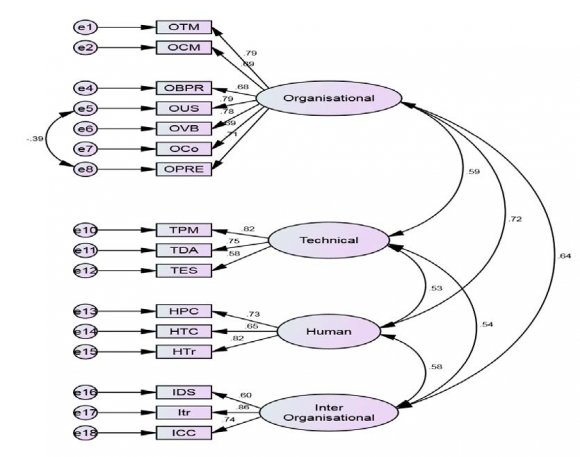
The initial SEM framework was developed from exploratory factor analysis (EFA) which determines the correlation among the variables and provides the factor structure. It is imperative to establish convergent and divergent validity for conducting confirmatory factor analysis (CFA). The convergent and divergent validity was checked using Composite Reliability (CR), Average Variance Extracted (AVE), Maximum Shared Variance (MSV), and Average Shared Variance (ASV) measures as shown in Table 8. For the convergent validity the values of AVE of the factors are greater than 0.5 and CR is more than AVE. These comply with the threshold values as indicated by Hair et al., (2010). Thus the variables correlate well with each other within their latent (parent) factor than with the latent factor outside the parent factor. The initial framework improvement was performed over several iterations using modification indices and theoretical justification to reach a final satisfactory framework. Figure 4 shows the final SEM framework. The rectangles indicate observed (or measured) variables. Unobserved latent variable constructs appear in ellipses. The arrows in the figure indicate the direction of hypothesized influence. For example, the influence of the 'Human' aspect (?3) is presumed to be reflected in the observed measures of the variables: Project Champion (HPC), Team composition (HTC), and Training (HTr) as depicted by the directional arrows. Error terms are included for each exogenous variable indicating a latent variable construct. For example, Team composition does not perfectly relate to 'Human' factor, and so an error term is needed to represent the error of measurement. This To evaluate the fit of CFA various goodness of fit (GOF)
The refinement was done according to the modification indices provided by the AMOSS software. Table 9 : Goodness of fit measurement of the SEM framework' and 3 of table 9 and last two columns shows the values of the indices for the initial SEM framework and final framework respectively. The final SEM framework selected after the refinement and with the best performance of GOF indices is shown in the figure 2.
20. Measurement Component of Sem Model
The latent organizational variable is measured in SEM framework by Top Management Support Pre implementation analysis, Change Management, Business Process Reengineering (BPR), Clear Business Plan and Vision, User support and Communication. Top management support and user support with ? = 0.79 had the most influence on the organizational factor. This was followed by Clear business plan and vision with ? = 0.78, Pre implementation analysis (? = 0.71), communication (? = 0.69) and change management (? = 0.69). BPR had the least influence on the variable (? = 0.68). BPR is considered to have least influence on the organizational variable because managers view BPR as a tactical issue rather than a strategic one. According to research by Estevez 2002 in most ERP implementation projects, BPR is seen as a consequence of an ERP implementation and hence its importance is dismissed. 0.75. External support had the least influence on the variable (? = 0.58). Huge cost is involved in using the service of the consultants so it makes sense for in house IT staff to take up the responsibility of implementing these information systems. The in house IT staff should have sufficient technical expertise to match business and system requirements. They should possess overall understanding of the business process and how it can be reengineered leading to the successful implementation of the system.
The latent human variable is measured in SEM framework by Project Champion (HPC), project team composition (HTC) and Training for the users (HTr). Training for the users of the system with ? = 0.82 had the most influence on the human factor. This was followed by Project Champion with ? = 0.73. Team composition had the least influence on the variable (? = 0.65). The role of the project leader is much more The latent technical variable is measured in SEM framework by effective Project Management (TPM), Data Accuracy (TDA) and External support for the implementation (TES). Effective Project Management with ? = 0.82 had the most influence on the technical factor. This was followed by Data Accuracy with ? = important than the project team composition. Project leader needs to lead from the front, should have an experience in the project management, and should be capable enough to resolve conflicts, manage resistance and take up the role of a mentor for the successful implementation of the system.
The latent inter organizational variable is measured in SEM framework by Trust among the trading partners (Itr), Cooperation and commitment among them (ICC) and maintaining security of the data (IDS). Trust among the trading partners with ? = 0.86 had the most influence on the inter organizational factor. This was followed by Cooperation and commitment among the trading partners with ? = 0.74. Data security had the least influence on the variable (? = 0.60). Trust being the most influential variable incorporates the security of the data spanning across the organizations.
21. Structural Component of Sem Framework
The initial SEM shows the relationship between the four latent variables. The highest correlation was observed for Organizational and human factors (?=.72), followed by organizational and inter organizational with ?=.64, organizational and technical has correlation of ?= .59, human and inter organizational has ?=0.58 followed by technical and inter organizational with ?=0.54 and the least correlation of ?=0.53 between technical and human factors.
The study was conducted to test whether the structural component of four latent variables fit the data of the sample. According to Bryman and Cramer [6], a correlation below 0.39 is considered low, modest if the value is from 0.49 to 0.69 and is considered high if the value is above 0.70. The result showed that the value of the correlation among the latent variables is between 0.53 and 0.72, therefore falls in the modest category. Discriminant validity was also checked for the latent organizational, technical, human and inter organizational factor. The validity was checked using Average Variance Extracted (AVE), Maximum Shared Variance (MSV) and Average Shared Variance (ASV) and for establishing divergent validity MSV and ASV are more than AVE. Thus indicating that these factors are statistically independent.
Thus there exists a strong correlation between the organizational and human factors since organization is a group of people working together to an objective. The variables in the organizational factor like user support, communication among the different stakeholders, top management support all deal with the people working for an organization. Therefore a strong correlation exists between organizational and human factors.
For the academic researchers the study forms the basis of a more detailed examination of the subject related to the implementation of SCMIS. The proposed model can form the basis of deriving 'performance metrics' to give organizations a clearer picture of the benefits accruing from SCMIS. This study can encourage and enlighten policy makers to establish new training institutes and formulate policies in favour of SCMIS in the wider interest of the industries and improve the overall economy.
22. Implications of the Study
The contributions of the paper are important for industry practitioners, researchers and policy makers. The process model and critical success factors will provide a useful guide for industry practitioners who are planning to implement SCMIS in their Organizations. The study can help them to improve decision making for successful implementation of SCMIS right from inception and subsequent realization of the enormous benefits that will accrue with right implementation.
23. Conclusions and Discussion
This paper explored CSVs in the implementation of SCMIS in the automobile industry in India. EFA was used to analyze the data collected through the questionnaire from the executives of two companies in the Northern capital region of India. Factor analysis grouped the 18 CSVs into four critical factors (CSFs) which were named as organizational, human, and inter organizational. The SEM was used to confirm the relationship between the identified CSVs and four latent critical factors.
The analysis of the data shows that the successful implementation of SCMIS is strongly influenced by the relationship between organizational and human success factors, while the relationship between technical and human success factors is least significant. It was also found that top management support and user support had the most influence on the organizational factor, effective Project Management had the most influence on the technical factor, training for the users of the system had the most influence on the human factor and trust among the trading partners had the most influence on the inter organizational factor.
It is very imperative to view the information system not only as a technical initiative but as a social change within the organization. We need to consider information system. To accomplish these dimensions the support from the top management is essential so that the implementation process receives the necessary resources, time and the change management initiatives. Next CSF that must be addressed is the user training and education so as to make them comfortable with the working of the system and also the benefits of the system to be communicated clearly to the users. By carefully managing these four factors the chances of successful implementation of SCMIS can be increased and thus decreasing the failure rate.
24. VI.
25. Limitations of the Study
The major limitation of this study is that the findings were limited to only two major players of the automotive sector of National capital region of India. Thus it is recommended that similar research studies should be conducted by taking a larger sample of organizations in automotive industry from other parts of India so as to include any other dimension whatsoever, that might have been left out while covering these two organizations only of the automotive industry. Secondly the study does not include the views, opinions and perceptions of software experts that are involved in the

| YEAR | COST | % O F COST | DURATION | % O F | % |
| OVERRUNS | DURATION | RECEIVING 50% OR | |||
| OVERRUNS | LESS BENEFITS | ||||
| 2012 | $7.1MM | 53% | 17.8 months | 61% | 60% |
| 2011 | $10.5MM | 56% | 16 months | 54% | 48% |
| 2010 | $5.5MM | 74% | 14.3 months | 61% | 48% |
| 2009 | $6.2MM | 51% | 18.4 months | 36% | 67% |
| (Source: 2013 ERP Report by Panorama Consulting Solutions) | |||||
| m) Complexity of the software |
| Complexity of the software has been studied |
| extensively by various researchers (Adam and O'doherty |
| 2000; Bradford and Florin 2003; Francalanci 2001; Parr |
| and Shanks 2000; Robey et al. 2002; Ribbers et al. |
| 2002; Sumner 2000) and they have concluded that there |
| exists a negative relationship between complexity of the |
| software and successful implementation of these |
| systems. According to the studies (Petter et al. 2008) the |
| information systems for supply chain management |
| should be accessible, compatible, user-friendly, stable |
| and reliable, requiring minimal training |
| Identification of Critical Success Factors for the Implementation of Supply Chain Management | ||||||
| Information System through Sem Approach | ||||||
| III. Research Objectives and | ||||||
| Methodology | Year 2015 | |||||
| 2. | ||||||
| Volume XV Issue VI Version I | ||||||
| ( ) A | ||||||
| S.N o 1 2 3 4 5 | Variable Top Management Support Communication Organizational Culture Training And Education User Support And | NO. OF ITEMS 5 4 4 4 2 | ITEM Knowledge and good understanding, commitment, involvement, persuasion of employees for participation in the development of the system and managing the transition to the new system. Accurate and timely communication, easy communication with the suppliers, transparency and sharing information Cultural readiness , knowledge and learning capabilities , relationship building and open culture for sharing business process Training on system implementation, qualified personnel to execute training, developing own in-house training for the system, training on use of the system and understanding benefits of the system by all personnel User involvement in the stage of definition of the | AUTHOR Ngai et al., (2004) Ngai et al., (2004) Stefanou (1999) Ngai (2004) Zhang , (2004) | Global Journal of Management and Business Research | |
| Involvement | company's SCMIS system needs; and user participates | |||||
| in the implementation of the system | ||||||
| 6 | Change | 4 | Training of the employees for change management, | Vinod et al., | ||
| Management | changes in organization structure to support the new | (2003) | ||||
| systems, Counseling of employees and developing new | ||||||
| business performance and control measures. | ||||||
| 7 | External Support | 3 | Service response time of the software vendor; qualified Zhang | et | ||
| S.No Company | Population | Sample | % of sample | No. of users of | ||||
| SCMIS in the | ||||||||
| sample | ||||||||
| 1. | Maruti Suzuki India Ltd. | |||||||
| 1st Tier Suppliers | 80 | 5 | 6.25 | 10 | ||||
| Dealers in NCR | 45 | 5 | 11.11 | 10 | ||||
| 2. | Honda Cars India Ltd. | |||||||
| 1st Tier Suppliers | 50 | 4 | 8.00 | 08 | ||||
| Dealers in NCR | 20 | 4 | 20.00 | 08 | ||||
| Table 4 shows the actual response and % | respondents expressed their opinions concerning the | |||||||
| response rate of the users of SCMIS. A total of one | importance | of | subsequent | factors | for | the | ||
| hundred and thirty seven respondents or thirty eight | implementation success. | |||||||
| percent has responded to the questionnaires. The | ||||||||
| S.No. Company | Population | Sample Actual response | % response rate | ||
| 1 | Maruti Suzuki India Ltd. | 260 | 160 | 49 | 31 |
| 1st Tier Suppliers | 10 | 10 | 10 | 100 | |
| Dealers in NCR | 10 | 10 | 06 | 60 | |
| 2 | Honda Cars India Ltd | 310 | 160 | 58 | 36 |
| 1st Tier Suppliers | 08 | 08 | 08 | 100 | |
| Dealers in NCR | 08 | 08 | 06 | 67 | |
| c) Data Analysis | |||||
| Profile of the respondents | |||||
| experience of more than 10 years. Around 46% of the | |
| total respondents surveyed worked in 'Supply Chain | |
| shows the demographic profile of the | Management' and another 15% worked in IT |
| respondents. The survey was conducted among 137 | Department. Around 10% each of the total respondents |
| respondents of whom around 80% were Males. Around | worked in Production, Marketing and Purchase |
| 42% of total respondents had working experience of 5 - | Departments. |
| 10 years while 30.65% respondents had working |
| Number of respondents | Percentage of respondents | |
| Gender | ||
| Male | 109 | 79.56 |
| Female | 28 | 20.44 |
| Total work experience | ||
| Less than 5 years | 38 | 27.74 |
| 5-10 years | 57 | 41.61 |
| More than 10 years | 42 | 30.65 |
| Department | ||
| Production | 17 | 12.41 |
| Purchasing | 12 | 08.76 |
| Supply chain Management | 63 | 45.99 |
| IT | 21 | 15.33 |
| Finance | 02 | 01.46 |
| Marketing | 14 | 10.22 |
| Others | 08 | 05.83 |
| VARIABLES | FACTOR 1 | FACTOR 2 | FACTOR 3 | FACTOR 4 | |
| ORGANISATIONAL | TECHNICAL | HUMAN | INTER | ||
| ORGANISATIONAL | |||||
| Top Management support (OTM) | .752 | ||||
| Change (OCM) | Management | .749 | |||
| Organizational (OCT) | culture | .745 | |||
| Business Reengineering(OBPR) Process | .738 | ||||
| User Support (OUS) | .706 | ||||
| Clear Business Plan and vision (OVB) | .652 | ||||
| Communication (OCo) | .612 | ||||
| Pre Analysis (OPRE) implementation | .537 | ||||
| Technical (TTI) | infrastructure | .821 | |||
| Project Management (TPM) | .765 | ||||
| Data accuracy (TDA) | |||||
| Year 2015 | ||
| Volume XV Issue VI Version I | ||
| ( ) A | ||
| LATENT VARIABLES -----FACTORS | MEASURING VARIABLES ----ITEMS | CRONBACH ? VALUE |
| ( ?i ) | ||
| Organizational ( ?1 ) | 1.Top Management Support (OTM) | 0.88 |
| 2.Change Management (OCM) | ||
| 3.Organisational Culture (OCT) | ||
| 4.Business Process Reengineering (BPR) | ||
| 5.Clear Business Plan and Vision (OVB) | ||
| 6.Pre implementation analysis (OPRE) | ||
| 7.User support (OUS) | ||
| 8.Communication (OCo) | ||
| Technical ( ?2 ) | 1.Technical Infrastructure(TTI) | 0.79 |
| 2.Project Management (TPM) | ||
| 3.Data Accuracy (TDA) | ||
| 4.External support (TES) |
| CR | AVE | MSV | ASV | |
| HUMAN | 0.780 | 0.544 | 0.511 | 0.372 |
| ORGANISATIONAL | 0.891 | 0.540 | 0.511 | 0.410 |
| TECHNICAL | 0.798 | 0.502 | 0.305 | 0.273 |
| INTERORGANISATIONAL | 0.781 | 0.547 | 0.415 | 0.330 |
| EVALUATION | GOF | THRESHOLD | INITIAL SEM | FINAL SEM | ||
| INDEX | ||||||
| Absolute | Pearson chi-square | The least | 193.605 | 107.290 | ||
| fit | (?2) | |||||
| index | ||||||
| Degrees of freedom | 129 | 97 | ||||
| CMIN/DF | <3 good | 1.501 | 1.106 | |||
| <5 | sometimes | |||||
| permissible | ||||||
| P value | ?0.05 | .000 | 0.223 | |||
| RMR value SRMR value RMSEA value | ?0.05 ?0.05 ?0.05 | .014 .065 .061 | .010 .0495 .028 | Year 2015 | ||
| GFI value | ?0.9 | .869 | .915 | |||
| Relative fit index Parsimonious fit index | AGFI NFI value IFI value CFI value PNFI value PCFI value | ?0.8 ?0.9 ?0.9 ?0.9 ?0.5 ?0.5 | .827 .841 .941 .939 .709 .792 | .881 .898 .989 .989 .726 .799 | Volume XV Issue VI Version I | |
| ( ) | ||||||
| Global Journal of Management and Business Research | ||||||