1. I. Introduction
n recent decades, the subject of management accounting has been created in universities as a social science, increasing the credibility and status of this field of knowledge (Baldvinsdottir, Mitchell and Norreklit, 2010).At first, this status led to a growth of research in the fieldof management accounting Larcker, 2001 and2002;Zimmerman, 2001;Hopwood, 2002;Lukka and Mouritsen, 2002;Luft and Shields, 2002;Chapman, Hopwood and Shields, 2007;Malmi and Granlund, 2009;Vaivio and Sirén, 2010;Modell, 2010;Lukka, 2010), but a decrease in publications has been observed over the last decade (Bonner et al., 2006;Hesford et al., 2007;Merchant, 2010;Lunkes et al., 2012).
Despite this initial growth and its importance, management accounting has been losing ground in academia and in the research world (Lukka, 2010;Merchant, 2008.According to the literature, publications, mainly in the United States, have been losing ground to other accounting areas, such as financial accounting. This phenomenon is affecting the participation of professors from the management area in graduate programs and in the training new doctorates in management accounting.
Additionally, Merchant (2010) reported that considered a study and how studies should be developed. Thus, management accounting has been weakened, and the possibility of a study being accepted for publication in major accounting journals in the United States is lower than for other areas. This phenomenon has led to publications on management accounting being rare in these publications, due to the migration of researchers, in addition to a lack of attraction of new doctoral students to management accounting areas. This scenario has caused non-financial subjects to be removed from the curricula of U.S. accounting programs, and the professors of financial areas are thus becoming the vast majority.
Several studies have been conducted to analyze the level of publications in management accounting in Brazil (Oliveira, 2002;, in the United States (Bonner et al., 2006;Hesfort et al., 2007) and in Spain (Pérez et al., 2005;Lunkes et al., 2012).
Although, as stated, management accounting suffers from restrictions and is losing ground in the United States, Hopwood (2008) reported that this phenomenon did not occur in European and South American countries because of the proportionately greater number of papers in management being presented at conferences and workshops in those regions, as well as several conferences in management accounting and (high-quality) journals that publish research on all types of accounting (Merchant, 2010). Aiming to confirm such claims, the research problem of this study was to determine what is the level of publication and training of doctorates in management accounting in Brazil.
Brazil was selected for this study due to the attention that the country has been receiving on the world stage as an emerging economy. Brazil's GDP grew by 7.5% in 2010, occupying eighth place in the world rankings, although, at some point, the country was in sixth place in the world ranking (The Economist, 2013).
To achieve the objective of the study, which was to analyze the scientific production and training of doctorates in management accounting in Brazil, the paper encompasses, in addition to this introduction, an exposition of the origins and development of management accounting and of studies related to I scientific production and the training of doctorates in management accounting. The third section describes the methodological procedures used in this study. In the fourth section, the results of the research are presented, and the fifth section includesa discussion and the conclusions of the work.
2. II. Literature Review a) Origins and Development of Managerial Accounting
Since 1960, management accounting has emerged and established itself as a social science (Ryan, Scapens and Theobald, 2002). In general, this process occurred due to an emphasis on empiricism and positivism (Zimmerman, 1979;Watts and Zimmerman, 1979), together with the growth of case and field studies in Europe (Panozzo, 1997;Drury and Tayles, 2005) and the establishment of this field as an academic subject (Baldvinsdottir, Mitchell and Norreklit, 2010).
During the initial stages of its implementation, management accounting was strongly grounded in economic theories, although this scope has constantly expanded with the inclusion of social sciences, such as sociology, psychology and organizational studies, in addition to mathematical analysis and philosophy. These interdisciplinary developments have aided the implementation and expansion in scope of management accounting and primarily have afforded it academic and professional credibility (Baldvinsdottir, According to Merchant (2010), a smaller proportion of works is published on management accounting compared to other areas. Hopwood (2007 and) also showed concern with the narrowing of perspectives and careers related to research in management accounting.
The consequences of this, according to Merchant (2010), are that non-financial subjects are being removed from the curricula of U.S. accounting programs, and professors in financial areas are becoming the vast majority. Moreover, new doctoral students are not being attracted to management accounting areas, which could create an imbalance in the training of doctorates in accounting.
3. b) Previous Studies
Aiming to assess in the literature the scientific production and training of doctorates, studies related to this research subject are described below. process was used to select articles on accounting, and a literature review was used to examine these articles. The methodological procedures used are explained below.
4. a) Structured Process to Construct a Theoretical Framework
The structured process for the selection and analysis of bibliographic references was divided into three phases: choice of databases, selection of articles and systemic analysis (Rosa, Ensslin and Ensslin, 2009). The first phase grounded the choice of the database; the second obtained a portfolio of articles from a set of pre-determined parameters for the selection of items aligned with the theme (use of keywords, screening of title, abstract and full text, respectively) and that are scientifically recognized (based on the number of citations); and finally, the third stage consisted of the systemic bibliometric analysis of the portfolio of articles.
Based on this structure, articles aligned with the theme of scientific production and doctorates in management accounting were selected. To obtain the selected articles, the phases and stages were conducted sequentially. The ISI -International Statistical Institute, SCOPUS and SCIELLO databases were used.
The keywords used were "scientific production" and "accounting doctors" and their combinations. In the ISI, articles were selected using these keywords and considering the areas of business, finance, management and economics. In SCOPUS and SCIELLO, the keywords were used when considering multidisciplinary areas.
5. b) Procedure for the Selection and Analysis of Research Data
To generate a discussion considering the Brazilian context, studies were conducted in the major journals on accounting and in graduate programs in accounting, mainly from the perspective of management accounting. To analyze this problem, from the viewpoint of research in Brazil, publications on management accounting in leading accounting journals, according to Qualis (Capes), were identified and analyzed. In addition, the training of new doctorates in accounting by the main higher education institutions (University of São Paulo [Universidade de São Paulo -USP], University of Brasília [Universidade de Brasília -UnB] and Regional University of Blumenau [Universidade Regional de Blumenau -FURB]) was also analyzed.
One limitation of the analysis of accounting journals is worth mentioning here. That is, at the same time that it indicates the profile of research in specific journals, it also stratifies the population of articles
6. Global Journal of Management and Business Research
Volume XIV Issue II Version I Year ( )
7. III. Research Methodology
This study was characterized as descriptive regarding its objectives (Richardson, 2008). A structured because articles on management accounting can also be found in journals from related fields, such as administration, management and production engineering. In this article, we chose to conduct the analysis considering specificity. Thus, for the selection of journals, the term "contabilidade" or "contábil" (both translated as "accounting") was considered,as well as these terms' inclusion in Qualis from Capes (Coordenação de Aperfeiçoamento de Pessoal de Nível Superior-Brazilian Federal Agency for Support and Evaluation of Graduate Education), considering the publications with the best classifications, namely,A1, A2 and B1. The choice of Qualiswas due to its wide spread use in the classification of studies in Brazil, including for evaluating graduate programs in the country, and the impossibility of using another database. Moreover, the accounting field has no journals with A1 classification nor any journals indexed in ISI or JCR. For the selection of articles, a period of 13 As for the selection of doctorates in accounting, this study included the theses from the "theses" database of the Ministry of Education and Graduate Programs in Accounting in Brazil. All of the programs in the country under the name "accounting" were considered. Data were collected between January and February 2014.
To classify the accounting publications and theses, this study was based on the divisions provided by Brown and Gardner (1985a), Brown and Gardner (1985b), Brown et al. (1987), Shields (1997) IV.
8. Presentation of Results
For a discussion from the perspective of scientific production and training of doctorates in accounting in Brazil, this material will be contextualized with an analysis of publications in major accounting journals and the training of new doctorates in accounting.
9. a) Publication of Studies in Accounting Journals
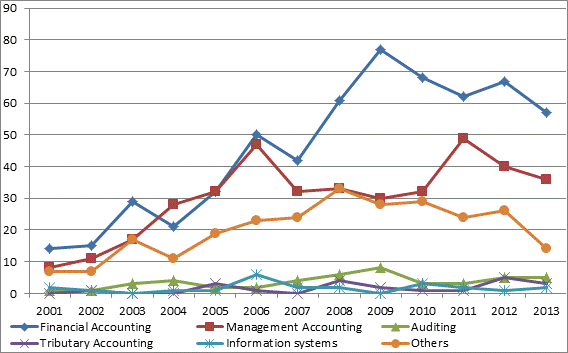
For the analysis of publications in accounting, six Brazilian journals were selected as indicated in the Methodology section. The results showed that Brazilian accounting journals exhibited an average publication of articles in management accounting for approximately 29.5%. On the one hand, this percentage is similar to the 28% reported by Hesford et al. (2007) Plot 1 : Numbers of articles published in the main accounting journals turning point, generating an opposite behavior to that of financial accounting, which displayed a rapid growth, with the decrease in publications in management accounting. This phenomenon should be monitored in the coming years to analyze whether the seasonality in the levels of publication will be maintained or whether we are in reality moving toward the same situation as that of the United States (Bonner et al., 2006) and Spain (Lunkes et al., 2012), which have low levels of publication in management accounting.
Another factor worth noting is the low number of publications on the topics of auditing, taxation and systems, which throughout the period analyzed was significantly lower than the levels of publication on financial and management accounting and other areas. There has also been considerable publication in Brazil in the field of accounting education, which explains the number of publications in the "others" category.
10. b) Training of Doctorates in Managerial Accounting
Doctoral education in accounting in Brazil grew in 2008-2012, with an average of approximately 20 new doctorates per year. Plot 2 shows the training of new doctors in financial accounting, management accounting, systems, tax, auditing and others, by major accounting programs in the country from which doctors graduated during the period covered by the study.
11. Plot 2 : Number of doctors who graduated from major branches of accounting
The results showed that the training of doctors in financial accounting was higher than that in management accounting and that the proportion of doctors in financial accounting has been growing in recent years, compared to management accounting. This finding corroborates the study by Lunkes et al. (2012) conducted in Spain, in which training in financial accounting was far greater than training in management accounting. This finding indicates that the aspects related to the lack of publication and low training of doctorates in management accounting in Spain were slightly more pronounced compared to Brazil. Overall, Brazil's problem is the low training of doctorates in all branches of accounting.
12. V. Discussion and Conclusions
The objective of this study was achieved with the classification of publications in management accounting in major accounting journals (Plot 1), and the number of doctors in accounting (Plot 2).
The results concerning the number of publications in management accounting corroborated the findings of Hesford et al. (2007), who conducted a study of ten major English-language accounting journals. However, comparing the findings of this study with those of Lunkes et Some of the explanations highlighted in the literature for the decrease in the number of publications include the following: the lack of depth (Ittner and Larcker, 2001;Hopwood, 2002;Mourisen and Lukka, 2002); the lack of creativity among researchers in management accounting (Zimmerman, 2001); and the lack of data (Ittner and Larcker, 2001;Pérez et al., 2005;Hopwood 2008, andMerchant, 2010). Other causes include excessive focus on describing management practices through case studies and surveys (Zimmerman, 2001;Ittner and Larcker, 2001;Gendron, 2007) and the diversity of conceptual sources (Ittner and Larcker, 2001;Luft and Shieds 2002), which includes the lack of hypotheses (Zimmerman, 2001;Lukka and Mourisen, 2002). These factors, coupled with the new accounting standards in Brazil, which have naturally resulted in increased production in financial accounting, might lead to a narrowing of research in management accounting.
This trend is a possible sign of a future decline and of a lack of publications in management accounting. At this point, it is believed that studies in management accounting should not be evaluated using the same evaluation systems as in other areas of accounting, in terms of the methods and forms of presentation. For example, the U.S. model requires a large number of data for new and emerging issues (MERCHANT, 2010), which makes research in management accounting practically unfeasible because management databases must be constructed, and this construction requires funding sources, which are scarce. One must consider that management accounting must produce its own data, thus making research difficult and costly ( This history shows that of the eight doctoral programs in accounting, seven were created in recent years.
These results show that the training of new doctorates in accounting in Brazil has much room for growth and improvement compared to the United States, with 7,531 doctors in 2011 and Spain with 549 doctors in 2010. Moreover, the training of doctors in accounting is low overall, in addition to being concentrated in the field of financial accounting in recent years. Notable is the training of doctorates in other areas of accounting, mainly related to the field of education and teaching. On this particular point, the results were not conclusive because the training of doctorates in management accounting in Brazil has shown consistent growth, which can also be observed in other areas.
Recommendations for future studies include the possibility of expanding research to the identification and analysis of scientific production and the training of doctorates in other accounting branches (auditing, tax accounting and systems), which exhibited low results. Additionally, the inclusion of other databases, such as ISI, SciELO, Dialnet and Latindex, among others, could increase the possibility of inclusion in Brazilian and U.K. journals, among other possibilities. Finally, conducting research into the publication and training of new doctorates in accounting in other countries is another possibility for future research.
13. Global Journal of Management and Business Research
Volume XIV Issue II Version I Year ( ) D

| Additionally, one can mention other works, such | |||||||||
| as Carvalho et al. (2010), who conducted a study to | |||||||||
| characterize the contributions of organizational life-cycle | |||||||||
| theories to research on management accounting. To | |||||||||
| this end, the authors developed a bibliometric study | |||||||||
| using the ProQuest®database that reviewed 22 other | |||||||||
| studies. Nascimento, Junqueira and Martins (2010) | |||||||||
| conducted a bibliometric and content analysis of works | Estudos/Fipecafi(Study Notes/ Fipecafi) -C.E., | ||||||||
| from the Conference of the National Association of | EnfoqueReflexãoContábil | (Focus: | Accounting | ||||||
| Graduate Programs in Accounting (Congresso da | Reflections)-ERC and Contabilidade Vista e Revista | ||||||||
| AssociaçãoNacional | dos | Programas | de | Pós- | (Views in and Journal of Accountancy) -CVR. The | ||||
| GraduaçãoemCiênciasContábeis | -ANPCONT/Brazil) | subjects of the articles were classified as managerial | |||||||
| and the Conferences on Accounting and Controllership | accounting, financial accounting, accounting theory, | ||||||||
| at the University ofSão Paulo (USP/Brazil), from 2007 | accounting education and research,cost accounting, | ||||||||
| Year | and 2008. Cardoso, Pereira and Guerreiro (2007) analyzed research profiles focused on costs in the field | professional practice, public accounting, public budgeting and public finance and international | |||||||
| of management accounting and control from the | accounting. During this period, management accounting | ||||||||
| National Meeting of the National Association of | was the most discussed topic. | ||||||||
| Graduate | and | Research | in | Management | Bonner et al. (2006) conducted research on five | ||||
| Volume XIV Issue II Version I | (EncontroNacional da AssociaçãoNacional de Pós-Graduação e PesquisaemAdministração -EnANPAD; | top U.S. journals (Accounting, Organizations and Society, Contemporary Accounting Research, Journal of Accounting and Economics, Journal of Accounting Research, and The Accounting Review) during the period from 1984 to 2003. In this study, 2,480 studies were analyzed and classified as auditing (543), financial accounting (1,281), management accounting (532), | |||||||
| ( ) | |||||||||
| Global Journal of Management and Business Research | |||||||||
| other areas, they represented 49%. These values show | |||||||||
| the relative consolidation of financial accounting in | |||||||||
| Spain, compared to other areas. | |||||||||
| ITTNER AND LACKER, | ||||
| 2001 AND 2002; HOPWOOD, 2007 AND 2008; | ||||
| MERCHANT, 2010). | ||||
| The United States launched its first doctoral | ||||
| program in accounting in 1938 (BEDFORD, 1997). | ||||
| Today, the country has approximately 91 universities | ||||
| that offer doctoral programs in accounting or doctoral | ||||
| degrees in administration with a focus in accounting | ||||
| (HASSELBACK, 2014). Spain offers 32 doctoral | ||||
| programs whose names include the term "accounting" | ||||
| (LUNKES ET AL., 2012), in addition to finance, | ||||
| administration | and | economics, | among | other |
| terminologies. In Brazil, there are only eight doctoral | ||||
| programs in accounting: University of São Paulo (USP), | ||||
| created in 1978; | ||||