1. Introduction
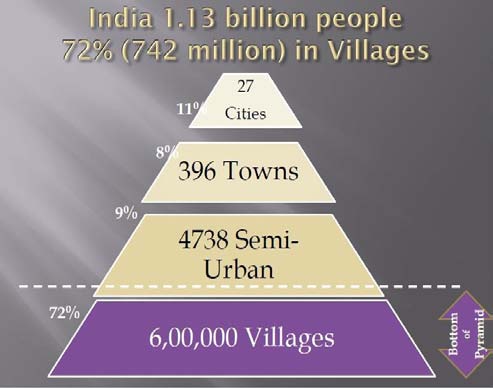
ast moving consumers good (popularly known as FMCG) is the fourth largest sector in India and creating employments for more than 3 million people in India with $ 37 billion market size. FMCG industry is expected to grow over $ 43 billion by 2014. According to a study by Mc.Kinsey Global Institute, incomes in India are expected to grow three times over next two decades and India will become fifth largest consumer market by 2025. Now increased awareness and increasing income level of rural population making it as high opportunity market for FMCG. Around 72% population of India is still living in India and due to increased purchasing power rural consumers are ready to upgrade their lifestyle. This tendency is opening gates for FMCG producers to serve in rural market with deep penetration. Indian rural market is expected to grow With 800 million customers by the end of 2013. The above picture shows that bottom of pyramid i.e. rural population has highest percentage which attracts the FMCG producers.
2. II. Rural Market for Fmcg in Haryana
Different experts and organizations have varied views on what constitutes the term, 'rural'. Collins Cobuild Dictionary (2001) describes the word 'rural' as 'place far away from towns and cities'. A rural market broadly comprises of consumer markets, institutional markets and services (Dogra&Ghuman, 2008). According to Velayudhan (2002), rural marketing includes all those activities of assessing, stimulating and converting the rural purchasing power into an effective demand for specific products and with the aim of raising the standard of living. It is a two way marketing process of flow of goods and services from rural to urban areas and vice-versa (George & Mueller, 1955). Rural marketing is any marketing activity in which one dominant participant is from rural area (Kotler, et al., 2009). If FMCG companies make their strategies in such a way so that the above combination is matched properly then it will be a win-win engagement for both consumer and producer. Income is the main variable to in creating BOP but now PPP of rural consumer is increasing that make them able to upgrade their lifestyle and effect their purchasing.
New economic policy 1991 has changed the Indian marketing scenario due to its liberalization policies (Gopalaswamy, 1997). (Habeeb Ur Rahman, 2007) argued about rural market that it is still untapped for a number of products and now opening its door for FMCG. Rural population is different in their quality seeking and value for money attitude. They behave differently from urban consumer for the same product as stated by Anand&Krisana, 2008. (Blackweel,1977) analyzed that there are various factors which influence the behaviour of consumer and (Krishnamoorthy, 2008) stated that rural consumers are required to study for influencing factors of their behaviour for FMCG. Price, promotion, packaging, quality, brand name etc. influence the purchase of the rural consumers (Sarangapani& Mamatha,2008, Bhatt &Jaiswal, 1986, Pandey, 2005, Kumar & Madhvi,2008, Narang,2001). In 1994 Ying Zhao argued that retailers also play essential role in the purchase of FMCG of rural consumer.
The study of literature make it necessary to conduct the present study because it is clear from the review of literature that a lot of thing are to be find out about rural consumer behaviour. Rajan. R.V argued that a lot of space is unfilled in the sense of research in the rural consumer behaviour study from last two decades. After going through the literature it is clear that there is lot of scope of studies related to influencing factors of rural behaviour. The review of literature make it clear that there are very few studies conducted on influencing factors of rural behaviour for FMCG with special reference to Haryana. Some studies are there but all are of South India and there is a effect of geographical location on the purchasing of rural consumers (Sinha, 2008).
To fill this gap present study is an attempt to find out the influencing factors of rural consumers purchasing behaviour for FMCG in Haryana.
The main objective of the present stud y is to identify the factors responsible for buying behaviuor of rural consumers for FMCG in Haryana.
3. a) Research Methodology
For this data has been collected through primary survey and for that structured questionnaire has been designed to get the responses of consumers. Likert's five point scale was used to get the exact responses of consumers which varies from strongly agree (5) to strongly disagree (1). A sample of 500 consumers was studied to get the answer of the question. The below formula was used to get the exact sample size n = Z2(pq)N ÷ e2(N-1)+ Z2(pq)
The sample size taken for study is more than the required according to the formula.
4. b) Sampling unit
The rural customer or consumers of FMCG from rural population of Haryana was taken as sampling unit. Sample represents the rural Haryana which almost half of the total population of Haryana. c) Reliability and validity of questionnaire A pilot study has been conducted to test the reliability and validity of questionnaire. For reliability croanbach ? and for adequacy KMO test were applied. The questionnaire was reliable because ? was more than 0 .75 which means that test was reliable.
5. d) Data sources
Primary as well as secondary source of data collection were applied for the present study. Primary data was taken from survey and secondary was taken from books, websites of companies and articles on rural marketing and FMCG.
6. e) Tools & Techniques used
A factor analysis was used to find out the factors influence the purchase of FMCG by rural consumers in Haryana.
The present study tried to find out the factors influencing the rural purchase of FMCG in Haryana. Twenty two variables were found which affect the purchase decision of rural consumers for FMCG . Rural consumers want to have a product as a whole package whatever they want it must contain in a FMCG. As (Prahalad, 2005) proved quality as most influencing variable, again in the present study quality of FMCG proves to be an important influencing variable of rural purchase. Rural consumers also seek different variety in FMCG that may affect their product choice for FMCG.
7. b) Factor 2(Promotion)
Promotion or advertising come with highest factor loading which proves that in case of FMCG rural purchase are highly influenced by the advertisements. Rural consumers relate the product with the celebrity who endorses the product and it influences the product purchase in case of FMCG. FMCG marketers' tries to educate the rural population about their brand and product and it affect the sale as a result. Sales promotions and relationship marketing also play important role in influencing the rural purchase of FMCG as their factor loading are 0.809 and 0.802.
8. c) Factor 3 (Value)
In the present study it is shown that rural consumers are price sensitive and relates the purchase with need satisfaction. They give value to that product which is low priced, satisfy their need, have extra benefits and affordable for their pockets. The product which has maximum of these attributes is treated as most valuable product by rural consumers.
9. d) Factor 4 (Attitude)
The present study proved that rural consumer links their purchase with the attitude and lifestyle. Packaging is the first impression of a product and it affects the purchase of rural consumers. Rural consumers want to have those products which make them to feel dignified while purchasing and using the product. Rural consumers try to purchase the FMCG which improve the lifestyle and make them to feel in superior class.
10. e) Factor 5 (Interest)
It is common that a consumer will purchase that product in which he/she interested. Current study prove that retailer's recommendation in case of FMCG make the rural consumers interested to buy a product (Factor loading = 0.891). Brand awareness makes a consumer ready to purchase if it create the interest of consumer in that product. Brand loyalty is also affecting the purchase of FMCG because it is noticed that rural consumers repeat their purchase for same brand. f) Factor 6 (Demographics) A large literature is available which proves that demographics affect the purchase of FMCG. Current study is also supporting the same thing. Age is proved as the most influencing variable of rural consumer purchase of FMCG (factor loading = 0.968). Gender differences are also affecting the sale of FMCG in rural market. Income and education level of rural consumers are also playing significant role in their purchasing of FMCG.
Rural customers buy the FMCG through retailers in their villages.The present study proved that the retailers are aware of the fact that theircustomers listen to them; they are the one who can create their interest in product. It necessitate thatcompanies must educate rural retailers aboutmodern marketing principles for a betterperformance. As price influences rural purchase ofFMCG, it is recommended to pursue the low-pricestrategy in rural marketing. Attaining low price notonly requires low-cost manufacturing but alsoperforming various marketing activities such aspromotion and distribution in a cost effectivemanner. It is also recommended to promote goodson price plank. For rural customers, value formoney is very important when they purchased FMCG. The study revealed thatthe rural customers are not only price
11. Conclusion
offerFMCG in different varieties. Rural consumers are highly affected by their lifestyle and attitude. Rural marketing is highly influenced by celebrity endorsement and companies should take care of this and take that celebrity who is popular in rural areas.
In the end it is concluded that FMCG companies make such marketing strategies which create a favorable environment for rural consumers and help to understand them which product suit best to them. Special kind of marketing mix strategies are required for rural marketing which emphasize on low price along with low cost phenomena.

| Twenty |
| Factor | Croanbach ? | No. of variables included |
| Factor 1 (Product) | 0.859 | 3 |
| Factor 2 (Promotion) | 0.901 | 4 |
| Factor 3 (Value) | 0.773 | 4 |
| Factor 4 (Attitude) | 0.822 | 3 |
| Factor 5 (Interest) | 0.862 | 3 |
| Factor 6 (Demographics) | 0.796 | 4 |
| Overall reliability | 0.806 | 21 |
| a) Factor1 (Product) |
| Rural |