1. Introduction
number of important qualitative changes in demand have taken place in recent years, such as the rise in education, income and status levels in the market (Richards 2007). This means that the public's general knowledge is increasing, making them become more demanding and better informed. This change, along with greater interest in experiences (Monteagudo 2008) and creativity and the growing presence of technology, social media and digital platforms (Bryce 2001;Castells 2001Castells , 2005 (Pine and Gilmore 1999;Monteagudo 2008) rather than merely selling information or services.
The same trend is taking place in the events sector and more specifically in the case of music festivals. Current audiences do not attend festivals and merely listen to the concert, but are simultaneously tweeting, taking photos or videos to upload them, sharing the opinions of the concert with their Facebook or Whatsapp friends. This shows an evolution in the way people attend festivals and a change in their expectations of music events. This transformation constantly challenges festival creators and managers to reinvent their festivals to achieve the attendee reactions they desire (Bonet 2009; Calvo-Soraluze 2011, 2013). Therefore, festival managers intend to maximize and enrich the experience taking into account the aspects that today's attendees' value most such as interactivity (Kerckhove 1999 Hence, the goal of this chapter is to find out what innovative strategies and managerial processes current festivals are implementing in order to stimulate Author ? ?: University of Deusto, Spain. e-mail: [email protected] their attendees' leisure experience and achieve more dynamic participation and engagement.
In the first part, we examine the phenomenon of the network society and digital culture as a way to understand the context we live in and the main changes that technology is bringing to current society. In the second part, we delve more deeply into social media as a social digital phenomenon that is changing the way we communicate and interact in different contexts. In the third part, we focus on the influence of technology and social media in music festival management to subsequently analyse the innovative strategies and managerial processes that current festivals are implementing. In the fourth part, we concentrate on a specific case: the BBK Live Festival. Finally, in the last part, we present a brief conclusion of the main ideas and some lines for further research.
2. II.
3. Network Society and Digital Culture
The spread of Information and Communication Technologies (henceforth ICTs) together with the development of network infrastructure (Internet) and the democratization of Social Media (social networks, blogs, wikis, virtual communities, etc.) have resulted in a digital and social revolution that has transformed and digitalized many areas of human action. Consequently, time and space dimensions, which are constituent elements of human life and culture, have been altered. Localities are becoming detached from their cultural, historical and geographical significance and reintegrating into functional networks or collages of images causing a space of flows and time is being rescheduled, becoming continuous and timeless (Castells 1997).
The number of Internet users increases day after day and there are currently 2,405 million Internet users worldwide, which accounts for almost 35% of the total world population (Internet World Stats 2012). Internet is already infrastructure of our lives (Castells 2013) and cyberspace is seen as a social, cultural, educational, work and leisure environment, as well as a new context for civic participation and the enjoyment of digital culture, among others. The Net is something more than a support, a mere communication tool or a
4. Global Journal of Management and Business Research
Volume XIV Issue II Version I Year ( ) platform for online services, and is now becoming an important virtual environment for cultural coproduction, exchange and collaboration. A real laboratory for social and emotional experimentation (Aranda and Sánchez-Navarro 2010) and a space to learn and empower citizens (Reig 2013).
As a consequence, the traditional way of understanding "culture" has changed (Uzelac 2010). The Network has caused new social paradigms to emerge, which are now called "Global Informational and Transformational Era" (Fernández 2013), 'Cyber Culture' (Lévy 2007;Kerckhove 1999), "Age of Information" (Castells 2005), "Digital Culture" (Gere 2002), "Network Society" (Castells 2001), "Third Environment" (Echeverría 1999), "Digital World" (Negroponte 1995) or "Knowledge Society" (Drucker, 1994), among others. This new social paradigm has some inherent characteristics such as interactivity, connectivity, hypertextuality, ubiquity, synchronicity anonymity, virtual reality, transparency, totality, convergence, immersion, random access, mobility, (Kerckhove, 1997;2005;Nimrod and Adoni, 2012) which have exerted a significant influence on social behaviour and changed the way that culture is conceptualized.
All these characteristics inherent to the Internet have contributed to establishing cyberspace as a large server that hosts an infinite amount of fragmented data which is created, destroyed, mixed and modified thanks to the joint action carried out by people through online connections (Siemens, 2006). The digital nature of data with the design of the Internet as an open network (O'Reilly, 2005) has enabled the construction of an online digital culture catalogued as digital heritage. So, how can we define "culture" in the digital era?
The rapid development and deployment of ICTs globally have prompted the need to take a new approach to the term "culture", establishing and more precisely redefining it to include the influence of the intrinsic characteristics of the network in the culture that we have previously underlined.
Mass-scale implementation of digital innovations and the constant proliferation of online content have brought about great opportunities for the cultural sector. One of the most noticeable impacts of the development of digital technologies has been their impact on all sectors of the value chain for classic works of art. "From creation to production, distribution and consumption of cultural goods and services, including the demands, uses and ways in which culture is enjoyed" (European Commission 2010).
The Digital Era has influenced a large cultural industry which, according to Eurost at (European statistics database), covers eight areas: monuments and heritage, archives, libraries, books and press, visual arts, architecture, performing arts, audio-visual and multimedia; and six functions: preservation, creation, production, dissemination, trade, and education. A new digital economy where the intangible value of culture determines material value has been created. This is due to the fact that consumers want to have new enriching experiences as well as content (Pine, J.B. and Gilmore, J. H. 1999).
Access to the net, remixing content and interaction as opposed to contemplation, are the keys to the new digital formats. These are new processes linked to online, distance and collaborative work which, on the one hand, have made possible the creation of a more social and collective culture and, on the other, have fostered a more ephemeral, diffuse and fragmented kind of art. The means of cultural production and distribution are now more readily available than ever, and the boundaries between creators and audiences are being reinvented at an increasingly faster pace, and in a more permeable way. This causes the exchange of roles between creators and receivers to occur more easily. Today's consumers are also culture producers, hence the emergence of "cultural prosumers", people who, thanks to the Net, not only consume digital cultural content, but also produce it.
Today's digital cultural content is defined by the parameters of co-creation, collectively created content (Lévy, Rheingold, Surowiecki, 2004), sharism (Mao, 2008), remix of contents, active participation, collaboration, converge of media (Jenkins, 2008), trans media narratives (Scolari, 2013) etc. In other words, the Internet has become "the largest shop-window in history; it is the expression of a way of producing, disseminating, sharing and consuming culture which tends to prevail" (Igarza, 2012:153).
Hence, the UNESCO (2003) had to adapt and include the emerging digital cultural contents in the official categorisation of "cultural heritage". Heritage is defined in UNESCO documents as "our legacy from the past, what we live with today, and what we pass on to future generations". Heritage is something that is, or should be, passed from generation to generation because it is valued. In the digital era humans are creating and sharing digital resources -information, creative expression, ideas, and knowledge encoded for computer processing -which they value and want to share with others over time as well as across space. So, in a digital context, the definition of "cultural heritage" also needs to be re-formulated.
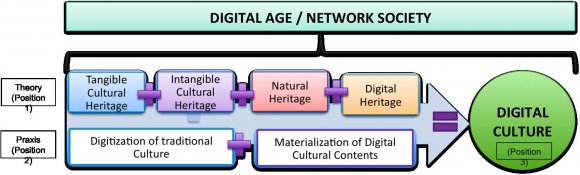
According to the "UNESCO Charter for the Preservation of Digital Heritage" 1 "Unique resources of human knowledge and expression. It embraces cultural, educational, scientific and administrative resources, as well as technical, legal, medical and other kinds of (2003) the digital heritage consists of: information created digitally, or converted into digital form from existing analogue resources. Where resources are "born digital", there is no other format but the digital object. Digital materials include texts, databases, still and moving images, audio, graphics, software and web pages, among a wide and growing range of formats. They are frequently ephemeral, and require purposeful production, maintenance and management to be retained. Many of these resources have lasting value and significance, and therefore constitute a heritage that should be protected and preserved for current and future generations. This ever-growing heritage may exist in any language, in any part of the world, and in any area of human knowledge or expression" (UNESCO, 2003:75) For this reason, in the digital age "cultural heritage" 2 Nevertheless, although the theory shows a digital culture based on the values of co-creation, participation and collaboration, many studies demonstrate a different digital content reality. There are does not end at monuments and collections of objects (tangible cultural heritage such as movable cultural heritage paintings, sculptures, coins, manuscripts etc.; immovable cultural heritage monuments, archaeological sites, and so on; and underwater cultural heritage shipwrecks, underwater ruins and cities), intangible cultural heritage (traditions or living expressions inherited from our ancestors and passed on to our descendants, such as oral traditions, performing arts, social practices, rituals, festival events, knowledge and practices concerning nature and the universe or the knowledge and skills to produce traditional crafts) and natural heritage (natural sites with cultural aspects such as cultural landscapes, physical, biological or geological formations). The cultural heritage of the digital era also includes "digital heritage" made up of computer-based materials.
Whereas in theory (position 1), we can consider digital culture as the sum of tangible, intangible, natural and digital cultural heritage and, in praxis (position 2), we can define digital culture in a double direction: on the one hand, as the digitization of traditional cultural contents or practices and, on the other, as the materialization of, originally digital heritage. The point (position 3) at which all stances cross gives rise to what we understand as our present-day cultural model (see figure 1). A new space supporting communicative needs, creative practices, new trans media narratives and social transformations; a context that we are unable to control and that is gradually encroaching on our daily lives. some researches which have analysed the use that citizens in general, and youth in particular, make of the Internet ( Thus, what happens in the case of music festivals? Do festival managers take advantage of the use of social media to stimulate attendees' leisure experience? In the third part of the article we focus on the influence of technology and social media in music festival management to subsequently analyse the innovative strategies and managerial processes that current festivals are implementing. However, we first describe the different uses of the Internet. How rewarding our digital experiences will be basically depends on the use we make of ICTs and social media.
5. III.
6. Different uses of Digital and Social Technologies
The Internet is the widest and fastest technological revolution in history, and in only 23 years has become a real social and digital revolution. In 1990 the Internet was little more than a promising technology redoubt of a minority of power users and companies offering Internet services and information seekers. In the first stage of the Internet (Web 1.0), these companies simply used the Internet as a channel to publish information about their products and services, so users merely adopted a passive attitude and consumer networking products for their individual benefit. However, as a result of the development of all kinds of increasingly accessible, cheaper and easier to handle digital technologies, social media and web applications; the network has evolved today into a real techno-social environment.
In just over 10 years, the Internet has gone from being a static platform (Web 1.0), to become a social and participatory space (Web 2.0). The year 2000 marked this paradigm shift in the network (second stage of Internet) placing people (users or audience) in the centre of the virtual action as protagonists, offering them the ability to create and generate content and services online. Therefore the Internet and social media, as a social digital phenomenon, are gradually changing almost all the spheres of man's life (communication, politics, education, participation, employment, leisure etc.). However, what we are referring to when we talk about "social media"? a) The Social Media Revolution and the Power of Social Networks Social media is the set of an infinite number of applications and digital network services which enable people, as users, to evolve from being mere spectators and consumers of what the Internet offers, to become creators and generators of content and services. However, it is important to highlight that when we talk about social media we are referring not only to social networks, because the concept of social media encompasses much more than social networks and refers to blogs, virtual communities, wikis, forums etc.
Therefore, today, it is very common to talk about concepts such as Web 2.0, Social Web, Web of persons, Next Generation Web, Web of People, Web hypermedia, participatory Web, etc. That is, different notions used to define the virtual space where the user is king (Nafría, 2007). People connected have the possibility to participate in networks proactively, providing content and knowledge network, transforming and modifying existing information, generating debate and ultimately contributing to the momentum of the socalled collective intelligence (Lévy, 2004), the power of smart mobs (Rheingold, 2004) or the wisdom of crowds (Surowiecki, 2004).
The Revolution 2.0 has promoted cyberspace that hosts an infinite number of services, digital applications and data. Thus, it is extremely complicated to draw up a complete map that includes social media and tools covering all the sub-universe 2.0 and which is also valid over time. However, some authors have made different categorizations to show an overall idea of the mass social phenomenon that led to the network of networks. As an example, we show the structure of social media established by Cristobal Cobo Romani (2007) who designed a media map 2.0 based on four main lines that form the four pillars of the Social Web: 1) Social Networking tools designed to create spaces that promote or facilitate the creation of virtual communities and instances of social exchange; 2) Platform contents that encompass all media that support reading and writing online as well as their distribution and exchange;
3) Resources for optimum social and intelligent organization of information that serve to tag, organize and index, and facilitate order and information storage; and 4) Mashups that include all kinds of tools, software, online platforms and hybrid resources created to provide value-added services to the end user.
However, the social media revolution would not have been so successful without the parallel revolution of social networks. In just 10 years, hundreds of people have included social networks in their daily lives 3 . Therefore, referring to social networks means talking about life, society and people, this is nothing new. The concept of social network is not something that has emerged with the arrival of the Internet. Its social meaning and scope date back to an era before the Internet and computers. However, it is important to note that social networks are not just connected computers, but are real people who create online community, in this case called virtual communities.
In the last five years, social networks have developed into an authentic social and mass phenomenon. The innate characteristics of the Internet have introduced four radical changes in the way we interact socially: enormity, community, specification and virtuality. These characteristics have made social networks a true social, digital and mass revolution that, for some authors, is simply a fashion or trend. Nevertheless, at present it is transforming the way we live and interact.
In essence, social networks offer new forms of communication. Depending on the use made of them, it is possible to distinguish different types. The barrier separating some other types is sometimes very thin, and their classifications depend on the author. For example, the consulting agency The Cocktail Analysis distinguishes between "pure social networks: Facebook, My space, Hi5, LinkedIn, Spaces, Xing, Twitter or Badoo, among others, and "social network of community-communication", that is, networks which mainly focus on creating community-communication, such as forums, blogs, video platform YouTube or leisure virtual communities. Other authors, however, made simpler distinctions, distinguishing between "vertical social networks "(thematic networks, photography, music or video) and "horizontal networks" (networks of personal, professional and microblogging contacts). Meanwhile, Muñoz Calvo and Rojas Llamas (2009) classify social networks into four groups, depending on the purpose for which they are used:
? Personal Social Networks ? Professional Social Networks ? Thematic Social Networks ? Local Social NetworksIn short, social networks as a whole are networks whose main use is communication. However, it is very common to find that such digital tools are used for "hipercomunication" i.e., to communicate, to inform, to build, to maintain networks, to share, to participate, to collaborate, to gossip etc. It is important to know about the different uses of the Internet and reflect on how we actually use it. Because do we take advantage of potential Internet and social media users? Do music festival managers use them to stimulate their attendees' leisure experiences and achieve more dynamic participation and engagement? b) Different Uses of the Internet, Social Media and
Social Networks
To answer these questions, we refer to two models of analysis. The first has been developed by the social psychologist Dolors Reig (2012), who distinguishes between three levels of technology use:
1. ICT: Information and Communication Technologies 2. LKT: Learning and Knowledge Technologies 3. EPT: Empowerment and Participation Technologies Thus, far from considering digital media as being exclusively Information and Communication Technologies (ICT), the digital network culture is leading us to understand technology, as noted by the social psychologist Dolors Reig, as Technologies for Learning and Knowledge (LKT) and Empowerment and Participation Technologies (EPT). That is, as digital tools that ultimately enable our enjoyment, involvement and personal development through the Net.
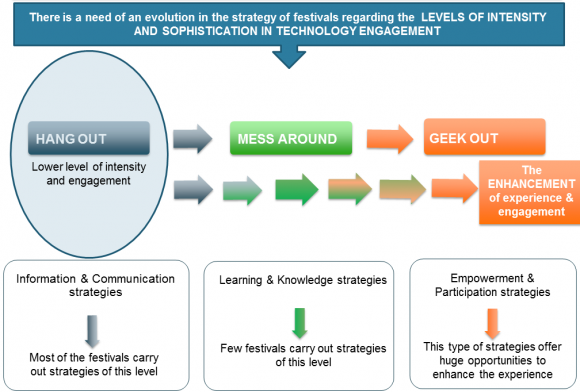
On the other hand, the categorization by Irvine researcher Mizuko Ito (2010) and her team is worth mentioning. They identified three participation genres that describe different degrees of commitment to media engagement: Hang Out, Mess Around and Geek Out.
These three genres are a way of describing different levels of intensity and sophistication in media engagement with reference to social and cultural contexts, rather than relying exclusively on measures of frequency or assuming that certain forms of media or technology automatically correlate with "high-end" and "low-end" forms of media literacy.
? Hanging Out refers to communication, relationships, gossip, chatting, flirting and dating with the desire to maintain social connections to friends.
? Messing Around represents the beginning of a more intense, media-centric form of engagement; that is people begin to take an interest and focus on the workings and content of the technology and media themselves, tinkering, exploring, and extending their understanding. It involves experimentation and exploration with relatively low investment, where trial, error, and even failure have few consequences.
? Geeking Out involves learning to navigate esoteric domains of knowledge and practice and participating in communities that traffic in these forms of expertise. It is a mode of learning that is peer-driven, but focused on gaining deep knowledge and expertise in specific areas of interest. As in the case of messing around, geeking out requires the time, space, and resources to experiment and follow interests in a self-directed way.
These two models on the use of technology serve us as a basis for analysing how the music festival organisers use digital technologies as a part of their strategies and managerial processes. In the case study (Bilbao BBK Live Festival) presented in this article we compare these two models with reality. We first describe how technology and social media influence management of music festivals.
7. IV.
The Influence of Technology and Social Media in the Management of Music Festivals
The growing presence of social networks and the new applications of technological devices such as mobile phones and tablets in daily life open new and unsuspected horizons in the field of experiences and cocreation (Bryce 2001; Nimrod and Adoni 2012) which can be applied in the events sector. In fact, technology and social media are increasingly being used in music festivals to heighten the leisure experience.
Furthermore, current audiences do not go to festivals and just listen to the music; they are tweeting, taking photos or videos to upload them, sharing their opinions of the concert with their Facebook or Whatsapp friends and many other activities that involve some form of technology, digital application or social media. In fact, 92% of the people that attended a European music festival in 2013 used Facebook, followed by Youtube 71%, Twitter 33%, Instagram 32%, and Google Plus 20% (EFA & CGA 2014). This shows an evolution in the way people attend festivals and a change in their expectations of music events. This transformation challenges festival creators and managers to constantly reinvent their festivals to achieve the attendee reactions they desire. Therefore, festival managers intend to maximize and enrich the experience taking into account the aspects that todays' attendees value most, such as interactivity, participation or emotional bonds.
For this reason, festivals across the world are beginning to use technology and social media sites before, during and after the event to further promote their festivals, and add another layer to the festival experience. Almost all the European festivals are present on all the personal social networks and some thematic ones for music (Spotify, Deezer and Vevo) and video (mainly Youtube). Festivals use these social platforms to offer promotional deals, release teasers or create personalized playlists. Some of the most interactive ones like Primavera Soundor Melt! Festival also create official forums and blogs so that the public can give their opinions, pose doubts or suggest ideas.
Some other festivals are also using social media for people who could not attend the event to help them enjoy it from afar and create a loyal fan base offering live streaming through their own social media channels. Many of them also have agreements with social networks like YouTube to offer live streaming concerts or clips from festivals. In fact, consumption of streaming video over the top (OTT) 4 music services are the two fastest growing subsegments according to the PwC report Global entertainment and media outlook with annual rates of 28.1% and 13.4% respectively.
Related to audio-visual content, some festivals are trying to find new ways of introducing the line-up and promote the event. For instance, Primavera Sound created a short and featured a preview screening in some cinemas, uploading the content on YouTube afterwards. In the case of Tomorrow land, the festival is well known because of the after movies they create and upload on YouTube following each edition of the festival.
Most of the festivals also have official mobile apps that can be downloaded to any smart phone. Most of these applications are free and contain important information about the festival. Although each festival includes different functions and services with the application, the free download usually contains: set times, a map of the festival site, information about the performers, camping and transportation options, the ability to scan food vendor menus, create custom schedules, rate food items or take pictures with Instagram. The most advanced apps also send push notifications during the festival notifying fans of set changes and secret pop-up shows.
Due to the growing importance of mobile phones at festival sites, some such as Roskilde Festival or Jelling Musik festival are including mobile charging stations or portable chargers. Therefore, festival goers do not have to worry about running out of power and they can be connected during the whole festival. The mobile charger connects with a short cable to the phone, for the charger to easily fit into a pocket, bag or wherever it suits the attendee. It recharges the phone allowing festival goers to focus on enjoying the festival and share their experience anywhere at any time. Some of the most innovative festivals are even integrating smart wristbands that are connected to social networks and allow the audience to publish new states on their Facebook wall directly or know who of their Facebook friends are at the festival site. There are festivals like the Benidorm Low Festival that currently use this technology and call themselves a 2.0 festival.
All these uses of technology and social media are changing interaction with and among the audience, and, as a consequence, the design process and management of the festival. Hence, technology is making a major difference in the industry. Some of the aspects that have been transformed are (EFA & CGA 2014): involved in the control or distribution of the content. The provider may be aware of the contents of the Internet Protocol packets but is not responsible for, nor able to control, the viewing abilities, copyrights, and/or other redistribution of the content. This is in contrast to purchase or rental of video or audio content from an Internet service provider (ISP), such as pay television, video on demand or an IPTV video service, such as AT&T U-Verse.
? The way managers understand the audience at their festival. New information and communication technologies, personal computers, Internet and mobile phones, have drastically changed norms and practices in all life domains. Individuals' access to leisure and culture, leisure behaviour and experiences have been transformed, changing the ways in which people spend their time, determining their cultural preferences and developing their social ties and networks (Bryce 2001; Nimrod and Adoni 2012). Therefore, technological change has influenced concepts of leisure and its organization, both in terms of access and experience (Bryce, 2001). Social networks, blogs, forums and the Internet in general offer new ways not only for the festival and the audience to communicate, but also to understand behaviour, collaborate and co-create. Thus, managers have new possibilities to comprehend and engage the audience. In fact, managers can use social media analysis tools in order to understand ticket-buyers and the potential audience more fully than ever before. All these numbers show the potential that social networks and the Internet offer for a festival to reach thousands of fans in a faster and a more direct way than ever before. ? The chance to be connected to the audience the whole year. Those communications are no longer restricted to audiences for a few months before and after the event; they can now continue 365 days a year. This enables ideas to be put out to fans to obtain their feedback. This deeper understanding of fans is being used by the most savvy to take a lot of the guesswork out of catering to their consumers' desires. This better understanding of the audience can be used not only to improve the festival, but also to increase users' participation and engagement. The option of developing the potential of festivals through networks and collaboration with technology companies. Nowadays, creativity from technology companies is improving event design and the way promoters manage festivals in many ways, helping them understand more, communicate more, plan better, and be more efficient. Some advanced technologies introduced in festivals include cashless payment methods, sophisticated planning software, high speed wireless internet at greenfield sites, the use of live streaming as a powerful marketing tool, increasingly sophisticated apps and the like (EFA & CGA 2014). Another important sign that technology and social media are making a major difference at music festivals is the creation of the community manager role. Although many different business companies are also bringing this role into their firms and it is not exclusive of the events sector, the community manager role is more important at music festivals than in any other kind of business. This is due to the seasonal, intangible and experiential character of festivals where the importance of keeping in touch with the audience becomes the key to the success of the next edition.
Community managersare responsible for building and managing the festival's online community on the Internet by creating and maintaining stable and lasting relationships with fans, getting them involved. Among other things, they are in charge of the following tasks (AERCO 2009; Jason Keath2012; The Community Roundtable 2014):
? Create attractive and qualitative content. Not only on social networks, but also on other online platforms for the festival such as the webpage, the blog or digital apps. The key is to have a holistic strategy for all the online platforms for the festival and manage them as a 'digital eco-system'. ? Know their target. Not only fans, but also potential ones. Thus, they can set out the strategy and identify the actions that will be most successful among the different targets. ? Know the best time to publish the content. There are tools that indicate the best time of the day and the best day of the week to ensure the content will have greater acceptance. There are also tools to schedule the publishing of the content. It is advisable to schedule content not only for primetime (although the best is to focus on these slots), but also for the rest of the slots in order to reach all the different targets. ? Monitor their own publications, analysing their acceptance and engagement by users. The most common way to do so is to measure the number of likes, comments and shares of the content. This indicates the engagement rate. For instance, in the case of Facebook, the rate can be calculated as follows (Leander 2011;Socialbakers 2013): Average Post Engagement rate (on Facebook) = Likes + comments + shares on a given day / Wall posts made by page on a given day / Total number of fans.
The rate number means the number of interactions fans have per post on average. The results above 1% engagement rate is good, 0.5%-0.99% is average and engagement below 0.5% most likely means that the organization needs to realign the messages to the audience's expectations and in the process attract more compelling and engaging messages from the community members.
? Identify intermediaries. Fans who are able not only to interact, but also to recommend and defend the festival. The community manager must know these intermediaries, their tastes and motivations to carry out specific actions and increase their level of participation and engagement. ? Monitor all the publications and news from the industry. The community manager ends up becoming the eyes of the organization on the Internet. This practice is not only useful to identify opportunities and threats in time, but also to detect the most relevant content from the competition and the industry. Due to the importance of this role and its increasing professionalization, a new company has recently been created to help different organizations in the music sector. This firm is called Music+ and is the first digital marketing agency for the music industry (Hernández 2014). The agency is formed by a multidisciplinary team of experts who are capable of identifying and addressing the needs of the music industry through consulting digital promotion, social media, online revitalization and technology in a customised way. The agency argues that is not enough to have a community manager role or allocate a budget for online advertising without a strategic vision and resource optimization (Music+ official website 5 V.
8. A Case Study: The bbk Live Festival
). The main challenge lies in being open to new practices and ways of working, but always with a pragmatic sense in which the tools used and the data go far beyond being mere information to become key pieces in the overall strategy of the industry.
Hence, technology can make extremely large contributions and transformations to promote cocreative and memorable event experiences at music festivals. The question is how managers can use technology and social digital platforms to its full potential and bring it into the festival to achieve audience engagement. As Erik Qualman says "We do not have a choice on whether we do social media, the question is how well we do it" (Qualman 2009).
Bilbao BBK Live is a rock and pop music festival that takes place every July in the city of Bilbao, Spain, for three days. Since its beginnings, the festival (by percentage) can be explained in the following way: has been held in its entirety at a special complex built specifically for the event on the slopes of Mount Cobetas, located southwest of the city. The festival area is 100,000 square meters, with the capacity and the infrastructure to accommodate 40,000 people per day. The festival area has four stages, VIP areas, backstage, a wide variety of food stands, sponsorship stands, camping area, market and free bus service every five minutes to the festival area from Bilbao and Barakaldo (Last Tour International Report, 2014).
The first edition was organized by the Basque musical promoter Last Tour International and sponsored by the Bilbao City Hall in the year 2006 under the name of Bilbao Live Festival. Since the following year, the festival has been sponsored by the local savings bank Bilbao Bizkaia Kutxa (BBK), which gave it its current name. The festival is the first of its kind and size to be held in the region. In the 2011 edition, the festival had over 100,000 visitors for the first time, doubling the 2006 attendance (bi fm, 2013). The 2013 event was reported to have had an economic impact estimated at over 17.5 million euros in the city (Europa Press, July 2013). This year, 2014, is the first time that the festival has sold out all the tickets. See the evolution of the number of spectators in Table 1.
The festival was nominated for 'Best Foreign Festival' at the UK Festival Awards in 2010 and 2011 and for 'Best Medium-Sized European Festival' at the European Festival Awards five consecutive times in 2009-2013 (Europa Press, October 2013).
Regarding the line-up, bands and performers such as Radiohead, The Cure, Coldplay, The Police, Metallica, Red Hot Chili Peppers, REM, Depeche Mode, Iron Maiden, Green Day, Lenny Kravitz, Guns n' Roses and many more have played during the eight-year history of Bilbao BBK Live (bi fm, 2013).
The profile of the public attending the festival has the following characteristics (Last Tour International Report, 2014):
? 53.8% are men and 46.2% women.
? Most of the public are between 25 and 40 years old.
? 74.5% come from Spain. Of these, 15.7% come from the Basque Country, 18.5% from Madrid, 5.85% from Barcelona and 34.45% from the rest of Spain. The remaining 25.5% come from outside Spain. ? 48.1% of the attendees have a bachelor's degree, 21.7% a postgraduate degree, 8.7% are currently studying and 21.5% do not have university studies. ? 80% of the attendees are employed and the remaining 20% are students or unemployed. With respect to technology and social media, the festival has been developing and investing in what they call a digital ecosystem platform that will allow the organisers to have direct communication with fans, followers, institutions, brands and media. The festival is almost on all the personal social networks: Facebook with 87,994 followers, Twitter with 29,600 followers, Instagram with 3,167 fans and Google Plus with 43,762 fans and 353,053 views. It is also on some thematic social networks. Related to videos, it is on YouTube with 179 subscribers and more than 200,000 views. As for music, the festival is on Spotify with an official profile and different playlists adapted to each edition (Bilbao BBK Live official website).
BBK Live also has an official website with 1.301.645 views per year and 213.720 users. The organisers send newsletters to fans with 110.000 contacts and for media with 4,500 contacts. The festival also has an official application that can be downloaded to mobile phones. Nowadays, the app has 30.680 downloads and contains practical information like bands, performance schedules, camping and transportation options, a map of the festival site: stages, W.C., food stands etc., all the info about the performers and information related to how to get to the festival and how to get to Bilbao (Last Tour International Report, 2014).
9. VI.
10. Analysis
As the main goal of this chapter is to find out the innovative strategies and managerial processes that current festivals are carrying out through technology and social media, in this section we analyse how and at what level the Bilbao BBK Live Festival is using Facebook in order to stimulate their attendees' leisure experience and achieve more dynamic participation and engagement.
We chose Facebook since it is the most used social network by European festival goers (92%) and therefore gives us more clues about the way the BBK Live Festival is trying to connect with its fans and at what level (Hang Out, Mess Around, Geek Out).
For that purpose, we have taken the posts published on Facebook by BBK Live and we have analysed how the festival organisers used it in the last edition (year 2013). The publications of the festival were examined one week before the festival took place (3th, 4th, 5th, 6th, 7th, 8th and 9th of July), during the three days of the festival (11 th , 12 th and 13 th of July) and after a week the festival was held (14 th , 15 th , 16 th , 17 th , 18 th and 19 th of July). In each post the number of likes, comments and shares was taken into account to calculate the percentage of engagement before, during and after the festival. The content of each post was also classified according to the level of intensity and sophistication in technology engagement: Hang Out or ICT, Mess Around or LKT and Geek Out or EPT.
Table 2 shows the data collected in the prefestival phase. The organization published seventeen posts in total a week before the music event was held. Some days like the 5 th and 6 th of July had no posts and posts, six in total. Nevertheless, what we really want to know is the type of the content of these publications. 88.2% of them are ICTs and the remaining 11.8% are LKT. That means that the festival used Facebook mainly to give promotional or practical information. Although most of the publications go with pictures, videos or links, all of them have an informative or communicative goal. Furthermore, there is no content related to the Geek Out or EPT level. Therefore, in this phase the organization does not use Facebook to create knowledge or encourage active participation in the festival, but to promote the event. The publications offer discounts and raffles for tickets to the festival and in general, all kinds of information to announce the music event and sell tickets. Regarding the engagement, the percentage is quite low with a rate of 0.242%. That indicates that in the pre-festival phase on average there are 0.00242 interactions per post by each fan.
With respect to the three days of the festival, the data collected are shown in Table 3. In this case, the activity on the social network is higher with more posts in less time, specifically twenty-five posts in three days. That means eight posts per day on average. Nevertheless, the content type does not show major changes compared to the pre-festival phase. The main posts continue to focus on providing information, that is, ICT content. In fact, the percentage grows to 92% and the posts focus on giving practical information about the festival. The type of publications particularly emphasises useful information related to performance schedules, location of the stages, food and drink stands and in general, any information that can help to move around the festival site. 4% is LKT content type and the remaining 4% is EPT. The engagement rate grows compared to the preceding phase, but it continues to be low at0.432%.
The data collected on the post-festival phase can be seen in Table 4. The number of posts decreases after the festival, even if it is one week. In total, thirteen posts were published, which means not even two per day. As the week after the festival progresses, the number of posts decreases and there are none on 20 th and 21 th of July. In relation to the content, 100% of the publications were linked to the Hang Out phase. The organization mostly uploaded images and videos about how the festival was held, emphasizing its success. In regard to the engagement rate, it continues to be similar to the previous phase of the event with a percentage of 0.476 specially influenced by all the reactions to fans' pictures and videos at the festival.
In general, we can observe that the rate of engagement before, during and after the festival is quite low, not exceeding 0.5% in any of the phases. Therefore, in this case we can state that the organization does not facilitate a digital structure where the users have a prosumer role and interact with the festival in an active way. The festival does not make a collaborative and sharing scenario possible through social networks or digital platforms and this, results in low audience engagement. This is related to the fact that the content of the posts are essentially ICT type, making it more difficult to engage the audience with only this kind of content. The festival is positioned in the Hang Out phase and hardly moves to other types of phases that require a higher level of participation and commitment.
11. VII.
12. Main Reflections about the Case Study
Recent social changes including the rise of the network society and the transformation of time and space have affected many areas of our society. The growth of networks has transformed the nature of interaction, allowing people to be connected to many others simultaneously (Bryce, 2001;Nimrod & Adoni, 2012). Hence, there is a possibility of more co-creation, participation, sharing and remixing. In fact, we have seen throughout the chapter how these trends are also affecting the events sector and, more specifically, music festivals. Technology and social media have changed the way we attend live music festivals and they offer an excellent opportunity to enhance the leisure experience.
Furthermore, the potential that current technology and social media have to engage the audience is a very important factor. The point is how music festivals are using it.
With the case of the BBK Live Festival, we have seen that festivals particularly use social media and digital platforms to:
? Provide information ? Before the festival. The information is focused on the line-up, music and biography of the bands, ticket prices, the poster for the specific edition and in general, all the aspects related to advertising the festival. Sometimes, depending on the strategy of the music event, they also offer information about what to do and see in the city where the festival takes place. ? During the festival. The information is focused mainly on practical facts such as performance schedules, location of stages, the festival site, food and drink stands, the announcement of pop-up performances and camping and transportation options.
? After the festival. The information is focused on how the festival was held. Publications are related mainly to videos (e.g. after movies), pictures and reports about the festival. ? Offer discounts, raffles and benefits.
? Advertise the festival in different ways: videos, pictures, news and any content that helps to announce the music event.
Other less frequent uses of social media and digital platforms that we have seen with the example of the BBK Live Festival and other European festivals are:
? Stimulation of participation through: smart wristbands that give the opportunity to upload pictures, like, comment and share; contests to take part in the design of the festival; personalization of some services; forums and blogs.
Therefore, most of the festivals are in the Hang Out phase where technology and social media are used at a lower level of intensity and engagement (see Figure 2). These live music events carry out strategies related to information and communication. That is, they particularly use technology and social media to provide information, communicate some kinds of content to users and keep up the relationship with them. The problem with strategies of this type is that audience engagement is not very high. As we have seen in the case of the BBK Live Festival, engagement was 0.242% before, 0.431% during and 0.476% after the festival although it was a successful festival in terms of the number of spectators.
For this reason, festivals do not take advantage of the full potential of technology and social media and therefore the festival strategy regarding the levels of intensity and sophistication in technology engagement needs to evolve (see Figure 2). Today's live music festivals could evolve to Mess Around and/or Geek Out phases and in this way develop learning and knowledge-related strategies (which would mean more engagement, tinkering, exploring, looking around, information searches, experimentation, online exploration) and empowerment and participation (andin turn would mean an intense commitment with media and/or technology, participation in communities, specialised knowledge networks, interest-based communities and organizations, feedback and learning, recognition and reputation).
VIII.
13. Final Conclusion
According to Kaplan & Haenlein (2010) Social Media represents a revolutionary new trend that should be of interest to organizations. When used as a marketing tool, social media can have a strong impact on consumers and allow any kind of organization to add value to their brands. Nowadays, technology and social media have become a powerful tool in the network society. On account of this, festival strategies need to evolve in terms of technology use related to information broadcasting via new media. They could move towards strategies for learning and empowerment and create more collaborative, co-creative and interactive events enhancing the audience experience to the fullest. In this way, audiences can become more involved and engaged by assuming a prosumer role. Moreover, as Powell (2011) states, technology and social media are not just for marketing. Social media also supports many other business functions linked to marketing. Technology and social media can also be used for product development and innovation by listening to customer input, in market research to understand trends and information affecting their brands, and for lead generation for business-to-business marketers. Technology and social media are a valuable way to reach the masses. And not only the masses but the specific niche group of any particular organization.
This chapter highlights the idea of this new context where technology and social networks are transforming and can continue to transform festival experience design.
However, the concepts outlined in this chapter call for further research to better understand the role that both technology and audiences can have in creating scenarios where managers produce interactive, participative and shared events and therefore, stimulate attendees' leisure experience and achieve a higher level of engagement.
Source: Author's own elaboration.

| Year | |||||||
| ( ) | |||||||
| Year | 2006 2007 2008 2009 2010 2011 2012 2013 | 2014 | |||||
| Number of | Number of | Number of | Type of | Engagementrate | |||
| Number of post | LIKES | COMMENTS | SHARES Type of post | CONTENT | |||
| 3th of JULY | |||||||
| Post 1 | 84 | 29 | 30 | Picture | ICT | ||
| TOTAL | 84 | 29 | 30 | 0.0025 | |||
| 4th of JULY | |||||||
| Post 1 | 264 | 39 | 112 | Picture + Link | ICT | ||
| Post 2 | 119 | 60 | 43 | Picture + Link | ICT | ||
| Post 3 | 79 | 1 | 28 | Video promo | ICT | ||
| TOTAL | 462 | 100 | 183 | 0.00434 | |||
| 7 of JULY | |||||||
| Post 1 | 39 | 2 | 1 | Video promo | ICT | ||
| TOTAL | 39 | 2 | 1 | 0.00073 | |||
| Post 1 | 88 | 11 | 17 | Picture + Link | ICT | ||
| Post 2 | 128 | 10 | 30 | Picture+comment ICT | |||
| Post 3 | 66 | 55 | 38 | Commentinfo | ICT | ||
| TOTAL | 282 | 76 | 85 | 0.00258 | |||
| 9 of JULY | |||||||
| Post 1 | 50 | 5 | 1 | Video promo | ICT | ||
| Post 2 | 330 | 5 | 29 | Video of a band | ICT | ||
| Post 3 | 115 | 1 | 37 | Video 'backstage' LKT | |||
| TOTAL | 495 | 11 | 67 | 0.00334 | |||
| 10 of JULY | |||||||
| Post 1 | 121 | 6 | 0 | Picture + Link | ICT | ||
| Post 2 | 139 | 22 | 28 | Picture | ICT | ||
| Post 3 | 38 | 2 | 1 | Video 'backstage' LKT | |||
| Post 4 | 31 | 2 | 1 | Picture+Linkapp ICT | |||
| Post 5 | 687 | 43 | 88 | Pictures | ICT | ||
| Post 6 | 690 | 15 | 113 | Picture | ICT | ||
| TOTAL | 1.706 | 90 | 231 | 0.0059 | |||
| Average | 0,00242 | ||||||
| Number of | Number of | Number of | Number of | Engagementrate | |||
| the post | LIKES | COMMENTS | SHARES | Type of post | Type of CONTENT | ||
| 11th of JULY | |||||||
| Post 1 | 59 | 4 | 3 | Link (map) | ICT | ||
| Post 2 | 40 | 10 | 13 | Link (underground) | ICT | ||
| Post 3 | 84 | 2 | 44 | Picture | ICT | ||
| Post 4 | 685 | 25 | 65 | Picture | ICT | ||
| Post 5 | 172 | 39 | 11 | Video | ICT | ||
| Post 6 | 271 | 19 | 17 | Picture (withinfo) | ICT | ||
| Post 7 | 96 | 3 | 21 | Video | ICT | ||
| TOTAL | 1407 | 102 | 174 | 0,00419 | |||
| 12th of JULY | |||||||
| Post 1 | 604 | 61 | 119 | Picture + Link | ICT | ||
| Post 2 | 269 | 14 | 83 | Video | ICT | ||
| Post 3 | 632 | 30 | 79 | Picture | ICT | ||
| Post 4 | 52 | 3 | 3 | Video | ICT | ||
| Post 5 | 33 | 11 | 2 | Picture | ICT | ||
| Post 6 | 64 | 3 | 2 | Pictures | ICT | ||
| Post 7 | 55 | 9 | 16 | Video | ICT | ||
| Post 8 | 13 | 2 | 1 | Video (artista opinion) | LKT | ||
| Post 9 | 303 | 30 | 97 | Video | ICT | ||
| TOTAL | 2025 | 163 | 402 | 0,00502 | |||
| 13th of JULY | |||||||
| Post 1 | 283 | 18 | 45 | Video | ICT | ||
| Post 2 | 357 | 16 | 50 | Picture + Link | ICT | ||
| Post 3 | 36 | 1 | 2 | Picture | EPT | ||
| Post 4 | 41 | 8 | 2 | Video | ICT | ||
| Post 5 | 186 | 6 | 0 | Picture | ICT | ||
| Post 6 | 71 | 10 | 2 | Video | ICT | ||
| Post 7 | 43 | 6 | 2 | Picture | ICT | ||
| Post 8 | 16 | 0 | 1 | Video | ICT | ||
| Post 9 | 598 | 26 | 88 | Picture | ICT | ||
| TOTAL | 1631 | 91 | 192 | 0,00371 | |||
| Average | 0,00431 | ||||||
| Number of | Number of | Number | Number | Type of | Engagementrate | ||
| post | LIKES | ofCOMMENTS | ofSHARES Type of post | CONTENT | |||
| 14 DE JULIO | |||||||
| Post 1 | 774 | 34 | 301 | Video | ICT | ||
| Post 2 | 720 | 61 | 150 | Picture | ICT | ||
| Post 3 | 308 | 15 | 17 | Sharedpublication | ICT | ||
| TOTAL | 1.802 | 110 | 468 | 0,01386 | |||
| 15 DE JULIO | |||||||
| Post 1 | 39 | 3 | 1 | Pictures | ICT | ||
| Post 2 | 201 | 14 | 25 | Pictures | ICT | ||
| Post 3 | 188 | 3 | 13 | Pictures | ICT | ||
| Post 4 | 1215 | 45 | 162 | Sharedpublication | ICT | ||
| Post 5 | 284 | 47 | 357 | Video | ICT | ||
| TOTAL | 1.927 | 112 | 558 | 0,00907 | |||
| 16 DE JULIO | |||||||
| Post 1 | 231 | 1 | 25 | Pictures | ICT | ||
| Post 2 | 14 | 1 | 1 | Pictures | ICT | ||
| Post 3 | 12 | 2 | 0 | Pictures | ICT | ||
| TOTAL | 257 | 4 | 26 | 0,00167 | |||
| 17 DE JULIO | |||||||
| Post 1 | 265 | 21 | 163 | Video | ICT | ||
| TOTAL | 265 | 21 | 163 | 0,00784 | |||
| 19 DE JULIO | |||||||
| Post 1 | 224 | 14 | 84 | Video | ICT | ||
| TOTAL | 224 | 14 | 84 | ||||
| TOTAL | 4475 | 261 | 1299 | 0,00562 | |||
| Average | 0,00476 | ||||||