1. Introduction
his research focuses on the empirical evidences of the previous researches related to impacts of TV advertising on children. A substantial body of research indicates that the prevalence of obesity in childhood is increasing. The classic externality theory of obesity postulates that the obese are more influenced by external stimuli than are the lean (Schacter, 1971). Direct exposure to certain types of food, such as processed and snack food high in fat and sugars, generally energy dense, may contribute to the development of child obesity. A critical indirect influence on children's food choices and intake may be advertising of foods on television. Many correlational studies have demonstrated an association between the duration of TV viewing and levels of overweight and obesity in both children and adolescents (Anderson et. al. 1998).
Kauret. al. in 2003 conducted a prospective study in which it was found at the three-year follow up that those who watched two or more hours of TV per day were twice as likely to become overweight during the course of the study. Two other longitudinal studies have produced similar findings (Franciset.al. 2003;Proctor et. al., 2003). This supports the notion that, excessive TV viewing does contribute to weight gain. Furthermore, in a 6-months intervention study in which children's TV viewing was substantially limited, Robinson (1999) found that rises in Body Mass Index and fat deposition were significantly less than in a control group without intervention.
The effect of TV viewing on weight gain seems to be, at least in part, due to a lack of physical activity rather than the act of viewing itself (Huet.al. 2003). However, TV may not just promote sedentary behaviour.
There is evidence that it also stimulates food intake. TV viewing is associated with overconsumption in girls, specifically of snack foods (Francis et. al., 2003). Children who eat their meals in front of the TV tend to consume more dietary fat (Coonet.al. 2001). Woodward et al. in 1997 found that the number of hours of TV viewing by teenagers was significantly correlated with the number of unhealthy food items consumed per day. There is another way in which TV viewing may induce food consumption.
Furnham et. al., in 1997 noted that, during programmers scheduled for children over two consecutive weekends, 37% of the adverts on TV channels in the USA and 49% on the UK TV channels were for food. The majority of advertised products were snacks, followed by breakfast cereals and then fast food outlets. Also Lewis and Hill (1998) found that half of the advertisements on British television were for food items. Previous studies have shown that exposing children to different types of food adverts may influence their subsequent food choices but there is little evidence to show a direct causal relationship. Therefore, a study was devised in order to assess if children attended to and recognized food advertisements on television more often than advertisements not for foods. In the light of Schechter's externality theory, we were interested in ascertaining if overweight or obese children are more responsive to food adverts. So we sought to determine if there was any difference between normal weight and overweight/obese children in the ability to recognize food adverts, as well as assessing the impact of recent exposure to TV food adverts on total intake of food and choice among foods. It was hypothesized that (i) obese and overweight children would recognize more foodrelated adverts than their normal weight counterparts, (ii) an increased ability to recognize food-related ads would be associated with the amount of food consumed after food advert exposure, and (iii) the child's weight status (weight in the healthy range, overweight or obese) would also influence the types and the total amount of food consumed during the test sessions.
Parental pressure on children to buy advertised products and refuse to fulfil the wishes of their parents (The dream is more demand) and that conflict between parents and children leads to conflict. If parents refuse to buy goods in question, it would be sinful to their children, if you accede to the demands of parents and children, certainly the price they pay for a toy or food package, the price will be higher, because that's what common sense would forbid it. Another negative consequence of television advertising, consumption of food products such as candy and fruit juice is fresh. About 80 percent of the volume of television ads promoting these products makes up the children. All of this publicity, the belief that young children about nutrition and the impact of food. Children cannot understand that eating foods with high sugar levels, because weight gain and tooth decay is correlated. Since most advertising, scenes from the life of the rich and affluent children can be displayed, without this, undesirable tendencies and trauma in the lives of other children who can afford it will not it may even make it to the crime and unethical behaviour you have to seize it, to push.
Research on television advertising is focused on children in Sri Lanka. The study used primary data with 100 children in-between the age of 9-14 representing Sangamiththa Girls School, Sri Lanka and Oldsent Boys School in Galle, Sri Lanka. Four stage sampling method was used by the study. In the first stage stratified cluster sampling was used to select two schools from five main girls' schools and five main boys's chools in Galle randomly by using lotteries method. In the second stage stratified random sample was selected representing the students in the classes from year 4 to year 9 cluster representing 25% of each class in both schools. At the final step, systematic random sampling was used to select students with the gap of 4 students. Two questionnaires were provided for students and their parents to collect data. Descriptive statistics and multiple regression model were used for the analysing. The dependent variables were used as expenditure on additional food items while using different socio economic demographic characteristics of children and their parents as explanatory variables. The focus of advertising is another important consideration in the field of market in Sri Lanka. Sometimes advertising focuses on specific groups such as children and women. According to Nishshanka (2004), television advertising for more consumption commodities focuses on children and they force their parents to buy that commodity for them. If television advertising based on the experiences which is strictly influence to the minds of children by using the most appropriate and best strategies, this directly influences on the food pattern of the children (Livinngstone, & Helsper, 2004). According to Borekowski & Robinson (2001), even a short food advertisement has very high influence on food demand among pre-school children. Blisard (2008) found that children in between 2-11 years old watch 25629 television advertisements per year and 75.5% of those are watched with two children's programmes in USA in his research on "Advertising and What We Eat". Many advertising companies focus parents to promote their food product for children previously but currently children are directly focused by the advertisements and it converted children into consumers (Wiese, 2004). In Australia 30% of advertisements are food related and it creates high intensive for children for fast food consumption (Katke, 2006). According to Livingston and Helsper (2004), 38% of total advertisements in USA are related to the fast food items and it has a direct influence on food patterns of children. Kunkel (2001) found that American food producers spent seven billion dollars for food advertising in 1997. Even in Sri Lanka children based advertising has become a very popular event among business community. In this study our main objective was to find out the impact of TV advertisements on children's behaviour. Furthermore to find out the influence of food and beverage advertisements on children to identify the particular advert that interests the children most in television II.
2. Materials and Methods
3. a) Conceptual framework
In this study we have examined students' impact on TV advertisement on children's behaviour. This topic was judged to be extremely important to have a conceptual understanding of what is the influence on advertisement. The study design in this study is presented in the Fig. 1. Approval for the study was obtained from the Staff Development Center. Target population of this study represents from one mix school in Sri Lanka. Fifty students who participated in this study and gave their consent were included in the study. The purpose of the study was explained to the students at the beginning of the survey. The students who consented to participate in the study were individually tagged and given them a tag. Primary data were collected from Kandawala Maha Vidyalaya, Ratmalana, Sri Lanka. The questionnaire method was used for the data collection and 10 questions were prepared separately for the children and the parents. Population sample was fifty. Demographic information of child including age and gender were analysed.
4. c) Administration of Questionnaire among the Students
The questionnaire was administered among each of the respective students at the Kandawala School within a period of a week. They have given the option to answer with the parents as well. Care was taken to avoid exchanging the students' information or ideas.
5. d) Data Analysis
To analyze the questions, we compared informal reasoning displayed by individuals representing high and low level of understanding of advertisement on behaviour. The validity of the translation was independently assessed by two observers competent in English language. We analyzed our data as a balanced figure in a percentage of application. For statistical analysis, we transformed all our data using the basic statistical analysis package.
6. III.
7. Results
8. a) Impact on food advertisement
The prevalence of obesity and the increasing obesity in children with academic, political and social problems were identified. TV indicators show a significant relationship between consumption, advertised brands, advertised a variety of junk foods and drinks. Most children are aware of the intention, but the ads are skills that they do not use, unless explicitly stated that the answer should be. Politicians, consumers and with organizations involved with the services may be more powerful children. Starting with a strong strategy for food security information among the children and their families to improve at the beginning and then focus on the consumption ability of children to rise. Negative impact of television advertising, the consumption of food products such as sweets and fruit juice is fresh. About 80 percent of the volume of TV advertisement that promotes these products and even makes children. All this advertising, the belief that children about nutrition and the effects of food.
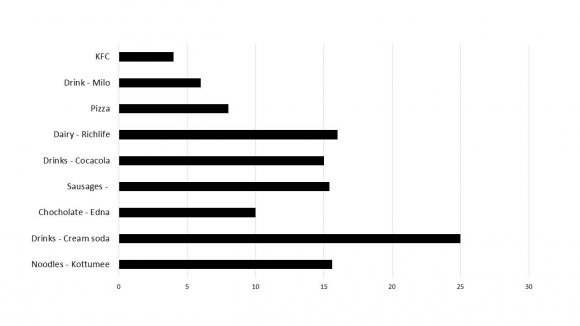
The final data analysis of the students of Kandawala Maha Vidyalaya (Grade 5) reveals the influence on TV advertisement in varies food products. According to the table 1, it shows sweets strongly affected the children behaviour. Furthermore soft drink advertisement influenced a lot or affected. Second factor which was dairy was least affected more nutritious less advertisements. The most popular advertisement among these students is a soft drink labelled as cream soda advertisement (Fig. 2). Noodles -Kothttumee and Sausages were high demand due to advertisement
9. b) Impact of TV advertisement on children behaviour
The results of these children of actions to increase the demand for buying and indirectly increase the child's parent's conflict. The advertisement do not have parental purchasing power, or refuse to buy cause unhappiness and discomfort in children. Advertising full to display customized products with a world of beautiful people, while their children are compared with the ideal world and conflicts in the world, in the real world because they are unhappy. Male children spend more violence, while girls are more educated and are often expressed to apply buyer. Apart from that conflict between parents and children in the family occurs in the bargain. After the parents' point of view, the impacts of advertising on children's nutritional needs are very high with some specific techniques used in the display. Examples of many ads use popular characters to add the product to promote, toys and small items with the product and has a degree in children and provide sponsorships are such methods offer for children's activities.
10. Table 2: Influence of advertisement (in percentage)
As shown in Table 2, 20% of parents believe that the competition to carry out and provide sponsorship for children's exposure to events on the food needs of the children. 42% of parents believe that toys, gifts and stickers with the food manages to be a great demand for food products in children. 28% thought that parents with popular characters to food ads have a strong impact on the demand for food products in children. Given the support of parents in relation to the policy of food advertising directional decisions related to the children, 95% among fast food items among children. The child focused advertisements are advertised during the target times and during the programmes for children. Time duration of watching television, specific time preferences for watching television and specific television programmes have considerable influence on the preference of the children. parents for a total ban on food advertisements during children's television broadcasting want targeted programs. 30% of parents want for a complete ban on food advertisements.
IV.
11. Conclusion
Children are very interested in advertising. Laws of the various countries to limit the number of ads that earlier, the nature, content and timing of the broadcast advertising and advertising broadcasts aired in children few minutes before, is prohibited. Some researchers believe that it is better to limit the advertising of excessive products to inform parents of children and tell them about products and promotions researchers to discuss limiting the understanding of the power of excessive growth of advertising.
Most of the time children are addicted to watching television for their viewing average is over 62%, which means that they watch television more than five hours a day, they are heavy viewers. After while watching the television commercials, most children demanding IU drinks Coca-Cola, Fanta and Pepsi other junk food in your hand like a burger, pizza, and eat some chocolate and donuts, etc. These drinks and junk food developed unhealthy habits of children in Sri Lanka. Some children try 10-12 years for the same action they saw as the ads, which are dangerous to imitate their lives. Data from this study show that the accumulation of fat in the body of the people, especially in children, if these products regularly consume they drink the interpreter ads is healthier because they drink that given milk after they are trying to buy drinking milk power, but they do not know the actual image. Increased fat in the body is not a good sign, because fat leads to obesity and heart disease. The children are overweight for their age and height, as they regularly use those cold drinks and eating fried meat outside the house with their parents or older. Regarding the confectionery ads, ads must be presented with their pros and cons. To some extent children have limited understanding, so advertisers cannot convince direct children to buy the product that appears in the advertisement.
Children should be protected from advertising and to check update. The replacement of digital television in the near future, we can easily find, while the television screen watching by pressing a button, to enter the world of the Internet in the world of digital television, which will replace the TV for children to be no limit and children have free access to all forms of advertising. The new technology also allows advertisers detailed information watching habits of children in the media to obtain, and then make them more targeted Advertisers should not abuse the relative lack of experience of children. Children are so simple, is far, celebrities, directly or indirectly, confections, he / she has shown that the product can be used to attract celebrities should persuade children to buy their products. If your children are watching on television, especially that they are heavily influenced by advertising sweets and then see what parents tried to use it to explain what the pros and cons of such products duties of parents.
If advertising for children conveyed the wrong message or learning to children must be, there must be a moral right message out children. Seller children should target very carefully, because it is very innocent and other easily copied. They should carry out the campaign closely. Children love for creativity and innovation, so that the advertising message innovative and creative should be. It is difficult to segment the market in the case of children, because they are more or less similar in their behaviour through sex, the study area and the other demographic groups.
V.
| Strongly Affected | Affected | Neutral | Not Affected Never Affected | ||
| Fast food | 1.6 | 40.8 | 35.5 | 9.3 | 13.0 |
| Soft drink | 3.6 | 45.8 | 24.1 | 9.6 | 16.9 |
| Sweet | 39.6 | 29.1 | 14.0 | 14.0 | 16.3 |
| Dairy | 1.2 | 23.1 | 41.5 | 12.2 | 22.0 |
| Influence of advertisement | Giving toys, presents and stickers with the item | Holding Competition and giving sponsorships | Using popular person for the advertisement |
| strongly Affect | 9 | 5 | 10 |
| Affect | 42 | 20 | 28 |
| Neutral | 25 | 64 | 30 |
| Not Affect | 12 | 2 | 19 |
| Strongly not affect | 13 | 6 | 13 |