1. I. Introduction
his article will introduce the importance of innovation and creativity. Leaders in today's complex business world environment cannot close the gap of innovation. The three principal foundation strategies are (1). Leading innovation, (2). Culture innovation and (3). Organizational practices for innovation. Survey studies, results indicate that 70% of organizations reported that their main priority is innovation. However the research also revealed that there is less than 20% innovation training conducted. Thus organizations must increase the amount of innovation training conducted. Building strong organization value depends on two criteria (1). Innovation and (2). Creativity.
The specific courses of action that would be appropriate to implement innovation initiatives in an five steps are (1). Inventing, (2). Developing, (3). Diffusing, (4). Integrating and (5). Monitoring. Najmaei, (2014) writes that organizations should be able to comprehend and understand the best relationship that exists between "firm's structure, leadership, culture and systems"(p.68). The researchers have been able to identify five companies from different industries that have change the course of action plan to implement innovation and these are IBM, Dell Computer, Lufthansa Airlines, Southwest Airline and American Airlines, Chevron. The organization success lies in the business performance and capability of adopting of new technology product.
Leadership has a direct relationship with organizational structure and the strategy employed by the organization. Research studies indicate that culture play a vital role within the organization, because provide adequate resources and motivate employees to perform at a high level. A company that has proven result of its innovation operational change is General Motor (GM). Therefore, the main philosophy of leading innovation change is the adaptation of new changes in the global market arena.
2. II. Literature Review
According to Kenny and Reedy (2006) the three strategies that leaders (as cited in Cumming, 1998) can use to create a climate that encourages innovation are (1). The foundation of creativity, (2). The application of a new idea and (3). The applicability of a successful concept. The foundation of creativity can be defined as the way of thinking by improving and promoting a new product. The application of a new idea is understood as a consistent improvement of creativity and identifying innovation values that are critical to the organization. The applicability of a successful concept encompasses by establishing a new product and services in its market industry, meeting the organizations demand.
Rogers (1995) defined innovation as any practice or idea provided by a new individual. Also, innovation is the fundamental principle of a firm outcome. For instance, Muffatto (1998) prescribe that a successful leader is the one that is capable of motivating innovation in the organizational climate and able to incorporate new innovation outcomes. Chan et al., (2004). Therefore, innovation and creativity can be form by organizational culture (Kenny, & Reedy, 2006).
The research study of Legrand and Weiss (2011) reveals that 80% of the leaders in the organization believe that innovation is important for the organization's future success. In addition, leaders in today's complex business world environment cannot close the gap of innovation. Moreover, the "close gap of innovation" is constructed under three principal foundation strategies. The three principal foundation strategies are (1). Leading innovation, (2). Culture innovation and (3). Organizational practices for innovation.
Leading innovation requires a leader to influence individuals and groups in the organization where they can innovate by creating a supportive and better strategic decision making among cross-functional team projects. Survey studies, results indicate that 70% of organizations reported that their main priority is innovation and that there is less than 20% innovation training be conducted. Thus organizations must increase the amount of innovation training conducted.
Culture innovation relates directly to the organization's leader by focusing on seven major characteristics: (1). Followers need to understand the organization's direction, (2). Leaders need to promote within the organization innovation's priority, (3). Executive teams are required to think about new innovative practices avenue, (4). Leaders and followers need to open a trusting communication channel relationship, (5). Leaders need to reinforce the effectiveness among cross-functional teams projects, (6). Leaders need to engage their innovation strategy by delivering new values and (7). Leaders are required to balance their innovation thinking process by supporting Human Resource (HR), Information Technology (IT) and Finance department which evidently can promote the success of the organization. Therefore, the researchers suggest that organizations must invest on their leaders and most importantly align their innovation plan (Legrand, & Weiss, 2011).
Leaders in order to create a climate that supports and encourages innovation, must possess effective skills to influence others in the organization. In addition, a leader needs to persuade people by creating short-term sacrifices and establishing long-term implementation benefits. Moreover, a leader needs to develop four influence tactic skills and these are: (1). Impression management tactics, (2). Political tactics, (3). Proactive tactics and (4). Reactive tactics. Certo and Certo (2012) define leadership as a process of directing behaviors toward accomplishing some objectives through people.
Bill Gates, the former Chief Executive Officer (CEO) of Microsoft understands that innovation is important for organizational success. He believe that leaders that promote innovation are now needed more than ever before. Building strong organization value depend on two criteria (1). Innovation and (2). Creativity. Therefore, influence tactics for the past twenty years have change the thinking perspective of global leaders (Yulk, 2010). (Kenny, & Reedy, 2006, p.132) The above Figure 8.1: illustrate the top nine important sources of innovation from a Likert Scale strongly disagree 1 to strongly agree 5.
3. III. Appropriate Course of Action Plan to Implement Innovation Initiatives in an Organization
The specific courses of action that would be appropriate to implement innovation initiatives in an organization is covered in a sequence of five steps. The five steps are (1). Inventing, (2). Developing, (3). Diffusing, (4). Integrating and (5). Monitoring. The first step in the course of action plan to implement innovation is inventing that illustrate the process of a new idea covered in four phases (1). Technology ideas, (2). Product ideas, (3). Process ideas and (4). Management ideas. Evidently technology ideas will help the organization to diffuse the company's information across the globe by utilizing the most up dated technology in the market. Under product ideas the organization will develop an adequate research and development plan by relating directly to the demand of the product in the market. The process of ideas can encompass the improving of the manufacturing process and redesigning the organization's work station productivity. The management ideas under inventing is the focus of redesigning the organization as Certo and Certo (2012) writes "human resource management, redesigning organizational structure, changing organizational leadership, or refining competitive strategy"(p.485).
The second step in the course of action plan to implement innovation is developing where the organization has the opportunity to turn the innovation process into practical ideas. For example, 3M Company has become famous worldwide for developing new ideas and by establishing a simple process which encourages employees and managers to work together. The third step in the course of action plan to implement innovation is diffusing where the innovation process in this step takes place after the idea is implemented. The organization at this stage is responsible for testing the development of the ideas established. Eastman Kodak with the product innovation of the new disposable digital camera illustrates the importance of following an innovation process plan. For instance, if customers provide a negative feedback about the disposable digital camera, Eastman Kodak needs to evaluate in the organization's innovation plan the stage of the product invention, the product development and the quality improvement of the product. The fourth step in the course of action plan to implement innovation is integrating that establishes the invention method as part of the working process within the organization. For instance, if the organization decides to focus on their operating procedures the organization has to evaluate a new product process. Then management takes the necessary road map guidance to manufacture and sell a new product. The fifth step in the course of action plan to implement innovation is monitoring which indicates that the organization will determine if the new idea can be accepted or rejected. Management in this step will secure the organization success by generating new contribution value and extending the life of the product. As a result, as long as the new ideas are accepted by management, the organization success will continue to flourish at the useful life of the new accepted idea. On the other hand, when a new idea complete the useful life cycle, management must recommend terminating the same. Therefore, the researchers in the above mentioned literature have discussed in five steps the appropriate course of action plan to implement innovation in an organization (Certo, & Certo, 2012).
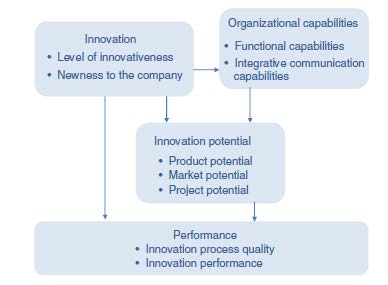
The above figure illustrate how mangers should strive to make an organization creative and innovate and most importantly raising awareness of the innovation process. The above diagram indicates that innovation can be a complex process. Also, the researchers suggest that in order to overcome the complexity framework of innovation, management should understand the innovation related factors to the integration of a new project within the organization. The combination of key resources is management capabilities and innovation contribution outcomes (Tepic, Kemp, Omta, & Fortuin, 2013).
4. IV. Complexities in Innovation Management
Innovation in the 21st business century among organizations worldwide is an engine for growth. In addition, innovation as an organizational process can take many forms in terms of developing products, services and expanding the organization business model by creating a source profitability and sustaining the organization's competitive advantage in the market. Furthermore, innovation is understood by organizations as a strategic process and presents a paradigm of managerial analytical approach for decision making. For instance, technological changes (as cited in Barney, 1986;and Holm, 2009) have presented new challenges for organizations in the global market arena and also noted by Drejer (2002) innovation has expanded in each individual industry sector rapidly (Najmaei, 2014).
The above diagram reveals the importance of organizations adopting an archetype as a course of action plan by bringing organizational success to the appropriate strategic innovation portfolio system in its industry. Najmaei (2014) writes that organizations should be able to comprehend and understand the best relationship that exists between "firm's structure, leadership, culture and systems"(p.68).
Organizations should carefully analyze the importance of implementing innovation by using three dimensional steps. The first dimensional step is technology that provides competitive advantage and benefits to organizations by improving the planning performance of the same. The second dimensional step is innovation process (as cited in Schumpeter, 1934) that refers directly to the value chain process in the manufacturing industry. The third dimensional step consists in the organization performance that describes the importance of information technology as a foundation ground for organizational success. Therefore, the organization success lies in the business performance and capability of adopting of new technology product (Ismail, & Mamat, 2012).
The researcher has been able to identify five companies from different industries that have change the course of action plan to implement innovation. IBM has been building the Vrontis, 2012). The innovated approach of Lufthansa Airline is by creating in the aviation industry a sustainable environment through e-learning value and having employees and management create a solid corporate relationship (Wilkesmann & Wilkesmann, 2011). In the United States (US) aviation companies have reshaped their organizational innovation strategy. Southwest Airline and American Airlines have adopted three innovation approaches. The approaches are: Understand the concept of new technology, Adopt a new transformational leadership style and Maintain strong organizational values among their existing competitors in the market (Bunz & Maes, 1998). Lastly, Chevron Company has been able to adjust the organization's Corporate Social Responsibility (CSR) policies by investing more in renewable source of energy and becoming a more green oriented company in the oil and gas industry (David, 2011).
A leader that encourages healthy organizational climate needs to establish operating procedures by securing group team, observe closely the team work process, rewarding team members for their new ideas and accomplishments and lastly by setting high goals and objectives within each individual team. However, a leader should be able to promote new innovation ideas by encouraging commitment and organization corporate expectations. For instance, today's business leaders need to understand the new line operating business model in the technology sector, the global issues in regards to health, energy and social science expectations. Collins (2012) encourage leaders to ask the right questions, speak to the right people and advise organizations to adapt new creative avenue of doing business overseas. Therefore, it can be determined, a leader that intend to establish and create a healthy organizational climate as suggested by Yulk (2010) needs to have, shared organizational objectives commitment, provide role clarity of the project and understand the internal and external coordination of the work process. And as well deliver mutual trust of the organization leadership guidance (Certo, & Certo, 2012).
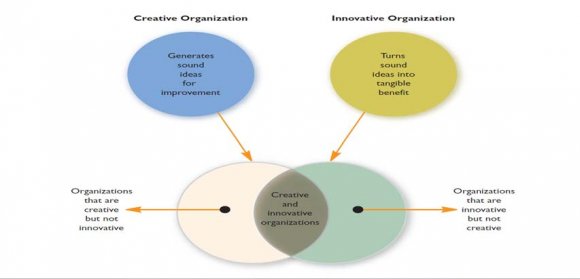
Innovation and creativity (as cited in Angle, 1989) shared similar characteristics. In addition, innovation is the concept that captures the importance how a plan needs to be implemented. Moreover, creativity is how useful the ideas are for the organization. However, creativity is the one that fuels the innovation process. As a result, in order for a leader to maintain a suitable organization climate, the process of creating new ideas and utilizing innovation at best is to capture the potential realization value of the same.
McLean (2005) defined creativity as something unexpected and original on its nature. Also, Stenberg and Labart (1999) indicate that new ideas deserve a lot of attention. Innovation takes many paths in the organization, because innovation is the generation of implementing new ideas and bringing a new concept to a market where demand exist. For example, in the technology sector challenges are encountered by the organization, because the technology industry promotes competitive pressure among competitors. Creativity can be reflected at individual level by encouraging motivation, expertise and personality behavior. On the contrary, innovation operates more at group level by supporting the organization culture and climate of the same (McLean, 2005).
Culture refers to assumptions and beliefs. Climate refers to the manifestation of practices and it's rooted by behavior assumptions and make up for the support of culture. Scholars when defining the term climate should include in the content beliefs, values and basic assumptions. As a result, culture and climate are consistent terms within the leadership literature. Leadership has a direct relationship with organizational structure and the strategy employed by the organization. Research studies indicate that culture play a vital role within the organization, because provide adequate resources and motivate employees to perform at a high level. However, the triangulation of structure, strategy climate. For example, the reward strategy is a strong supporting factor in motivating the employees to meet the organization goals and objectives. The researchers suggest that employees need time to provide creative work by adopting new strategies and adapt to the organization's culture (Dixit, & Nanda, 2011).
Leading innovation change is necessary for the organization climate. In addition, leading innovation change, essentially in global companies require a soft touch and experience leaders that can influence followers by delegating more authority in the decision making process. Developing innovative ideas require flexibility, evaluation and objectivity. Innovators need to explore in-depth the value judgment of their ideas. For example, in order to treat changes and procedures during the innovation process, teams and organizations are required to maintain one singular sustainability plan. A company that has proven result of its innovation operational change is General Motor (GM). The researchers recommended that a leader need to understand the applicability of the living system theory among individuals and organizations by reshaping the social progress of the business world as noted by Vancouver (1996). Frandberg (1999) defines living system theory as the integration of the social science and stimulating the human thinking process among organizations, community and society. Therefore, the main philosophy of leading innovation change is the adaptation of new changes in the global market arena (Osland, & Turner, 2011).